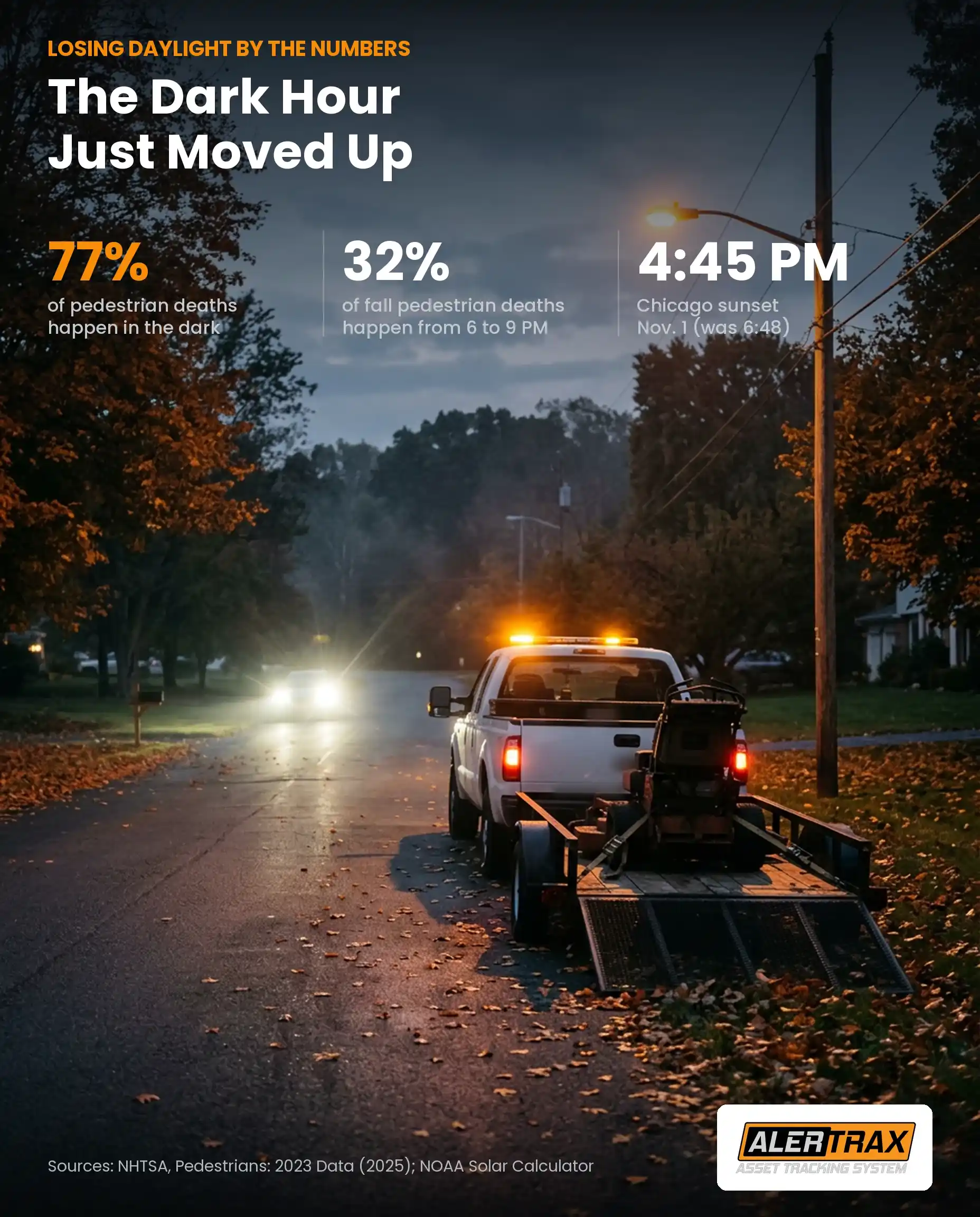
It is 5:40 on a Tuesday evening, the first week of November. Your crew is finishing the last property of the day, a leaf cleanup that ran forty minutes longer than the estimate said it would.
The truck is on the shoulder with the hazards on. The trailer ramp is down. One guy is walking a mower up it while another is coiling a blower cord at the tailgate. A pair of headlights comes around the bend at forty-five miles an hour, and for a second nobody in that truck can tell whether the driver sees them.
Six weeks ago, this exact job would have wrapped up with an hour of daylight to spare. Nothing about the crew changed. Nothing about the route changed. The sun did.
This week is the fall equinox, and from here until late December every day is shorter than the one before it. Most service companies adjust to that slowly and by feel, one uncomfortable evening at a time. Here is what the data says about the hours you are about to lose, and what is worth changing before the clocks go back.
Sunset Is About to Move Two Hours Earlier
Two things happen to the end of your workday between now and the holidays. The days shorten on their own, and then Daylight Saving Time ends at 2:00 AM on Sunday, November 1, 2026 (federal law sets the change for the first Sunday in November), which pulls every sunset back another hour overnight.
Here is what that looks like in a few representative cities, calculated with the equations behind the NOAA Solar Calculator (local time):
Chicago: sunset at 6:48 PM on September 22, 4:45 PM on November 1, and 4:23 PM on December 21.
Boston: 6:41 PM, then 4:37 PM, then 4:15 PM.
Denver: 6:57 PM, then 4:58 PM, then 4:39 PM.
Atlanta: 7:34 PM, then 5:45 PM, then 5:33 PM.
Dallas: 7:24 PM, then 5:36 PM, then 5:25 PM.
In the northern half of the country, that is about two hours of evening light gone in six weeks. Chicago goes from roughly 12 hours and 10 minutes of daylight this week to about 9 hours and 8 minutes on the shortest day of the year, per the same NOAA calculations. Even in Atlanta and Dallas, the last usable hour of the day moves up by nearly two hours.
For example, a crew that wraps its last job at 5:30 PM in Chicago has nearly 80 minutes of daylight to spare tonight. On November 2, the same 5:30 finish lands about 45 minutes after sunset. Same crew, same route, same clock time, and the last stop of the day is now a job done in the dark.
The Dangerous Hours Follow the Sunset
The reason this matters is not comfort. It is who else is on the road, and what they can see.
According to NHTSA's Pedestrians: 2023 Data fact sheet (DOT HS 813 727, published June 2025), 7,314 pedestrians were killed in traffic crashes in 2023, and 77 percent of those deaths happened in the dark. Only 19 percent happened in daylight.
The same report breaks those deaths down by season and time of day, and the pattern tracks the sunset almost exactly. In the summer months, the single deadliest window was 9:00 to 11:59 PM (35 percent). In the fall months, September through November, it moved up to 6:00 to 8:59 PM, which accounted for 32 percent. In winter, the 6:00 to 8:59 PM window climbed to 34 percent.
Put plainly, the most dangerous hours for anyone on foot near traffic move three hours earlier in the fall, straight into the window when crews are loading trailers on road shoulders, walking equipment across driveways, and driving home. NHTSA's pedestrian data covers everyone, not just workers, so treat it as a picture of the conditions your crews are stepping into, not as a count of crew injuries.
At Work, the Road Is Still the Biggest Risk
The workplace numbers point the same direction. The Bureau of Labor Statistics Census of Fatal Occupational Injuries for 2024, released February 19, 2026, counted 5,070 fatal work injuries in the United States, one every 104 minutes.
Transportation incidents were the most common fatal event, at 1,937 deaths, or 38.2 percent of the total. Of those, 1,146 were roadway incidents. Pedestrian vehicular incidents, where a worker on foot is struck by a vehicle, rose 19 percent, from 310 in 2023 to 369 in 2024 (BLS CFOI, 2024).
By occupation, the same BLS release counted 1,032 fatalities among construction and extraction workers and an increase to 356 among building and grounds cleaning and maintenance workers, the category that includes landscaping crews.
BLS does not break these numbers down by light condition, so we will not pretend it does. But when the leading cause of death at work is the road, and the most dangerous hours on the road move up by three hours in the fall, the last hour of your crew's day deserves a second look.
Lighting Is a Rule on the Jobsite, Not a Courtesy
For construction work, OSHA already spells out what "enough light" means. Under 29 CFR 1926.56, construction areas, ramps, runways, corridors, offices, shops, and storage areas must be lit to minimum levels "while any work is in progress."
The table in that standard sets 5 foot-candles for general construction area lighting, 3 foot-candles for access ways, active storage areas, loading platforms, refueling, and field maintenance areas, and 10 foot-candles for shops and equipment rooms.
In June, most small crews never think about that rule because they are done long before it applies. In November, a job that runs past 4:45 PM in the Midwest or Northeast is a job that needs lighting for its last stretch. Whether your work falls under the construction standards or the general industry standards depends on what you do, so it is worth confirming with a safety professional which rules apply to your operation.
What to Change Before November 1
None of this requires a new safety program. It requires deciding a few things on purpose instead of letting the season decide them for you.
1. Move the last job, not the whole schedule. Put the long jobs and the jobs on fast roads early in the day. Save the short, close-to-the-yard stops for last, so the one that runs over is the one with the easiest drive home.
2. Set a "loaded by sunset" rule. Equipment on the trailer, ramp up, straps set, before dark. Loading on a road shoulder is the moment your crew is on foot next to traffic, and it is the easiest part of the day to move into daylight.
3. Look up your own sunset times now. Plug your service area into the NOAA Solar Calculator and write the November and December sunset times on the dispatch board. Scheduling against a real number beats scheduling against how late it felt in August.
4. Check every light before the clocks change. Trailer marker and brake lights, hazards, work lights, and the reflective tape on ramps and tailgates. A trailer light that has been out since July did not matter in July. It will matter on November 2.
5. Know when the last truck is back. Pick a time by which every crew should be in the yard, and have a way to know when it happens that does not depend on someone remembering to call.
6. Plan for longer nights in the yard. By December 21, Chicago has nearly 15 hours of darkness a day. Trailers and equipment that used to sit in daylight after the crew went home now sit unwatched in the dark for most of the evening. Check the yard lighting and the gate while you are checking the trailers.
Where Tracking Fits When the Days Get Short
A GPS tracker does not make a road shoulder safer. What it does is take the guesswork out of the end of the day, when the light is going and nobody wants to be on the phone asking where everyone is.
Alertrax was built for exactly the kind of equipment that ends up on those shoulders.
- Live Tracking in the Fleet Portal: See every truck, trailer, and piece of equipment on one map in the Alertrax Fleet Portal, with location updates every 2 minutes. At 5:15 PM you can see which crews are still on site without making a single call.
- Geofence Alerts: Draw a boundary around the yard. When a trailer arrives, you know that crew is back. When the last one arrives, your day is done, and you know it without waiting for a text.
- Automatic Time-on-Site Logging: Every arrival and departure is timestamped. Pull a few weeks of it and you can see exactly which jobs routinely run past sunset, which is the data you need to rebuild the fall schedule instead of guessing.
- After-Hours Movement Alerts: Longer nights mean more hours your equipment sits unwatched. If something moves when it should not, you hear about it that night, not the next morning.
- One-Year Battery, No Wiring Required: Alertrax runs on two AA cells, with nothing to wire in and nothing to charge. That is what makes it work on trailers, mowers, and equipment that have no power of their own.
- 100% Waterproof, Covert Magnetic Mounting: Built for rain, mud, and pressure-washing, and mounted somewhere that is not the first place anyone looks.
- Shareable Tracking Link and Mobile App: Send a customer or a crew lead a live link with no login required, straight from the iOS or Android app.
Pricing for the Short Days and the Long Nights
You can equip your fleet with Alertrax for a low monthly rate, no long-term contracts, no hidden fees.
(Want to own it outright? We offer a $599 Lifetime option for permanent, subscription-free tracking.)
Weigh that against the cost of the alternative, which is a dispatcher calling around every evening from now until March to find out whether everyone made it back to the yard.
Sources
National Highway Traffic Safety Administration (NHTSA), "Pedestrians: 2023 Data," Traffic Safety Facts, DOT HS 813 727, June 2025, retrieved September 2026: 7,314 pedestrians killed in 2023; 77 percent of pedestrian fatalities in the dark and 19 percent in daylight; seasonal time-of-day breakdown (summer peak 9:00 to 11:59 PM at 35 percent; fall peak 6:00 to 8:59 PM at 32 percent; winter 6:00 to 8:59 PM at 34 percent)
U.S. Bureau of Labor Statistics (BLS), Census of Fatal Occupational Injuries Summary, 2024, released February 19, 2026, retrieved September 2026: 5,070 fatal work injuries; one every 104 minutes; 1,937 transportation incidents (38.2 percent); 1,146 roadway incidents; pedestrian vehicular incidents up 19.0 percent from 310 to 369; 1,032 construction and extraction worker fatalities; 356 building and grounds cleaning and maintenance worker fatalities
Occupational Safety and Health Administration (OSHA), 29 CFR 1926.56, Illumination, Table D-3, retrieved September 2026: minimum illumination of 5, 3, and 10 foot-candles for the listed construction areas while any work is in progress
NOAA Global Monitoring Laboratory, Solar Calculator equations, used to calculate sunset times and day length for Chicago, Boston, Denver, Atlanta, and Dallas on September 22, November 1, and December 21, 2026 (local time; results may differ by a minute or two from other published tables)
15 U.S.C. 260a, Advancement of time or changeover dates: Daylight Saving Time ends on the first Sunday in November (November 1, 2026)
This article is provided for general informational purposes and is not legal, safety compliance, or insurance advice. AlerTrax is a GPS tracking company, not a safety consultant, regulator, or law firm. The example schedules above are illustrations, not survey data. Which OSHA standards apply to your work, and what they require, depends on your operation. Consult a qualified safety professional and your legal counsel for guidance specific to your situation.
Decide the Last Hour Before the Season Decides It
Every fall, the end of the workday slides into the dark a few minutes at a time, and then an hour at once. Most companies notice it on the first evening something almost goes wrong.
You have about six weeks before the clocks change. That is enough time to move the last job, fix the trailer lights, and set up a way to know every crew is back in the yard without making a phone call.
Visit www.buyalertrax.com today and know where every truck, trailer, and crew is when the sun goes down this fall.