What the Weekly Numbers Say
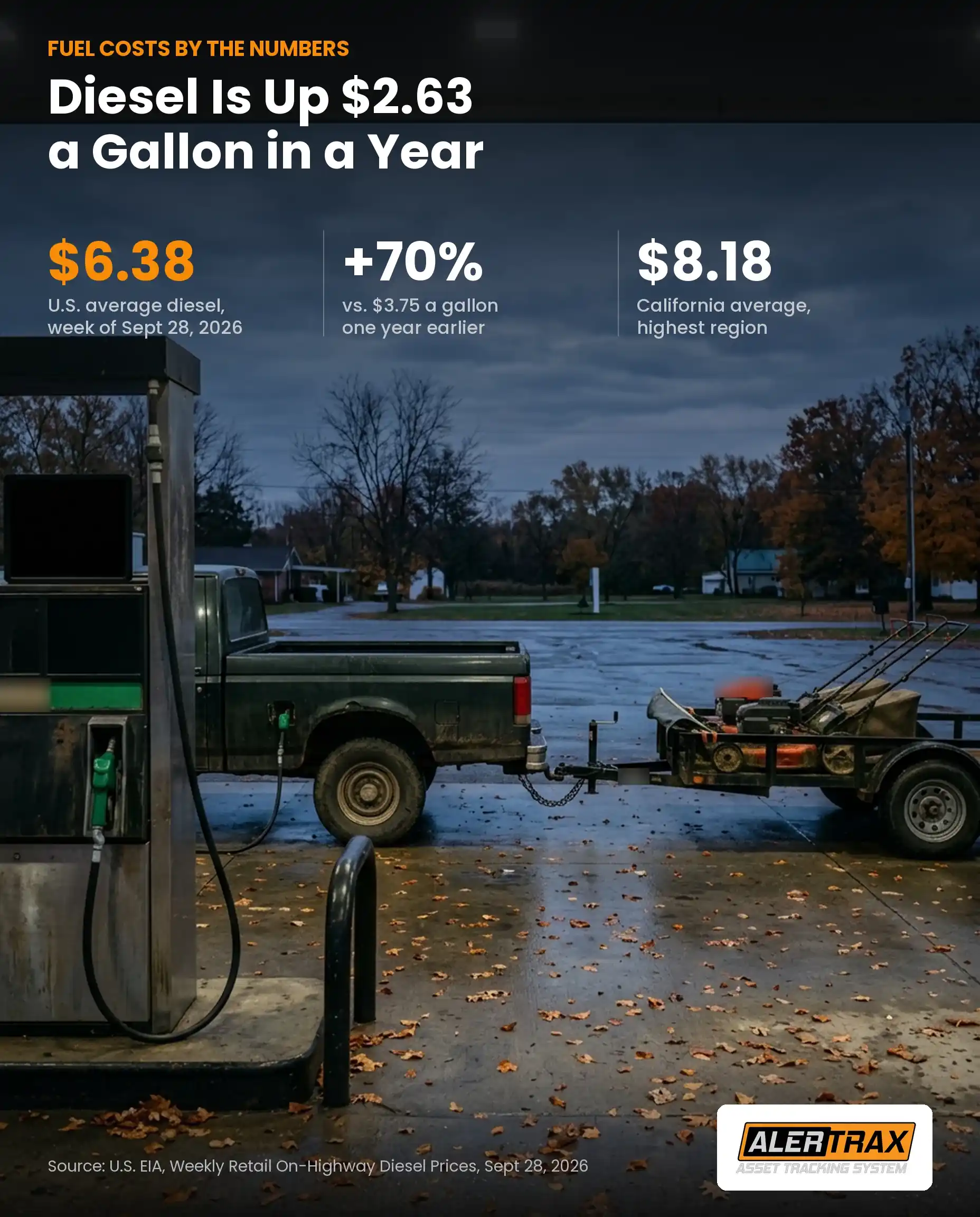
The U.S. Energy Information Administration surveys retail fuel prices every week. For the week of September 28, 2026, the most recent at the time of writing, the national average retail price of on-highway diesel was $6.382 a gallon. A year earlier, the week of September 29, 2025, it was $3.754. That is an increase of $2.628 a gallon, or about 70 percent (EIA, Weekly Retail Gasoline and Diesel Prices, September 2026).
Most of that increase came this year. Diesel averaged $3.477 the first week of January 2026 and $3.897 on March 2. One week later, on March 9, it was $4.859, a jump of nearly a dollar in seven days. After easing to $4.578 in early July, it climbed again, reaching $6.529 the week of September 21, the highest weekly average of the year so far (EIA, weekly U.S. No. 2 diesel retail prices, 2026).
Gasoline trucks are not spared. The national average for regular gasoline was $4.465 the week of September 28, 2026, up $1.347 from a year earlier (EIA, September 2026).
Where You Operate Matters
The weekly survey also breaks prices out by region. For the week of September 28, 2026, average diesel prices were (EIA, September 2026):
- California: $8.181
- West Coast: $7.357
- Central Atlantic: $6.531
- Midwest: $6.526
- New England: $6.510
- Rocky Mountain: $6.407
- Gulf Coast: $5.955
- Lower Atlantic: $5.953
Even the cheapest regions are well above where the national average stood a year ago.
What EIA Expects Next
EIA's Short-Term Energy Outlook, released September 9, 2026, forecasts that retail diesel will average $5.07 a gallon for all of 2026 and $4.40 in 2027, and attributes the elevated prices to a tight global distillate market (EIA Short-Term Energy Outlook, September 2026).
Read the 2026 number carefully. It is a full-year average that includes January and February, when diesel was under $4. It does not mean prices will be at $5.07 next month. The 2027 forecast is lower, but forecasts change, and nobody should build next season's bids on the hope that fuel gets cheap again.
What a Mile Costs Now
Here is an example, not survey data. Say a crew truck pulling a loaded trailer averages 10 miles per gallon. At the September 28, 2026 national average, every mile costs about 64 cents in diesel. A year earlier, it was about 38 cents.
Now say that truck drives an extra 10 miles a day that it did not need to, from backtracking, a forgotten part, or a stop out of order. Over five days a week for a 30 week season, that is 1,500 miles and 150 gallons, about $957 at today's average, compared with about $563 at last year's. For one truck.
You can run your own numbers with our Price of a Mile Calculator.
Fuel Is Not Even the Biggest Cost of a Mile
The crew is in the truck for every one of those miles, and under federal wage rules, "travel from job site to job site during the workday, must be counted as hours worked" (29 CFR 785.38).
The Bureau of Labor Statistics reports that production and nonsupervisory employees in landscaping services earned an average of $27.71 an hour in August 2026 (BLS Current Employment Statistics, August 2026, not seasonally adjusted).
Back to the example. Ten extra miles at an average route speed of 25 miles per hour is 24 minutes. For a three person crew, that is 1.2 crew hours, or about $33 in wages at the BLS average, against about $6.38 in diesel. Even at this year's prices, the labor in an unnecessary mile costs several times the fuel.
That is the good news hidden in high fuel prices. The same work that cuts fuel cost, removing miles that did not need to be driven, cuts the larger labor cost at the same time.
Where to Find the Miles
1. Get a baseline. Know how many miles each truck drove last week, and how many of those were between properties.
2. Compare planned to driven. Look at the route a crew was given next to the route it actually drove. Backtracking and out-of-order stops show up immediately.
3. Cluster the stops. Group properties by area, and put the dump site or supply house on the way rather than after the last stop.
4. Cut the extra supply runs. A missing part that costs one 20 mile round trip now costs about $1.28 in diesel and much more in crew time, by the example math above.
5. Watch trucks after hours. Take-home trucks and weekend use add miles that are easy to miss.
6. Re-price with today's number. Contracts and bids written when diesel was under $4 may not cover the fuel. For snow contracts and next season's renewals, consider a fuel adjustment clause tied to a published index like EIA's weekly price.
Where Alertrax Fits
You cannot cut miles you cannot see. Alertrax gives you a record of every route every truck drove, how far it went, and where it stopped, without asking the crew to log anything.
- Trip Reports You Can Export: Pull a date range by vehicle or across the fleet, with start time, stop time, addresses visited, duration, and distance.
- Complete Route History: A full breadcrumb trail of every stop, so backtracking and detours are easy to spot.
- Automatic Time-on-Site Logging: Every arrival and departure is timestamped automatically, so you can separate time on the property from time on the road.
- Live Fleet Map: Every tracked truck and trailer on one map in the Alertrax Fleet Portal, with location updates every 2 minutes, so you can send the nearest truck instead of the next one free.
- After-Hours Movement Alerts: Know when a truck or trailer moves outside working hours.
- One-Year Battery, No Wiring Required: Alertrax runs on two AA cells. Put it on the truck or the trailer with nothing to wire in and nothing to charge.
- 100% Waterproof, Covert Magnetic Mounting: Mounts to a steel frame in seconds and keeps working through rain, mud, and road salt.
- iOS and Android App: Check the map, the alerts, and the day's history from your phone.
Pricing
You can equip your fleet with Alertrax for a low monthly rate, no long-term contracts, no hidden fees.
(Want to own it outright? We offer a $599 Lifetime option for permanent, subscription-free tracking.)
Set that against the example above, where 10 unnecessary miles a day cost one truck about $957 in diesel over a season, before counting the crew's time.
Sources
U.S. Energy Information Administration (EIA), Gasoline and Diesel Fuel Update and weekly U.S. No. 2 Diesel Retail Prices series, retrieved October 2026: U.S. on-highway diesel of $6.382 the week of September 28, 2026, $6.529 the week of September 21, 2026, $4.578 the week of July 6, 2026, $4.859 the week of March 9, 2026, $3.897 the week of March 2, 2026, $3.477 the week of January 5, 2026, and $3.754 the week of September 29, 2025; regional diesel prices for the week of September 28, 2026; U.S. regular gasoline of $4.465 the week of September 28, 2026, up $1.347 from a year earlier
EIA, Short-Term Energy Outlook, September 9, 2026: retail diesel forecast of $5.07 a gallon for 2026 and $4.40 for 2027
U.S. Bureau of Labor Statistics (BLS), Current Employment Statistics, Landscaping Services (NAICS 56173), average hourly earnings of production and nonsupervisory employees, not seasonally adjusted, series CEU6056173008, retrieved October 2026: $27.71 in August 2026, subject to revision
Electronic Code of Federal Regulations (eCFR), 29 CFR 785.38, "Travel that is all in the day's work," retrieved October 2026
This article is provided for general informational purposes and is not legal, financial, or tax advice. Fuel prices change weekly and vary by station; the figures above are national and regional averages for the dates stated. EIA forecasts are subject to change. BLS figures are industry averages and may not reflect your company. The fuel economy, mileage, route speed, and cost figures above are an illustration, not survey data.
Fewer Miles, Same Work
You do not control the price of diesel. You do control how many miles your trucks drive to get the same work done, and right now every one of those miles is worth finding.
Visit www.buyalertrax.com today and see where every mile goes.