A customer calls on the last week of September and asks when you are coming out to blow out their sprinklers.
Whoever answers the phone says what everybody says. Sometime in October. We will get you on the schedule.
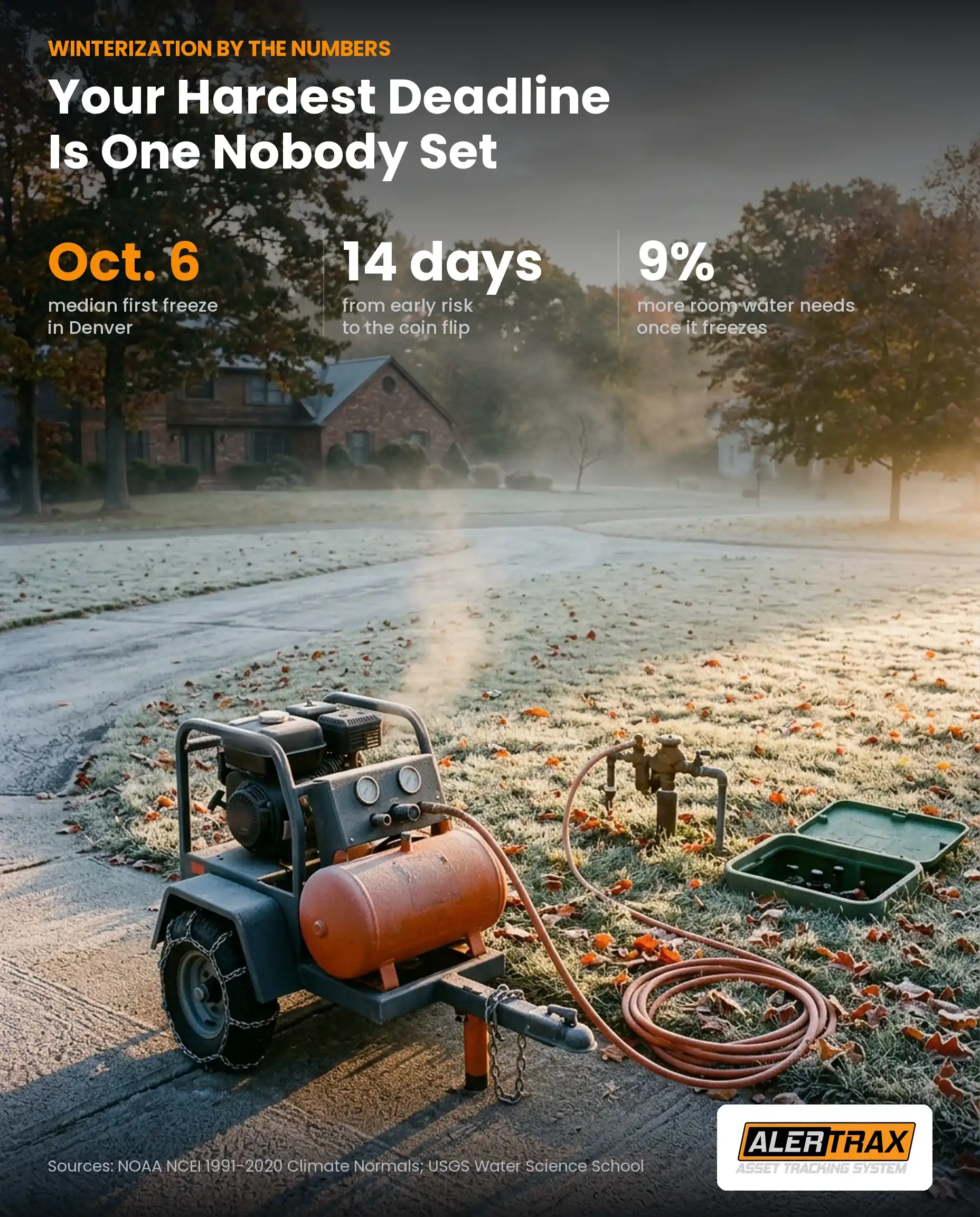
That answer is fine in Boston. In Denver, it is a coin flip. The median date of the first hard freeze at Denver International Airport is October 6, and there is already a one in ten chance it has happened by September 22.
Winterization is the only work most irrigation and landscape contractors do where the deadline is set by the weather, applies to every customer at once, and does not move. Miss it on one property and you are not rescheduling a visit. You are repairing something.
NOAA publishes exactly when that deadline lands in your market. Most companies have never looked it up.
Your Deadline Is a Probability, Not a Date
NOAA's National Centers for Environmental Information publishes freeze dates as part of the 1991 to 2020 U.S. Climate Normals, the official 30 year baseline. For each station, the normals give the date by which there is a 10 percent, 50 percent, and 90 percent chance that the first 32 degree freeze has already occurred.
Here is what that looks like at eight stations (NOAA NCEI, 1991-2020 Climate Normals). Read the first column as "early but not unusual," the second as "the coin flip," and the third as "assume it has happened."
Denver, CO: September 22, then October 6, then October 19.
Minneapolis, MN: September 28, then October 10, then October 26.
Chicago, IL (O'Hare): October 3, then October 19, then November 1.
Indianapolis, IN: October 6, then October 22, then November 5.
Kansas City, MO: October 6, then October 23, then November 6.
Salt Lake City, UT: October 9, then October 24, then November 6.
Columbus, OH: October 10, then October 27, then November 9.
Boston, MA: October 27, then November 8, then November 21.
Two things jump out. The first is the spread: the deadline in Denver and the deadline in Boston are more than a month apart, which is why generic "winterize by October" advice is useless. The second is that for most of the country, the early date has either passed already or lands within the next two weeks.
The Gap Between "Early" and "Likely" Is About Two Weeks
The number that actually governs your schedule is not the median date. It is the distance between the 10 percent date and the 50 percent date, because that is the stretch where a freeze is realistically possible but you have not run out of season yet.
From the same NOAA normals, that gap is 14 days in Denver, 12 days in Minneapolis, 12 days in Boston, 15 days in Salt Lake City, and 16 to 17 days in Chicago, Indianapolis, Kansas City, and Columbus.
Two weeks is the real window. Everything you can service before the 10 percent date is comfortable. Everything you are still holding at the 50 percent date is a gamble. And the customers who called in late are all sitting in that two week band together.
As an illustration, not a survey figure: a contractor with 600 winterization accounts and three crews averaging 12 properties a day needs about 17 working days to clear the list. In Denver, where the gap is 14 days, that math does not close. The season has to start before the window opens, not when the phone starts ringing.
A Forecast Gives You Days, Not Weeks
It is tempting to plan on reacting to the forecast instead of the calendar. The National Weather Service alert definitions show how little room that leaves.
A Freeze Watch is issued when there is potential for significant, widespread freezing temperatures within the next 24 to 36 hours. A Freeze Warning is issued when those temperatures are expected. A Frost Advisory covers a forecast minimum of 33 to 36 degrees on clear, calm nights during the growing season, because frost can form at ground level while the measured air temperature is still above freezing (National Weather Service, watch/warning/advisory definitions).
So the warning you are waiting for arrives a day or two ahead, and the frost advisory that precedes it can show up while the thermometer still reads 34. That is enough notice to protect one property you care about. It is not enough notice to reschedule two hundred of them.
Why a Missed Blowout Is Not a Callback
The reason this deadline behaves differently from the rest of your schedule comes down to basic physics.
According to the USGS Water Science School, when water freezes its density drops by about 9 percent, which is to say the ice takes up roughly 9 percent more room than the water did. In an enclosed backflow assembly, valve body, or lateral line, that expansion has nowhere to go.
That is the whole difference. A missed mowing visit is a mowing visit you do next week. A missed blowout is a cracked backflow assembly, a split valve, or a line break under a lawn that nobody finds until the system is pressurized in April, and the conversation in April is about who is paying for it.
It is also why the work backs up against a wall instead of sliding. Most seasonal work can absorb a week of rain. This cannot.
The Compressor Is the Constraint
Ask a contractor what limits how many properties they can winterize in a day and the answer is rarely labor. It is the tow-behind air compressor.
Most operations own fewer compressors than crews. The unit gets hooked to whichever truck needs it, dropped at a site, picked up by somebody else, left overnight at the last property of the day, or parked at a crew lead's house because tomorrow starts on that side of town. During the two weeks that matter most, the single most valuable asset in the company is also the hardest one to locate.
That is a scheduling problem before it is a security problem. Dispatch cannot commit to an afternoon route without knowing whether the compressor will be free, and no one can answer that from the yard. The phone call to find out costs ten minutes, and it happens several times a day, every day, in the exact stretch of the season where ten minutes is expensive.
A tow-behind compressor also has no power of its own to draw from, which is why most tracking hardware does not fit it.
What to Do in the Next Two Weeks
None of this requires new equipment or a new system. It requires working backward from a date instead of forward from a phone call.
1. Look up your own freeze dates. Pull the 10 percent and 50 percent first freeze dates for the station nearest your service area from NOAA's 1991-2020 normals. Those two dates, not a month name, are the boundaries of your season.
2. Count backward to a start date. Divide your account list by realistic properties per crew per day. If the answer is more working days than you have before the 10 percent date, your start date is already behind you, and the schedule needs to compress or the crew count needs to change.
3. Sort the list by risk, not by who called first. Properties with above-ground backflow assemblies, exposed piping, or a history of freeze damage go early. Sheltered systems and slab-adjacent equipment can wait.
4. Book the compressor before you book the crews. If you have three crews and two compressors, your real capacity is two crews. Build the route around the constrained asset.
5. Write down where every compressor sleeps. Every night during the season, each unit should have a known location, and somebody should be able to confirm it without making a call.
6. Get the weather alerts on the dispatch phone now. A freeze watch gives 24 to 36 hours. That is enough to move tomorrow's most exposed property to the front of the line, but only if the alert reaches the person who builds routes.
Where Tracking Fits in a Two Week Season
In a normal month, knowing exactly where a compressor sits is a convenience. In the two weeks before the first freeze, it is route planning.
Alertrax was built for equipment like this, the kind with no power source of its own.
- One-Year Battery, No Wiring Required: Alertrax runs on two AA cells. Nothing to wire in and nothing to charge, which is what makes it work on a tow-behind compressor, a water trailer, or any unpowered asset.
- Live Tracking in the Fleet Portal: Every compressor, trailer, and truck on one map in the Alertrax Fleet Portal, with location updates every 2 minutes. Dispatch builds the afternoon route from the map instead of from three phone calls.
- Automatic Time-on-Site Logging: Arrivals and departures are timestamped, so you can see how long a blowout actually takes per property. That is the number you need to count backward from the freeze date next year instead of guessing again.
- Geofence Alerts: Draw a boundary around the yard and around your regular sites. Know when the compressor comes back, and know when it leaves in the morning, without asking.
- After-Hours Movement Alerts: Equipment that overnights at a job site or a crew lead's house is exposed in a way it never is in the yard. If it moves when it should not, you hear about it that night.
- 100% Waterproof, Covert Magnetic Mounting: Mounts to a steel frame in seconds and holds up to a season of cold, wet, muddy work.
- Shareable Tracking Link and Mobile App: Send a crew lead or a customer a live link with no login required, straight from the iOS or Android app.
Pricing Before the Busiest Two Weeks of Your Fall
You can equip your fleet with Alertrax for a low monthly rate, no long-term contracts, no hidden fees.
(Want to own it outright? We offer a $599 Lifetime option for permanent, subscription-free tracking.)
Set against a single cracked backflow assembly, or one crew standing around at 9 AM waiting to learn where the compressor ended up last night, the cost of covering the equipment that runs your winterization season is a rounding error.
Sources
NOAA National Centers for Environmental Information (NCEI), 1991-2020 U.S. Climate Normals, annual/seasonal normals for probability of first fall 32 degree freeze (10 percent, 50 percent, and 90 percent dates), retrieved September 2026 for stations Denver International Airport, Minneapolis-St. Paul International Airport, Chicago O'Hare International Airport, Indianapolis International Airport, Kansas City International Airport, Salt Lake City International Airport, Port Columbus International Airport, and Boston
National Weather Service (NWS), watch, warning, and advisory definitions, retrieved September 2026: Freeze Watch issued for potential significant, widespread freezing temperatures within 24 to 36 hours; Freeze Warning issued when such temperatures are expected; Frost Advisory issued for forecast minimum temperatures of 33 to 36 degrees on clear and calm nights during the growing season
U.S. Geological Survey (USGS) Water Science School, "Water Density," retrieved September 2026: upon freezing, the density of water decreases by about 9 percent
This article is provided for general informational purposes and is not legal, insurance, or engineering advice. AlerTrax is a GPS tracking company, not a weather service, irrigation contractor, or insurer. Freeze dates are 30 year climatological normals, not forecasts, and any given year can freeze earlier or later than the dates above. The crew and account figures used above are illustrations, not survey data. Check the current forecast from the National Weather Service and follow the manufacturer's guidance for the systems you service.
Start the Season on a Date, Not on a Phone Call
Every year the first freeze arrives on schedule, roughly, and every year it feels like it showed up early. That is what happens when the start of the season is set by whoever calls first instead of by the date the work has to be finished.
Look up your two dates this week. Count backward. Then make sure you can find the compressor.
Visit www.buyalertrax.com today and put a tracker on the equipment your winterization season runs on.