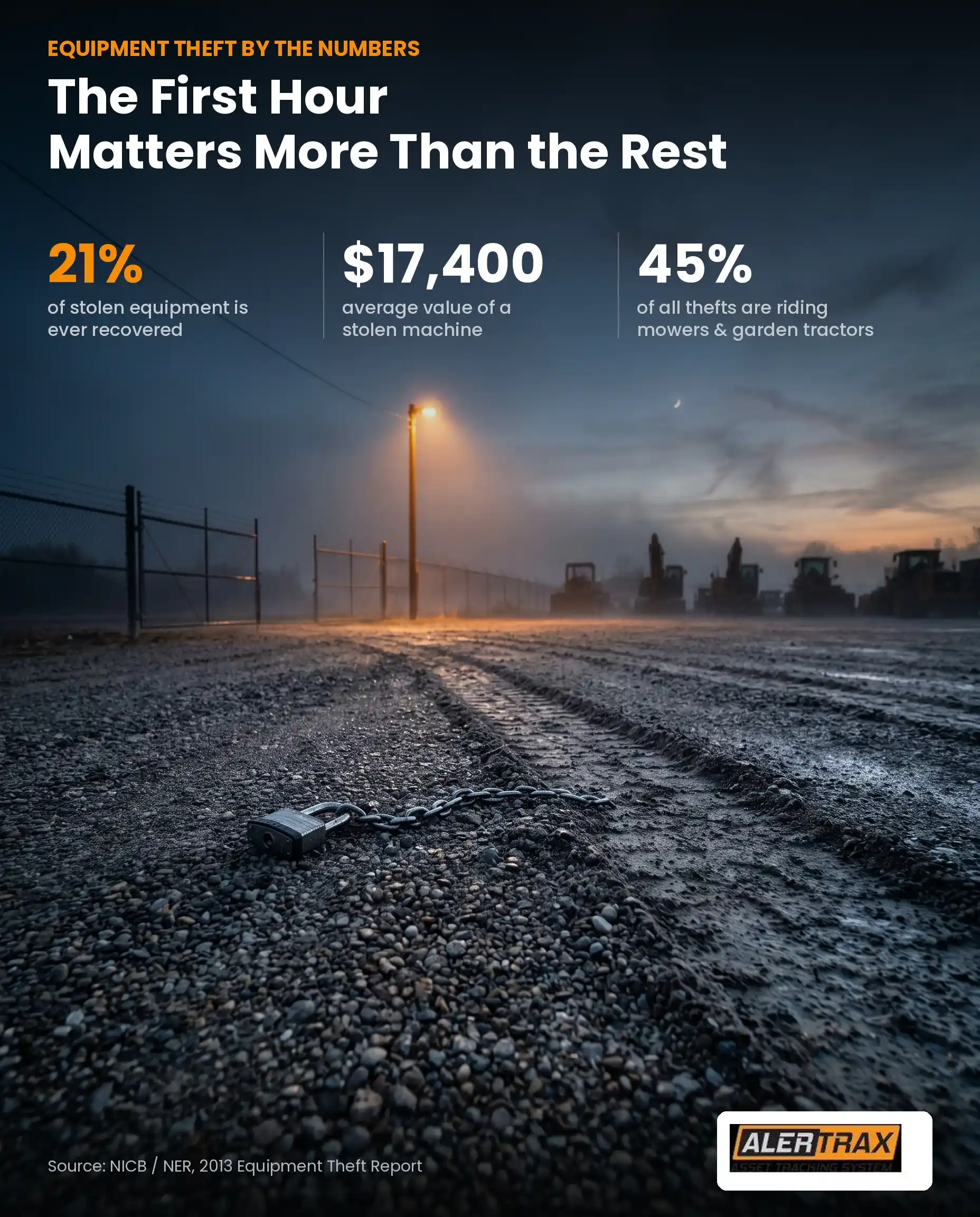
It is 5:50 AM. The foreman gets to the yard before the crew, the way he always does, and something is off before he can even say what. The skid steer is not where it was parked Friday. The chain that usually loops through the trailer hitch is lying in the gravel, cut clean through.
For the next several minutes, most owners do the same thing: they walk the lot again. They call the guy who was on the last job, just in case he moved it. They pull up the one camera angle that might show something, even though it never quite points the right way. They spend the most valuable sixty minutes of the entire event deciding whether this is really happening.
The data on equipment recovery says almost none of that matters. What matters is how fast the theft gets reported, described, and put in front of the people who can actually do something with it. Everything else, the who and the why, sorts itself out later or never at all.
This is what the numbers say about the odds you are working with, and the specific steps worth taking before that first hour is gone.
What the Recovery Numbers Actually Say
The most detailed public data on heavy equipment theft still comes from the joint annual report published by the National Insurance Crime Bureau (NICB) and the National Equipment Register (NER), built from theft reports submitted to the FBI's National Crime Information Center (NCIC). Their 2013 report, the most granular breakdown either organization has released, tracked 11,486 heavy equipment thefts reported to NCIC that year. Of those, 2,465 were recovered, a rate of 21 percent (NICB/NER, 2013 Equipment Theft Report). NICB has since described the number more bluntly: law enforcement recovers as little as 20 percent of stolen equipment.
Compare that to what happens after a car is stolen. NICB's own guidance on reporting a stolen vehicle states that 35 percent of recovered vehicles come back the same day they're stolen, and 45 percent within two days (NICB, "How to Report a Stolen Vehicle"). Cars have a nationwide VIN system, license plates, and, increasingly, license plate readers working in their favor. A skid steer or a trailer has none of that. If speed matters this much for an asset with every structural advantage on its side, it matters more, not less, for one without any of them.
The 2013 report also put a number on what is actually at stake. The average estimated value of a stolen piece of equipment was $17,400. Machines that were recovered with NICB and NER's direct assistance had an average value of $27,123, a reminder that thieves, insurers, and investigators alike pay closer attention to the equipment worth the most.
For landscaping and hardscaping operations specifically, the theft data lines up with what sits in most yards. Riding mowers and garden tractors accounted for 45 percent of all reported equipment thefts in 2013, more than 5,100 units, by far the single largest category. Among loaders, skid steers made up 61 percent of thefts and backhoes 31 percent (NICB/NER, 2013 Equipment Theft Report). These are not obscure, high-end machines. They are the exact equipment that rides on an open trailer to a job site every day and sits unattended most of the night.
Why the First Hour Is the Whole Game
The NICB/NER report notes that recoveries are heavily localized: most stolen equipment that does get recovered turns up in the same state it was stolen from. The longer a theft goes unreported, the more time a thief has to move the machine across a state line, repaint it, grind off a serial number, or sell it into the used market, and each of those steps makes recovery less likely, not just slower.
That is the entire logic behind the first-hour checklist below. None of it is about catching the thief. It is about making sure the information that could identify your machine is in the hands of police, your insurer, and the national theft database before the trail goes cold.
The First Hour Checklist
1. Confirm it fast, then stop confirming. Walk the actual footprint where the machine sat. Check with anyone who might have moved it. Give this five minutes, not fifty. Every minute spent second-guessing is a minute the thief does not have to spend at all.
2. Call the police before you call anyone else. Most insurers require a police report before they will act on a theft claim, so filing one is the first step in both the criminal and the insurance process at once (NICB, "How to Report a Stolen Vehicle"). Get an officer or a report number, even if it is a non-emergency line.
3. Hand over everything you have on the machine. Manufacturer, model, year, color, and, most importantly, the serial or PIN number. NICB and NER's own guidance to equipment owners is direct on this point: keep accurate lists of equipment with PIN and serial numbers, and submit them to law enforcement, your insurer, and NER as soon as a theft is discovered. A description without a serial number is a machine no database can flag.
4. Call your insurer the same day. Comprehensive or inland marine coverage typically applies to theft, but documentation requirements and deductibles vary by policy, and most carriers want the loss reported promptly. Ask what they need from you and get it to them before the day is out.
5. Register the theft with NER if it is not already on file. A serial number flagged in NER's database is one a dealer, auction house, or officer running a pre-purchase check can catch, even months later.
6. Pull whatever location data you have. If the machine carries a GPS tracker, get the last confirmed location and, if the platform supports it, a shareable link the responding officer can open directly on their phone. A live location is worth more to an investigator than any description.
Build the Folder Before You Need It
Every step above depends on information that has to already exist somewhere before the theft happens. A serial number is only useful if someone wrote it down. A description is only useful if it is specific.
This does not need to be complicated. Walk the yard once, photograph the serial plate on every piece of equipment and every trailer, and keep the photos and purchase documentation in one folder, physical or digital, that more than one person in the company can access. It takes less time than the walk-through that follows a theft, and it is the difference between a description an officer can act on and one they cannot.
What a GPS Tracker Changes About That Hour
A tracker does not stop a determined thief from cutting a chain. What it changes is everything that happens in the hour after, which is the part the recovery data says actually decides the outcome.
- After-Hours Movement Alerts: Instead of discovering a theft on your next visit to the yard, you get a notification the moment a tracked asset moves outside the hours you set. That can turn a multi-day gap into a same-night one.
- Geofence Alerts: Draw a boundary around your yard or a job site and get notified the instant a tracked asset crosses it, with no manual check-in required.
- Shareable Tracking Link: Generate a live link from the fleet portal or the mobile app and hand it directly to the responding officer. No waiting on a dispatcher, no walking anyone through a login.
- Automatic Time-on-Site Logging: Every tracked asset logs its own arrival and departure times, so the last confirmed location is already on record the moment you need it.
- One-Year Battery, No Wiring Required: Because there is nothing to wire in, a tracker goes on trailers, mowers, skid steers, generators, and anything else that would otherwise sit completely unmonitored.
- 100% Waterproof, Covert Magnetic Mounting: Built to survive mud, rain, and pressure washing, and mounted where it is not the first thing a thief looks for.
Pricing That Costs Less Than One Recovered Machine
You can equip your fleet with Alertrax for a low monthly rate, no long-term contracts, no hidden fees.
(Want to own it outright? We offer a $599 Lifetime option for permanent, subscription-free tracking.)
Set that against the numbers above: an average stolen piece of equipment is worth $17,400, and roughly four out of five never come back. A tracker that shortens the first hour, or replaces it with an alert you get before sunrise, is a small bet against a loss that size.
Sources
National Insurance Crime Bureau (NICB) and National Equipment Register (NER), 2013 Equipment Theft Report: 11,486 reported thefts, 2,465 recoveries (21% recovery rate), $17,400 average value of stolen equipment, $27,123 average value of NICB/NER-assisted recoveries, equipment-type and manufacturer breakdowns, and recovery localization analysis
National Insurance Crime Bureau (NICB), "How to Report a Stolen Vehicle": 35% of recovered vehicles returned same day, 45% within two days, and guidance on reporting sequence and insurer requirements
This article is provided for general informational purposes and is not legal, insurance, or law enforcement advice. Reporting requirements and coverage terms vary by state, jurisdiction, and policy. Consult your insurer, local law enforcement, and legal counsel for guidance specific to your situation.
Know Where Your Equipment Is Before You Need To
The odds on a stolen piece of equipment are not good, and no product changes that on its own. What changes the odds is how fast you find out, how fast you can describe what is missing, and how fast that information reaches the people who can act on it.
Visit www.buyalertrax.com today and put a tracker on every trailer, mower, and piece of equipment that would otherwise sit unmonitored overnight.