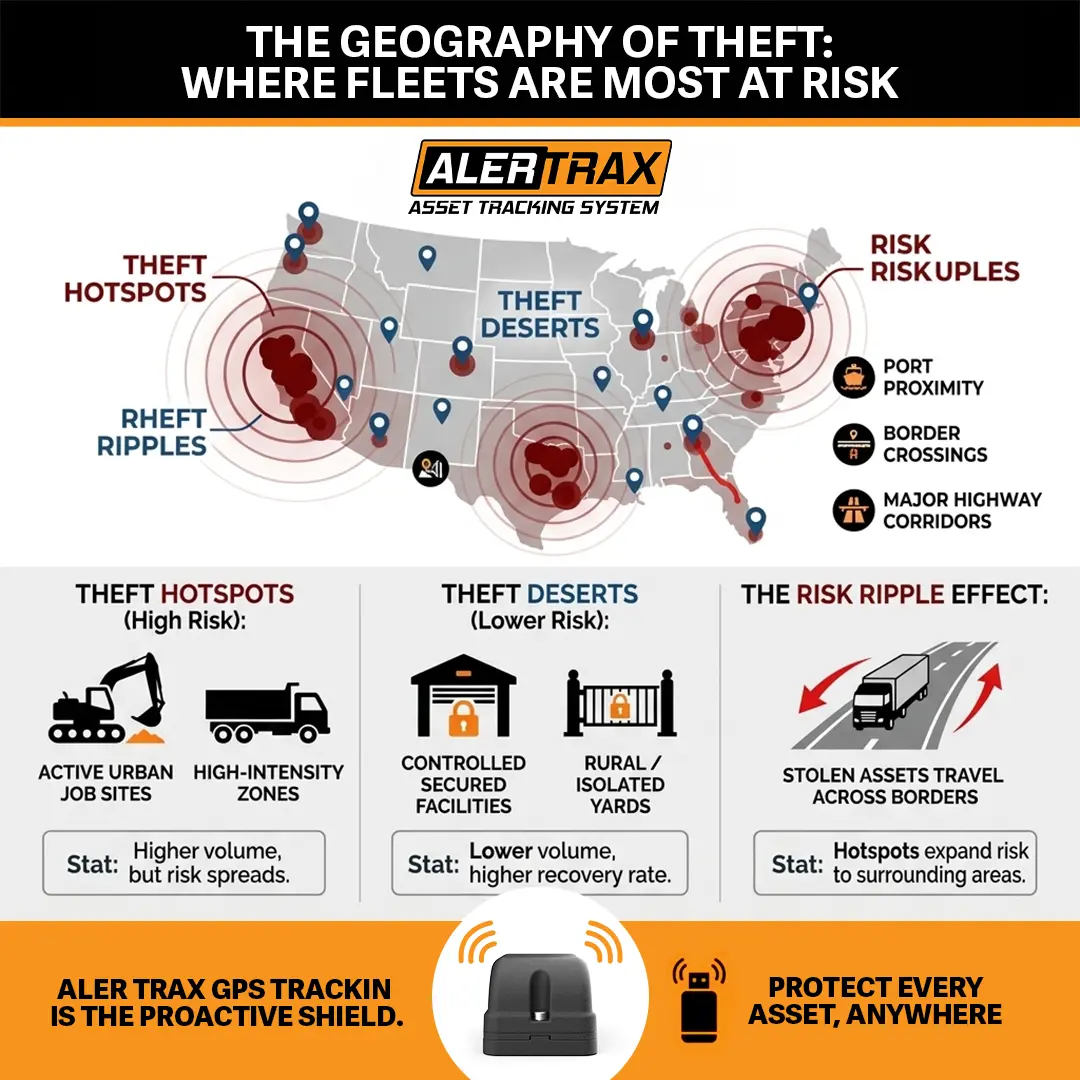
The Geography of Equipment Theft: Where Your State Ranks and Why It Matters
Equipment Theft Statistics by State

When contractors think about equipment theft, they tend to think locally. Was the job site in a rough area? Was the trailer visible from the road? Did the crew lock up properly? These are reasonable questions — but they miss the larger pattern.

Equipment theft follows geography. Specific states, cities, and corridors account for a wildly disproportionate share of incidents. Understanding where theft concentrates — and why — changes how you should think about protecting your assets.

The National Scale: 11,000+ Incidents Per Year

According to the National Crime Information Center (NCIC), 11,574 reports of stolen construction equipment were filed in the most comprehensive year of available data. The National Insurance Crime Bureau (NICB) has consistently confirmed roughly 1,000 equipment thefts per month — approximately 31 per day across the United States.

The total annual cost ranges from $300 million to $1 billion, depending on the source. The National Equipment Register pegs the average loss per incident at approximately $30,000, while trucks average over $40,000 per theft.

31 per day Approximate number of construction equipment thefts reported daily in the United States, based on NCIC data compiled by the National Insurance Crime Bureau.

The Top 10 States: Where 63% of Theft Happens

According to the National Equipment Register, equipment theft concentrates heavily in a handful of states. The pattern is consistent year after year.

RankStateKey Factor
1Texas6 of top 10 cities; massive construction volume
2CaliforniaYear-round construction; port proximity
3Florida3 of top 10 cities; rapid growth corridor
4North CarolinaGrowing metro areas; highway corridor access
5GeorgiaAtlanta metro; I-75/I-85 interchange
6MissouriCentral US crossroads; easy interstate access
7South CarolinaConstruction boom; port access in Charleston
8TennesseeNashville growth; multi-interstate hub
9OklahomaOklahoma City consistently in top 10 cities
10AlabamaI-65 corridor; limited law enforcement density

All but the bottom-ranked state on this list averaged more than one equipment theft per day. Combined, these 10 states account for over 63% of all equipment theft in the United States.

Why Geography Predicts Theft Better Than You Think

The Three Geographic Risk Drivers

Construction volume: More active job sites means more equipment sitting exposed overnight and on weekends. States with year-round building seasons (Texas, Florida, California) have proportionally more targets available at any given time.

Interstate highway access: Stolen equipment needs to move fast and far. States positioned along major interstate corridors provide quick escape routes across state lines. Missouri sits at the crossroads of I-70, I-44, and I-55. Stolen equipment can be 200 miles away in under three hours.

Port proximity: The NICB has documented that stolen heavy equipment is frequently exported overseas. States with major ports — California, Texas, Florida, South Carolina, Georgia — see higher theft rates partly because thieves have a ready channel to move equipment out of the country permanently.

The Recovery Rate Problem: Geography Makes It Worse

Overall, fewer than 25% of stolen equipment is ever recovered. But recovery rates vary significantly by location, with single-item thefts recovering at less than 7%.

Without GPS tracking, the police report becomes a formality. Officers don't have the resources to canvass hundreds of square miles looking for a stolen skid steer. Without a serial number database equivalent to the VIN system used for passenger vehicles, there's no systematic way to flag stolen equipment at the point of resale.

Recovery ScenarioEstimated Recovery Rate
Overall equipment recovery (all types)20–25%
Single-item theft (one machine)Less than 7%
With active GPS trackingSignificantly higher (real-time location provided to law enforcement)
Equipment moved across state linesNear zero without tracking
63% Share of all U.S. equipment theft occurring in just 10 states — meaning the vast majority of the country's theft risk is geographically concentrated.

The Cross-State Problem: Theft Follows the Highway

One pattern that the geographic data makes clear is the role of interstate highways in theft logistics. Equipment stolen in one state is often recovered — if it's recovered at all — in another. A trailer stolen from a job site in Charlotte can be in Virginia within two hours or in Georgia within three.

This creates a jurisdictional problem for law enforcement. GPS tracking collapses this problem. It doesn't matter how many jurisdictions the stolen equipment passes through — the location data follows it in real time, giving law enforcement an exact address instead of a cold case number.

Visit www.buyalertrax.com today. AlerTrax GPS tracking works in all 50 states, reporting location on a consistent interval — whether your equipment sits at one job site or moves across state lines.