The Number Is About One in Five
The Bureau of Labor Statistics tracks employment in landscaping services as its own industry (NAICS 56173) in the Current Employment Statistics program. Looking at the not seasonally adjusted numbers, which is the point here, the seasonal swing is enormous.
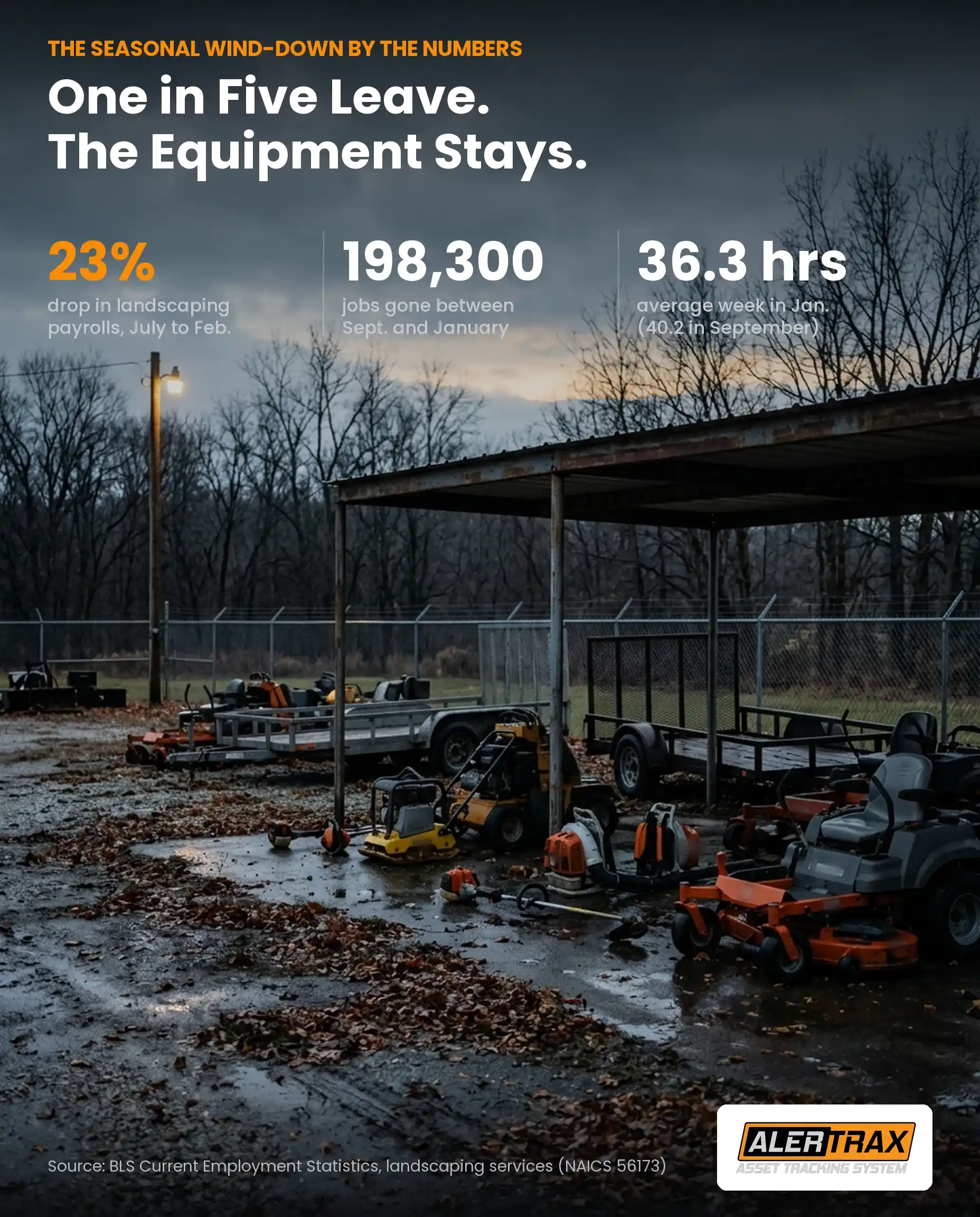
Employment peaked at 1,014,200 in July 2025 and bottomed at 776,400 in February 2026. That is a drop of 237,800 jobs, or about 23 percent of the industry, in seven months (BLS Current Employment Statistics, series CEU6056173001, retrieved September 2026).
Narrow it to the window you are standing in right now and it is nearly as stark. From 980,100 in September 2025 to 781,800 in January 2026, the industry shed 198,300 jobs, about one in five.
This is not a downturn. The same data shows July 2026 at 1,018,500, the strongest July in the last three years, ahead of July 2025 (1,014,200) and July 2024 (1,012,900). The industry is growing. It just empties out every winter and refills every spring, and the equipment does neither.
The Hours Leave Before the People Do
The headcount number hides how the wind-down actually feels, because it does not start with layoffs. It starts with short weeks.
In the same BLS series, average weekly hours for production and nonsupervisory employees in landscaping services ran 40.2 hours in September 2025, then 39.4 in October, 38.8 in November, 37.3 in December, and 36.3 in January 2026 (BLS CES, series CEU6056173002).
Roughly four hours a week come off the schedule before the bulk of the headcount does. In practice that means fewer trucks rolling on any given day, routes getting consolidated, and crews getting combined. Every one of those consolidations moves equipment from one truck to another, and none of those moves gets written down.
That is the real mechanism. The equipment does not go missing on the last day of the season. It drifts, for three months, while the schedule shrinks around it.
Landscaping Swings About Five Times Harder Than Construction
For contrast, total construction employment went from 8,401,000 in September 2025 to 8,003,000 in January 2026, a decline of 398,000, or 4.7 percent (BLS CES, series CEU2000000001, not seasonally adjusted).
Landscaping's 20 percent drop over the same four months is roughly five times that. So if you run a landscaping, irrigation, or grounds maintenance operation and you have been borrowing your process from the construction side of the business, the process is built for a much gentler curve than the one you are on.
Construction crews get smaller in winter. Landscaping crews largely go away and come back.
What Actually Happens to the Equipment
Here is the part the payroll data implies but does not say outright.
At peak season, your equipment is distributed. It is on trucks, at job sites, in the beds of personal vehicles, in a storage unit near the north side of the service area, at a shop waiting on a part, and at three or four crew leads' houses because that is how a 6 AM start actually works.
That distribution is efficient in July. In January it is just a list of places nobody is going to visit.
And there is no day on the calendar when all of it comes back. Layoffs happen one person at a time, as routes shrink. Each of those people is holding a slightly different set of your assets, and the person who knows what they had is usually the person leaving. By February, the inventory exists only in the memories of people who are no longer on the payroll.
Most companies discover the gap in March, when the trucks get loaded for the first real week of spring and two things are not where anyone thought they were.
The Wind-Down Checklist
This is a records problem, and records problems are cheap to fix in October and expensive to fix in March.
1. Do the inventory now, not in December. Count what you own while the people who have been using it are still working. A list assembled in October can be verified by the crews. A list assembled in February is archaeology.
2. Give every asset an owner of record. Not a location, a person. For each piece of equipment worth tracking, one name answers the question "who had this last." That single field prevents most of the March surprises.
3. Photograph serial numbers while you have the equipment in hand. Serial plates on mowers, blowers, compactors, and attachments. This is what makes a police report, an insurance claim, or a warranty conversation possible later, and it takes an afternoon.
4. Make the equipment list part of the offboarding conversation. When someone's last day is set, the list of what they are holding should be printed before that day, not reconstructed after it. Keys, fobs, tools, and whatever is in the back of their truck.
5. Consolidate to fewer locations on purpose. Every consolidation you do deliberately in October is one you are not doing by phone in March. Decide now what winters at the yard, what winters at a storage facility, and what stays on a truck.
6. Write down what winters where, and who checks it. Equipment in winter storage goes months without a set of eyes on it. Assign the check to a person and a date, the same way you would a job.
Where Tracking Fits in the Wind-Down
Most of the checklist above is process, and process is free. The one part that does not hold up is human memory about where things ended up, which is exactly the part a tracker replaces.
Alertrax is built for the equipment that has no power of its own, which is most of what drifts.
- One-Year Battery, No Wiring Required: Alertrax runs on two AA cells, with nothing to wire in and nothing to charge. That is what makes it work on trailers, mowers, compactors, and attachments that sit unpowered for months.
- Live Tracking in the Fleet Portal: Every tracked asset on one map in the Alertrax Fleet Portal, with location updates every 2 minutes. The October inventory stops being a clipboard exercise and becomes a screen you can check in March.
- Automatic Time-on-Site Logging: Arrivals and departures are timestamped, so you can see where a piece of equipment has actually been spending its nights, which is often not where the schedule says.
- Geofence Alerts: Draw boundaries around the yard and the winter storage location. Know when something leaves, and know when it comes back, without a phone call.
- After-Hours Movement Alerts: Equipment parked for the winter should not move at all. Any movement is worth a look, whether it turns out to be a crew lead grabbing a machine or something else.
- 100% Waterproof, Covert Magnetic Mounting: Mounts to a steel frame in seconds and holds up to a winter outdoors.
- Shareable Tracking Link and Mobile App: Send a crew lead or a manager a live link with no login required, straight from the iOS or Android app.
Pricing Before the Crews Go Home
You can equip your fleet with Alertrax for a low monthly rate, no long-term contracts, no hidden fees.
(Want to own it outright? We offer a $599 Lifetime option for permanent, subscription-free tracking.)
As an illustration, not a survey figure: one commercial mower that cannot be found in March, on a company running a dozen machines, costs more than covering the whole fleet for the winter. The point is not the arithmetic on any single machine. It is that the months when nobody is watching are the cheapest months to be covered.
Sources
U.S. Bureau of Labor Statistics (BLS), Current Employment Statistics, series CEU6056173001, "All employees, thousands, landscaping services, not seasonally adjusted" (NAICS 56173), retrieved September 2026: 1,014,200 in July 2025; 980,100 in September 2025; 781,800 in January 2026; 776,400 in February 2026; 1,018,500 in July 2026; 1,012,900 in July 2024
U.S. Bureau of Labor Statistics (BLS), Current Employment Statistics, series CEU6056173002, average weekly hours of production and nonsupervisory employees in landscaping services, not seasonally adjusted, retrieved September 2026: 40.2 hours in September 2025; 39.4 in October 2025; 38.8 in November 2025; 37.3 in December 2025; 36.3 in January 2026
U.S. Bureau of Labor Statistics (BLS), Current Employment Statistics, series CEU2000000001, all employees in construction, not seasonally adjusted, retrieved September 2026: 8,401,000 in September 2025 and 8,003,000 in January 2026
Note on the data: these are not seasonally adjusted figures, which is deliberate, because seasonal adjustment is designed to remove exactly the swing this article is about. Monthly CES estimates are revised, and the most recent month available at the time of writing was July 2026.
This article is provided for general informational purposes and is not legal, employment, insurance, or accounting advice. AlerTrax is a GPS tracking company, not a law firm, staffing agency, or insurer. National industry data describes the industry as a whole and may not reflect your market or your business. The equipment cost comparison above is an illustration, not survey data. Consult your own advisors on offboarding practices, employment documentation, and coverage for stored equipment.
Count It While They Are Still Here
The seasonal wind-down is the most predictable event on your calendar. It happens on roughly the same schedule every year, the payroll data has been showing the same curve for a decade, and every company it happens to is surprised by something in March.
The difference between a company that starts spring with a clean equipment list and one that starts it with a scavenger hunt is about one afternoon of work, done in the next few weeks, while the people who know where everything is are still on the payroll.
Visit www.buyalertrax.com today and know where every piece of equipment is before your crews head home for the winter.