Does This Apply to Your Trucks?
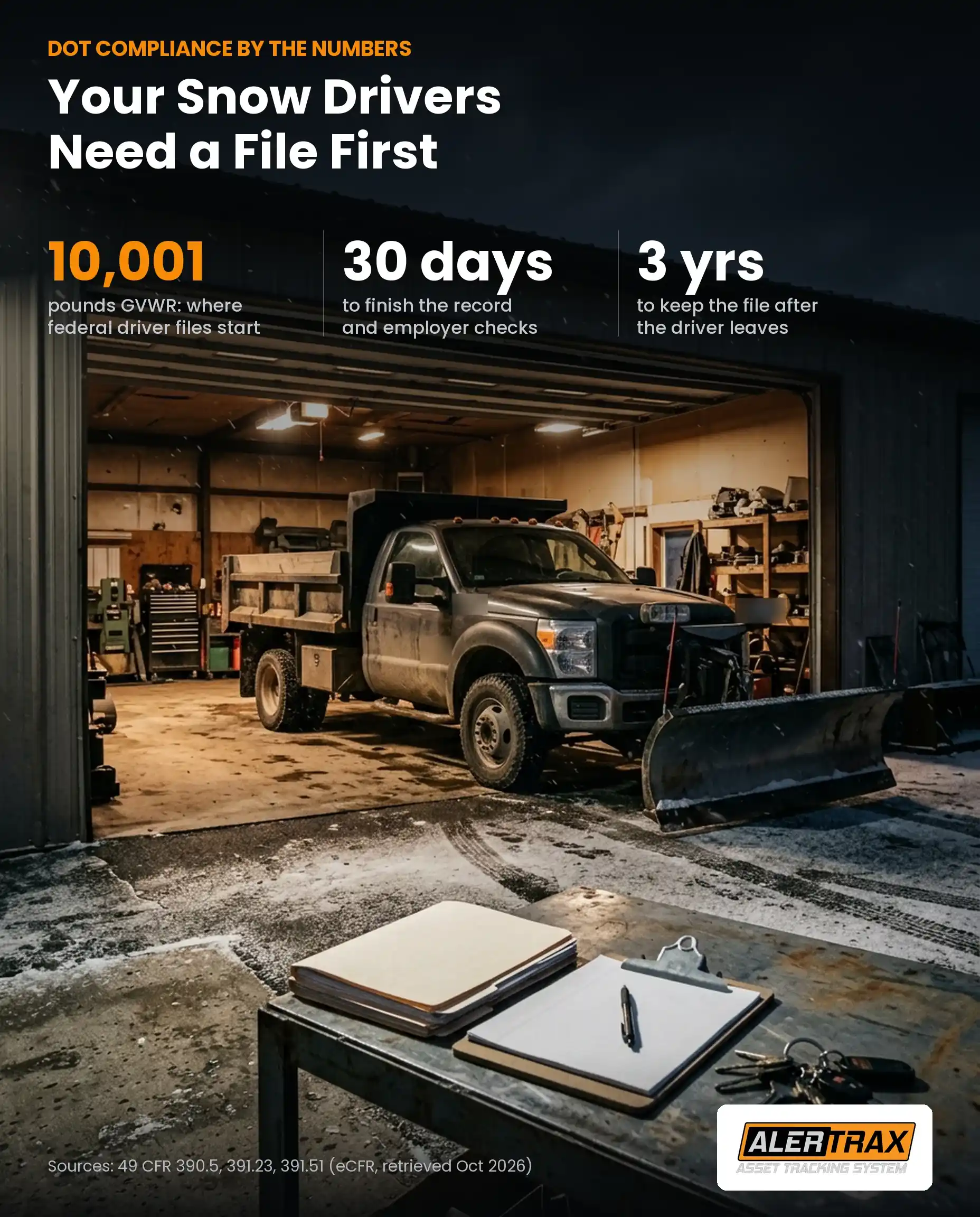
The Federal Motor Carrier Safety Regulations define a commercial motor vehicle by weight, not by license class. Under 49 CFR 390.5, a commercial motor vehicle includes any self-propelled or towed vehicle used on a highway in interstate commerce to transport property when it "has a gross vehicle weight rating or gross combination weight rating, or gross vehicle weight or gross combination weight, of 4,536 kg (10,001 pounds) or more, whichever is greater."
That threshold catches more snow and landscaping equipment than many owners expect. Many dump trucks are rated above it, and the rating is printed on the label in the driver's door jamb. So can a heavy-duty pickup when you add the rating of the trailer it is towing, because the rule counts the combination.
The other half of the definition is interstate commerce. Under the same section, that includes transportation between a place in one state and a place outside it, and transportation between two places in a state when it is part of trade that originates or ends outside the state. Contractors near a state line, or working for national property management companies, should not assume they are purely local.
Two more points. First, the exception in 49 CFR 390.3(f)(2) covers "transportation performed by the Federal government, a State, or any political subdivision of a State." It is written around who performs the transportation, so a private contractor plowing under a municipal contract should not assume it applies without checking. Second, most states apply their own driver qualification rules to intrastate carriers, sometimes with different weight thresholds. Check your state's rules even if all your work is local.
What Goes in the File
Under 49 CFR 391.51(a), "each motor carrier shall maintain a driver qualification file for each driver it employs." Under 391.51(b), the file must include:
- The driver's application for employment, completed under 391.21
- The motor vehicle record from each state where the driver held a license, covering the prior three years (391.23)
- The certificate of road test, or a license or certificate the carrier accepted as equivalent (391.31 and 391.33)
- Each year's annual motor vehicle record and a note of the annual review of the driving record (391.25)
- The medical examiner's certificate, or for CDL holders, the state driving record showing medical certification status (391.43 and 391.51(b)(6))
- For non-CDL drivers, a note verifying the medical examiner is listed on the National Registry of Certified Medical Examiners (391.23(m))
Separately, 49 CFR 391.11 lists who is qualified to drive a commercial motor vehicle at all, including being at least 21 years old, being physically qualified, holding a valid license, and having completed a road test or an accepted equivalent.
The Clocks That Start on Day One
30 days for the driving record. Under 49 CFR 391.23(a)(1), the carrier must make "an inquiry, within 30 days of the date the driver's employment begins," to each state where the driver held a license in the preceding three years, and place the record in the file within 30 days (391.23(b)).
30 days for prior employers. The carrier must also investigate the driver's "safety performance history with Department of Transportation regulated employers during the preceding three years" (391.23(a)(2)), and the replies, or documentation of good faith efforts to get them, must be in the driver investigation history file "within 30 days of the date the driver's employment begins" (391.23(c)(1)).
24 months for the medical certificate. Under 49 CFR 391.45(b), a driver must be examined and certified again if he has not been "during the preceding 24 months." Some medical conditions require shorter intervals.
12 months for the annual review. Under 49 CFR 391.25, the carrier must, "at least once every 12 months," get each driver's motor vehicle record and review it, and keep a note with the name of the reviewer and the date.
3 years after the driver leaves. Under 49 CFR 391.51(c), the file "shall be retained for as long as a driver is employed by that motor carrier and for three years thereafter." For seasonal drivers, that means a file from this winter may need to exist until 2030.
If the Truck Needs a CDL, There Is More
A vehicle rated at 26,001 pounds or more, or a combination of 26,001 pounds or more with a towed unit over 10,000 pounds, requires a commercial driver's license (49 CFR 383.5). Larger plow and salt trucks often fall in that range.
Drivers who need a CDL are also covered by the drug and alcohol testing rules in Part 382, which apply to employers of CDL drivers operating "in commerce in any State" (49 CFR 382.103). Two requirements matter most for a rushed seasonal hire:
- Pre-employment drug test. No employer may let a driver perform safety-sensitive functions "unless the employer has received a controlled substances test result from the MRO or C/TPA indicating a verified negative test result for that driver" (49 CFR 382.301(a)), subject to limited exceptions.
- Clearinghouse query. Employers "must not employ a driver subject to controlled substances and alcohol testing under this part to perform a safety-sensitive function without first conducting a pre-employment query of the Clearinghouse" (49 CFR 382.701(a)), and must query at least once a year for current drivers (382.701(b)).
Neither of those can wait until after the first storm. Both have to be done before the driver drives.
Why Seasonal Hires Are the Gap
The landscaping workforce changes a lot between summer and winter. The Bureau of Labor Statistics reports that employment in landscaping services fell from about 1,002,300 in August 2025 to 848,200 in December 2025 and 776,400 in February 2026, before climbing back to about 1,002,100 in August 2026 (BLS Current Employment Statistics, not seasonally adjusted).
Those numbers do not say who drives the plows. But they show an industry whose staff changes every season, and every new or returning driver behind the wheel of a covered vehicle needs a complete file. The files most likely to be missing are the ones started in a hurry the week of the first storm.
A Checklist Before the First Push
1. List every vehicle and combination by weight rating. Write down the GVWR of each truck, and the combined rating of each truck with the trailer it usually pulls. Anything at 10,001 pounds or more is in scope if it operates in interstate commerce.
2. Match drivers to vehicles. Every driver who might drive one of those vehicles this winter needs a file, including the yard guy who "only moves it sometimes."
3. Start the file at the offer. Get the application signed and request the driving records and prior employer information the same day. The 30 day clock is already running.
4. Get the medical card before the first shift. Confirm the examiner is on the National Registry and note it in the file.
5. For CDL drivers, test and query first. Run the Clearinghouse pre-employment query and get the negative drug test result before the driver performs any safety-sensitive function.
6. Put the renewal dates on a calendar. Medical certificates and annual reviews expire on their own schedules. A spreadsheet with each driver's dates beats remembering.
7. Keep files for three years after drivers leave. Seasonal drivers leave every spring. Their files stay.
Where Alertrax Fits
Driver qualification files are paperwork, and no tracker fills them out for you. What Alertrax gives you is the other half of the compliance picture: a timestamped record of where each truck went and when, which helps answer the questions that come after a long night of plowing.
- Complete Route History: A full breadcrumb trail of every truck's night, from the yard to each lot and back.
- Trip Reports You Can Export: Pull a date range by vehicle or across the fleet, with start time, stop time, addresses visited, duration, and distance, useful alongside time records and per-push invoices.
- Automatic Time-on-Site Logging: Every arrival and departure is timestamped automatically.
- AddressFence: Address-based arrival and departure alerts for your priority lots and your yard.
- Live Fleet Map: Every tracked truck on one map in the Alertrax Fleet Portal, with location updates every 2 minutes.
- One-Year Battery, No Wiring Required: Alertrax runs on two AA cells, so there is nothing to wire into a plow truck's electrical system.
- 100% Waterproof, Covert Magnetic Mounting: Mounts to a steel frame in seconds and keeps working through snow, slush, and road salt.
Between storms, the same device sends an after-hours movement alert if a plow truck, spreader, or skid steer trailer moves when it should not. If your drivers use the short-haul exception instead of logbooks, see No Logbook Does Not Mean No Records for the time records that exception requires.
Pricing
You can equip your fleet with Alertrax for a low monthly rate, no long-term contracts, no hidden fees.
(Want to own it outright? We offer a $599 Lifetime option for permanent, subscription-free tracking.)
Sources
Electronic Code of Federal Regulations (eCFR), 49 CFR 390.5, definitions of "commercial motor vehicle" and "interstate commerce," retrieved October 2026
eCFR, 49 CFR 390.3(f), exceptions, retrieved October 2026
eCFR, 49 CFR 391.11, "General qualifications of drivers," retrieved October 2026
eCFR, 49 CFR 391.23, "Investigation and inquiries," retrieved October 2026: driving record inquiries and safety performance history investigations covering the preceding three years, due within 30 days of the start of employment
eCFR, 49 CFR 391.25, "Annual inquiry and review of driving record," retrieved October 2026
eCFR, 49 CFR 391.45, "Persons who must be medically examined and certified," retrieved October 2026
eCFR, 49 CFR 391.51, "General requirements for driver qualification files," retrieved October 2026: required contents and retention for the period of employment plus three years
eCFR, 49 CFR 383.5, definition of "commercial motor vehicle" for CDL purposes, retrieved October 2026
eCFR, 49 CFR 382.103, 382.301, and 382.701, applicability, pre-employment testing, and Drug and Alcohol Clearinghouse queries, retrieved October 2026
U.S. Bureau of Labor Statistics (BLS), Current Employment Statistics, Landscaping Services (NAICS 56173), all employees, not seasonally adjusted, series CEU6056173001, retrieved October 2026: employment of 1,002,300 in August 2025, 848,200 in December 2025, 776,400 in February 2026, and 1,002,100 in August 2026. Recent months are subject to revision
This article is provided for general informational purposes and is not legal or compliance advice. It summarizes selected federal regulations only and does not cover every requirement or exception. Whether these rules apply to your company depends on your vehicles, your operations, and whether you operate in interstate commerce, and state rules for intrastate carriers vary. Confirm your obligations with FMCSA, your state's motor carrier enforcement agency, or a qualified transportation compliance professional.
File First, Then Plow
The storm will not wait for paperwork, which is exactly why the paperwork has to come first. Start the files this week, while the forecast is still clear.
Visit www.buyalertrax.com today and see where every plow truck goes this winter.