"Engaged to Wait" vs. "Waiting to Be Engaged"
The Fair Labor Standards Act regulations split waiting time into two categories, and the difference turns on who controls the time.
Under 29 CFR 785.15, an employee who waits because the work is not ready yet is still working. The regulation describes time that is "unpredictable," usually "of short duration," during which "the employee is unable to use the time effectively for his own purposes. It belongs to and is controlled by the employer." Its conclusion: "In all of these cases waiting is an integral part of the job. The employee is engaged to wait." The rule applies even "though the employee is allowed to leave the premises or the job site during such periods of inactivity."
The other side is 29 CFR 785.16. Time off duty is not hours worked, but only when the employee is "completely relieved from duty" and the period is long enough to use for his own purposes. And the regulation sets a specific condition: he is not completely relieved "unless he is definitely told in advance that he may leave the job and that he will not have to commence work until a definitely specified hour has arrived." That employee is "waiting to be engaged."
A crew told to sit at the shop until the snow starts, with no specific release time, fits the first description much more closely than the second.
On Call at Home Is Different From On Call at the Shop
Most snow companies do not call everyone in at 2 AM for every storm. They keep drivers on call. The federal rule on that is short. Under 29 CFR 785.17, "an employee who is required to remain on call on the employer's premises or so close thereto that he cannot use the time effectively for his own purposes is working while 'on call'." But "an employee who is not required to remain on the employer's premises but is merely required to leave word at his home or with company officials where he may be reached is not working while on call."
In practice that is the line between "keep your phone on tonight, we may call you" and "be at the shop at 2." The first is generally not work time under the federal rule. The second generally is, from the moment the crew is required to be there.
Response time requirements and restrictions can change the answer, because the test is whether the employee can use the time effectively for his own purposes. A very short required response time can make home on-call time look a lot more like working time. If your on-call policy is strict, have an employment attorney look at it.
Sleeping at the Shop Still Counts
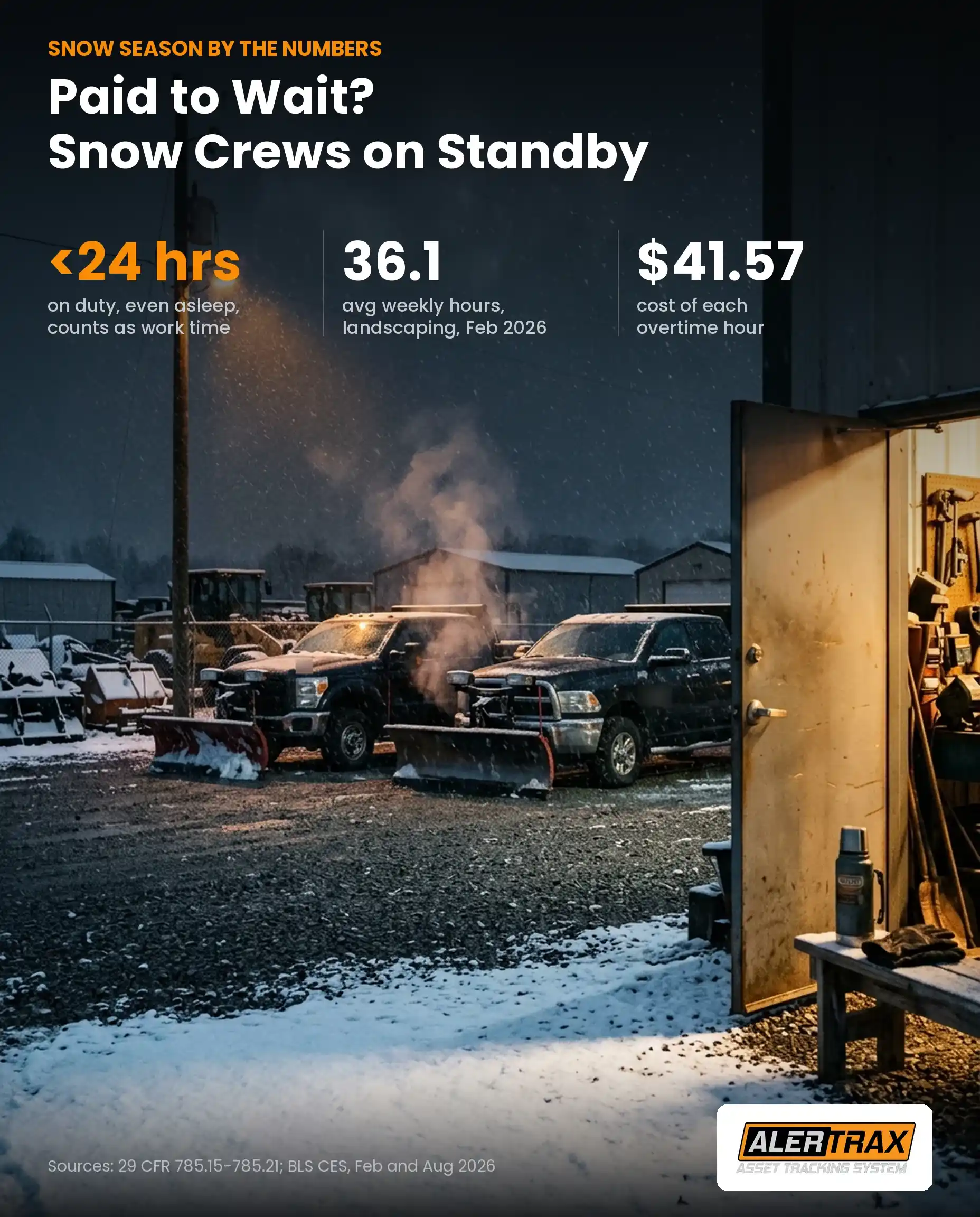
The break room nap is covered too. Under 29 CFR 785.21, "an employee who is required to be on duty for less than 24 hours is working even though he is permitted to sleep or engage in other personal activities when not busy." The regulation adds: "It makes no difference that she is furnished facilities for sleeping. Her time is given to her employer."
Most snow shifts, even long ones, are under 24 hours. So the driver who dozes off in a chair at 3 AM while waiting for the snow is, under the federal rule, still on the clock.
When the Workday Starts
The Portal-to-Portal regulations answer the last piece. Under 29 CFR 790.6(b), "if an employee is required to report at the actual place of performance of his principal activity at a certain specific time, his 'workday' commences at the time he reports there for work in accordance with the employer's requirement, even though through a cause beyond the employee's control, he is not able to commence performance of his productive activities until a later time." In that situation, "the time spent waiting for work would be part of the workday."
Snow that arrives three hours late is a textbook cause beyond the employee's control. If the crew was told to be at the shop at 2:00, the federal rule points to 2:00 as the start of the workday.
Short breaks during a long plow shift work the same way. Under 29 CFR 785.18, rest periods "running from 5 minutes to about 20 minutes" are "customarily paid for as working time" and "must be counted as hours worked."
What It Adds Up To
Landscaping crews do not work full weeks all winter. The Bureau of Labor Statistics reports that employees in landscaping services averaged 37.3 hours a week in December 2025 and 36.1 hours in February 2026, compared with 41.1 hours in August 2026. Employment in the industry fell from about 1,002,300 in August 2025 to 776,400 in February 2026 (BLS Current Employment Statistics, not seasonally adjusted).
Average weekly hours are the wrong number to watch in snow season, though, because storms do not arrive on an average schedule. A quiet week can be 25 hours. A week with two storms can be 60.
Average pay for production and nonsupervisory employees in landscaping services was $27.71 an hour in August 2026 (BLS CES, August 2026), and overtime must be paid at no less than one and one-half times the regular rate for hours over 40 in a workweek (29 CFR 778.107). At that average, every overtime hour costs about $41.57.
Here is an example, not survey data. A four person crew is called in at 2 AM and waits three hours for the snow to start. That is 12 crew hours of waiting time. At the August 2026 average straight-time rate, it costs about $333. If it lands in a week when the crew passes 40 hours, it costs about $499. A season with ten of those false-start nights is a roughly $3,300 to $5,000 line item that most snow contracts never priced.
What to Decide Before the First Storm
1. Write down your standby policy. Decide when crews are on call from home and when they are required at the shop, and tell them in writing. The federal rule turns on what the employee is actually required to do.
2. Call people in for the snow, not the forecast. If waiting at the shop is paid time, the cheapest wait is the one that does not happen. Bring in a small first-out crew and call the rest when the snow reaches trigger depth.
3. Use a definite release time. If the storm stalls and you send people home, tell them exactly when they need to be back, as in "you are off until 6 AM." That is the language 29 CFR 785.16 uses for off-duty time.
4. Record four times for every storm. When the crew was called, when it was required to report, when the first truck left the yard, and when the crew was released. Those four times answer almost every pay question afterward.
5. Keep site times for every lot. Hourly and per-push contracts both depend on knowing when the truck arrived at each property and how long it stayed. The same record supports the invoice.
6. Watch the workweek across storms. Overtime is decided by the workweek, not the storm. A Tuesday storm and a Friday storm can push a crew well past 40 even in a slow month.
7. Check your state's rules. Some states have their own reporting-time or call-in pay rules that go beyond federal law. Know yours before the season starts.
Where Alertrax Fits
Snow work runs at night, in bad weather, across dozens of lots, and the questions afterward are always about time. Alertrax gives you a timestamped record of when every plow truck left the yard, where it went, and how long it stayed, without asking a tired driver to fill out a log at 4 AM.
- Automatic Time-on-Site Logging: Every arrival and departure at every lot is timestamped automatically, which supports both your payroll and your per-push or hourly invoices.
- AddressFence: Address-based arrival and departure alerts, so you know when a truck reaches a priority lot and when it leaves.
- Complete Route History: A full breadcrumb trail of the night, from the first push to the return to the yard.
- Trip Reports You Can Export: Pull a date range by vehicle or across the fleet, with start time, stop time, addresses visited, duration, and distance.
- Live Fleet Map: Every tracked truck on one map in the Alertrax Fleet Portal, with location updates every 2 minutes, so you can send the nearest truck to a lot that needs a second pass.
- One-Year Battery, No Wiring Required: Alertrax runs on two AA cells, so there is nothing to wire into a plow truck's electrical system.
- 100% Waterproof, Covert Magnetic Mounting: Mounts to a steel frame in seconds and keeps working through snow, slush, and road salt.
- iOS and Android App: Check the map and the night's history from your phone.
Between storms, plow trucks, salt spreaders, and skid steers often sit in the yard for days. The same device sends an after-hours movement alert if one of them moves when it should not.
Pricing
You can equip your fleet with Alertrax for a low monthly rate, no long-term contracts, no hidden fees.
(Want to own it outright? We offer a $599 Lifetime option for permanent, subscription-free tracking.)
Sources
Electronic Code of Federal Regulations (eCFR), 29 CFR 785.15, "On duty," retrieved October 2026: an employee who waits as an integral part of the job is "engaged to wait" and working
eCFR, 29 CFR 785.16, "Off duty," retrieved October 2026: periods when an employee is completely relieved from duty and told in advance of a definitely specified return time are not hours worked
eCFR, 29 CFR 785.17, "On-call time," retrieved October 2026
eCFR, 29 CFR 785.18, "Rest," retrieved October 2026
eCFR, 29 CFR 785.21, "Less than 24-hour duty," retrieved October 2026
eCFR, 29 CFR 790.6(b), "Periods within the 'workday' unaffected," retrieved October 2026
eCFR, 29 CFR 778.107, "General standard for overtime pay," retrieved October 2026
U.S. Bureau of Labor Statistics (BLS), Current Employment Statistics, Landscaping Services (NAICS 56173), not seasonally adjusted, series CEU6056173001, CEU6056173002, and CEU6056173008, retrieved October 2026: average weekly hours of all employees of 37.3 in December 2025, 36.1 in February 2026, and 41.1 in August 2026; employment of 1,002,300 in August 2025 and 776,400 in February 2026; average hourly earnings of production and nonsupervisory employees of $27.71 in August 2026. Recent months are subject to revision
This article is provided for general informational purposes and is not legal, payroll, or financial advice. It summarizes federal regulations only; state and local wage laws may impose different or stricter requirements, and some employees may be exempt from overtime. Whether a particular on-call arrangement is work time depends on the facts. Talk to an employment attorney or payroll professional about your own crews. BLS figures are industry averages and may not reflect your company. The waiting time and cost figures above are an illustration, not survey data.
Decide Before It Snows
The first storm is the worst time to figure out your standby policy. Write it down now, tell your crews, and make sure you will have a record of when each night really started.
Visit www.buyalertrax.com today and see when every plow truck rolled, and where it went.