The 2027 Fees, Bracket by Bracket
UCR fees are set in six brackets based on fleet size. These are the figures adopted in the final rule for registration year 2027 and subsequent years, with the 2025 and 2026 fee shown for comparison (FMCSA, "Fees for the Unified Carrier Registration Plan and Agreement," final rule, published September 1, 2026, 91 FR 56063, document 2026-17893):
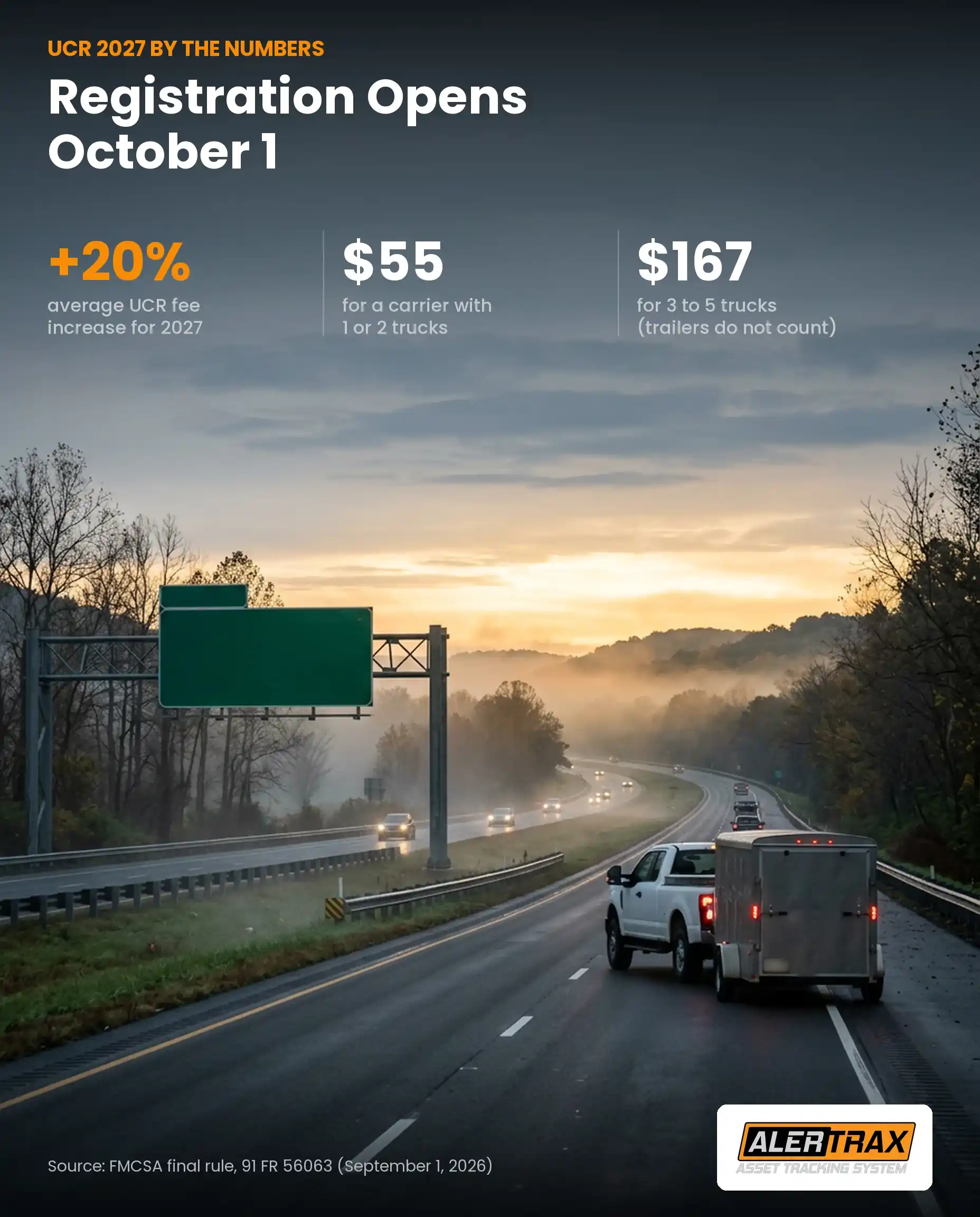
0 to 2 vehicles: $55, up from $46.
3 to 5 vehicles: $167, up from $138.
6 to 20 vehicles: $333, up from $276.
21 to 100 vehicles: $1,163, up from $963.
101 to 1,000 vehicles: $5,548, up from $4,592.
1,001 or more vehicles: $54,165, up from $44,836.
Brokers and leasing companies pay the bottom bracket fee, $55 for 2027.
The rule describes the change as an average increase of 20 percent, with increases ranging from $9 to $9,329 per entity depending on the bracket. FMCSA also notes that even after the increase, 2027 fees remain lower than the fees in effect for registration years 2019 through 2022.
For most of the companies reading this, the practical number is $55 or $167. That is not a budget problem. Not filing it is.
Why the Increase Happened
The fee is not set by FMCSA on its own. The UCR Plan's board of directors recommends fees, and FMCSA adopts them through rulemaking. The board issued this recommendation on September 18, 2025.
The reason given in the rule is arithmetic. UCR revenue is distributed to participating states for motor carrier safety programs and enforcement, and the amounts each state receives are set by statute. Collections had been running behind, and the rule states the adjustment is expected to cover a projected $21.79 million shortfall in the statutorily required funding (91 FR 56063).
The rule also explains why fees swing around from year to year: collections depend on how many carriers register and how many vehicles they operate, so a shortfall in one year gets made up later, and an overcollection comes back as reduced fees in a future year.
Your Trailers Do Not Count Toward the Bracket
This is the part worth reading twice if you run a fleet that is mostly trailers, and it comes straight from the statute.
In most federal safety contexts, "commercial motor vehicle" includes towed equipment. The general definition at 49 U.S.C. 31101 covers "a self-propelled or towed vehicle" used on the highways in commerce at 10,001 pounds or more, among other categories.
The UCR statute narrows that. For UCR purposes, 49 U.S.C. 14504a(a)(1)(A)(ii) defines a commercial motor vehicle, for years beginning after December 31, 2009, as "a self-propelled vehicle described in section 31101."
Self-propelled. So a company running four trucks and eleven trailers counts four vehicles for its UCR bracket, not fifteen. Four trucks lands in the 3 to 5 bracket at $167 for 2027. Counting the trailers would have put the same company in the 6 to 20 bracket at $333, which is a mistake that costs real money and is easy to make if you are working from your insurance schedule or your asset list.
Worth knowing in the other direction too: the same statute gives carriers the option to include additional self-propelled vehicles used in commerce regardless of weight rating when calculating fleet size. That is an option, not a requirement, and it is a question for your compliance advisor rather than a blog post.
If you are not sure whether your operation needs a USDOT number in the first place, that threshold is a different test with a different answer, and we wrote about it separately in the 10,001 pound rule.
The Calendar
UCR runs on a schedule that confuses people because the registration year and the calendar year do not line up with when you pay.
The final rule describes it plainly: the Plan assesses fees for a given fee year over a two year period, and "collections begin on October 1 of the year preceding the fee year to allow for advance registration" (91 FR 56063). The UCR Plan's own site says the same thing for this cycle: 2027 UCR registration opens October 1, 2026, through the National Registration System (plan.ucr.gov, retrieved September 2026).
So the window opens next week. Registering in October for the year ahead is the entire point of the advance registration period, and it is the cheapest possible way to handle this, because the alternative is discovering the gap at a scale house.
Enforcement and late registration rules are administered by the participating states, and the specifics vary, so confirm the details for your base state rather than relying on a general article.
What to Do in the Next Two Weeks
1. Count your self-propelled vehicles, not your assets. Trucks, tractors, and any other self-propelled vehicle that meets the definition. Trailers, and the equipment riding on them, do not go in the count for your bracket.
2. Check which bracket that number lands in. The boundaries are 2, 5, 20, 100, and 1,000. If you are sitting on a boundary, the difference between brackets for a small fleet is the difference between $55, $167, and $333.
3. Confirm your base state. Not every state participates in UCR, and carriers based in a non-participating state register through another state. Your base state determines where you file.
4. Register through the official system, and go directly. The UCR Plan's National Registration System at plan.ucr.gov is the official channel. Search results for "UCR registration" are full of third party filing services that charge a markup over a $55 fee.
5. Keep proof where the driver can reach it. Save the confirmation and keep a copy accessible to whoever is driving, in whatever form your operation uses for paperwork.
6. Put next year's on the calendar now. UCR is annual, the window opens every October 1, and the single most common way to get caught out is simply forgetting.
Where Tracking Actually Helps Here
A GPS tracker does not file anything for you, and nothing on this page is a compliance product. What it does is answer the factual questions that these filings rest on, which is harder than it sounds once a company has more than a couple of trucks.
Which vehicles actually operated out of state this year. Which trailer went with which truck. Whether the machine you are about to list as active has moved since spring. Those are records questions, and records are what audits and renewals run on.
Alertrax covers the part of the fleet that is hardest to document, the equipment with no power of its own.
- One-Year Battery, No Wiring Required: Alertrax runs on two AA cells, with nothing to wire in and nothing to charge, so it works on trailers, mowers, compactors, and equipment that sits unpowered.
- Live Tracking in the Fleet Portal: Every tracked asset on one map in the Alertrax Fleet Portal, with location updates every 2 minutes.
- Location History: Where an asset has been, with dates. That is the difference between remembering that a trailer went out of state in June and being able to show it.
- Automatic Time-on-Site Logging: Timestamped arrivals and departures, useful for job costing, billing disputes, and any conversation that starts with "when were you there."
- Geofence and After-Hours Alerts: Know when equipment leaves the yard, and know when it moves at a time nothing should be moving.
- 100% Waterproof, Covert Magnetic Mounting: Mounts to a steel frame in seconds and survives the weather your trailers live in.
- Shareable Tracking Link and Mobile App: Send a live link to a driver, a customer, or an officer with no login required, from the iOS or Android app.
Pricing
You can equip your fleet with Alertrax for a low monthly rate, no long-term contracts, no hidden fees.
(Want to own it outright? We offer a $599 Lifetime option for permanent, subscription-free tracking.)
Compliance filings and tracking hardware solve different problems. The one thing they share is that both are cheap compared to the version of the story where you are reconstructing last year from memory.
Sources
Federal Motor Carrier Safety Administration (FMCSA), "Fees for the Unified Carrier Registration Plan and Agreement," final rule, published September 1, 2026, 91 FR 56063, document number 2026-17893, effective October 1, 2026, retrieved September 2026: 2027 fee brackets of $55, $167, $333, $1,163, $5,548, and $54,165; 2025 and 2026 fee brackets of $46, $138, $276, $963, $4,592, and $44,836; average increase of 20 percent with per-entity increases ranging from $9 to $9,329; UCR Plan Board recommendation issued September 18, 2025; projected $21.79 million shortfall in statutorily required funding; collections for a fee year beginning October 1 of the preceding year; statement that 2027 fees remain below those in effect for registration years 2019 through 2022
Unified Carrier Registration Plan, plan.ucr.gov, retrieved September 2026: 2027 UCR registration opens October 1, 2026 through the National Registration System
49 U.S.C. 14504a(a)(1), Unified Carrier Registration System plan and agreement, definitions, retrieved September 2026: for years beginning after December 31, 2009, "commercial motor vehicle" means a self-propelled vehicle described in section 31101; option to include additional self-propelled vehicles in fleet size calculations
49 U.S.C. 31101(1), definitions, retrieved September 2026: "commercial motor vehicle" means a self-propelled or towed vehicle used on the highways in commerce principally to transport passengers or cargo with a gross vehicle weight rating or gross vehicle weight of at least 10,001 pounds, designed to transport more than 10 passengers including the driver, or used to transport placarded hazardous materials
This article is provided for general informational purposes and is not legal, regulatory, or compliance advice. AlerTrax is a GPS tracking company, not a law firm, a compliance service, or a filing agent, and is not affiliated with FMCSA or the UCR Plan. Whether UCR applies to your operation, which state is your base state, how your fleet is counted, and how enforcement and late registration are handled all depend on your specific circumstances and your state. Fees and rules change. Verify current requirements with FMCSA, the UCR Plan, or your state agency, and consult a qualified compliance professional or attorney before relying on any of the above.
File It in October
UCR is a small fee attached to a filing that is easy to forget, which is a bad combination. The window opens October 1. For most small fleets the whole thing is $55 or $167 and a few minutes on the official site.
Count the trucks, not the trailers. File it in the advance window. Then put the reminder on next October's calendar while you are thinking about it.
Visit www.buyalertrax.com today and keep a record of where every truck and trailer in your fleet has actually been.