When the Workday Starts
The Fair Labor Standards Act counts the workday from the first "principal activity" to the last. The Portal-to-Portal regulations describe it as the period "from whistle to whistle," and say that time between "the commencement of the employee's first principal activity and the completion of his last principal activity on any workday must be included in the computation of hours worked" (29 CFR 790.6(a)).
Loading the trailer is not a warm-up to the job. For a landscaping crew, it is part of the job. The regulations use a close parallel: an employee who, "at the commencement of his workday, oil, grease, or clean his machine, or install a new cutting tool" is performing activities that "are an integral part of the principal activity." Those preparatory activities remain compensable "regardless of contrary custom or contract" (29 CFR 785.24, quoting the 1947 Portal-to-Portal Bulletin).
Fueling equipment, checking oil, sharpening blades, and loading tools fit that description. Once they start, the workday has started.
The Drive to the First Property
The same rule covers the drive. Under 29 CFR 785.38, where an employee is required to report at a meeting place "to receive instructions or to perform other work there, or to pick up and to carry tools," the travel from that place to the work site "is part of the day's work, and must be counted as hours worked regardless of contract, custom, or practice."
A crew that meets at the yard, gets its route, and loads its own trailer checks all three boxes. In the example above, the 18 minute drive to the first property is part of the workday too.
That is different from an ordinary commute. Under 29 CFR 785.35, normal travel from home to work "is not worktime." The line is the yard. Driving to it is the employee's time. What happens after the crew starts working there belongs to the business.
What Is Not Work Time
The rules do not count every minute at the yard. Under 29 CFR 785.48(a), employees "who voluntarily come in before their regular starting time or remain after their closing time, do not have to be paid for such periods provided, of course, that they do not engage in any work." A crew member who shows up at 6:20 to drink coffee in his truck is not on the clock.
Checking in also is not, by itself, a principal activity. The regulations say "activities such as checking in and out and waiting in line to do so would not ordinarily be regarded as integral parts of the principal activity or activities" (29 CFR 785.24).
The difference is work. Coffee is not work. Loading the mower is.
Rounding Has to Even Out
Plenty of companies round start times, and the federal rules allow it with a condition. Under 29 CFR 785.48(b), recording time "to the nearest 5 minutes, or to the nearest one-tenth or quarter of an hour" is accepted, "provided that it is used in such a manner that it will not result, over a period of time, in failure to compensate the employees properly for all the time they have actually worked."
The regulation assumes that rounding "averages out." A policy that always rounds the crew's start time later, and never earlier, does not average out. Neither does a policy that starts the clock at the first property every day no matter when the crew started loading.
"A Few Minutes" Has a Limit
Some owners treat yard time as too small to count. The federal rule on small amounts of time is narrower than most people think. Under 29 CFR 785.47, "insubstantial or insignificant periods of time" may be disregarded, but the rule "applies only where there are uncertain and indefinite periods of time involved of a few seconds or minutes duration."
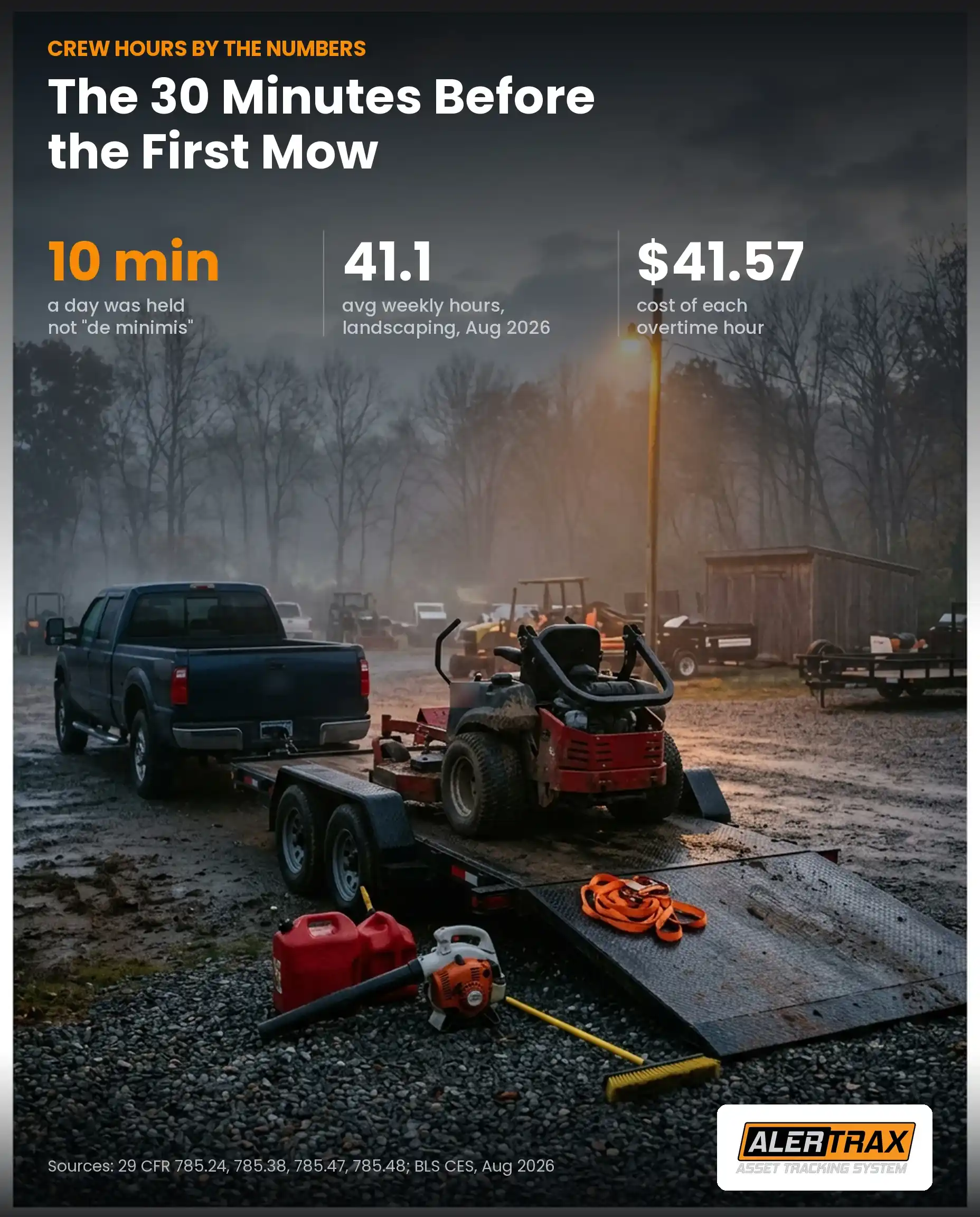
The same section adds that an employer "may not arbitrarily fail to count as hours worked any part, however small, of the employee's fixed or regular working time or practically ascertainable period of time he is regularly required to spend on duties assigned to him." Among the court decisions the regulation cites, one held that 10 minutes a day is not de minimis (Hawkins v. E. I. du Pont de Nemours & Co., E.D. Va., 1955, cited in 29 CFR 785.47).
Loading the same trailer at the same yard every morning is about as "practically ascertainable" as work time gets.
What the Minutes Are Worth
Yard time matters more when crews are already near 40 hours. In August 2026, the Bureau of Labor Statistics reported that employees in landscaping services averaged 41.1 hours a week, and production and nonsupervisory employees averaged 40.8. Their average pay was $27.71 an hour, up from $25.53 a year earlier (BLS Current Employment Statistics, August 2026, not seasonally adjusted).
Overtime must be paid at no less than one and one-half times the regular rate for hours over 40 in a workweek (29 CFR 778.107). At the August 2026 average, that is about $41.57 an overtime hour.
Here is an example, not survey data. A three person crew spends 25 minutes at the yard each morning loading, fueling, and getting the route before the truck leaves. Over a five day week, that is about 2 hours per person and 6.25 crew hours. If the crew is already at 40 hours, those minutes cost about $260 a week at the overtime average, or roughly $7,800 over a 30 week season, for one crew.
Either that time is on the timesheet and already part of your labor cost, or it is not, and it is a risk sitting in your payroll records. Both are good reasons to know the number.
How to Shrink the Yard Time
1. Decide when the day starts, and write it down. Pick a start time that matches when work actually begins at the yard, and make it the same for every crew.
2. Measure it for two weeks. Compare each crew's clock-in time with the time its truck actually left the yard. The gap is your yard time.
3. Stage the night before, as part of the paid day. Having the last crew back unload and restock the trailer for tomorrow while they are still on the clock is usually faster than having the morning crew hunt for everything.
4. Send the route before people arrive. If the foreman already has the day's stops, the morning meeting can be two minutes instead of fifteen.
5. Round both ways, or do not round. If you round, make sure it rounds in the employee's favor as often as in yours, as 29 CFR 785.48(b) requires.
6. Price it in. Yard time is real labor cost. Your hourly rates and bids should include it, rather than hoping it disappears.
Where Alertrax Fits
The most useful number in this whole article is the time each truck actually left the yard. Alertrax records it automatically, every day, for every truck and trailer, without asking the crew to do anything.
- AddressFence: Set your yard as an address and get departure and arrival alerts, so you know exactly when each crew rolled out and came back.
- Automatic Time-on-Site Logging: Every arrival and departure is timestamped automatically, including the yard and every property after it.
- Trip Reports You Can Export: Pull a date range by vehicle or across the fleet, with start time, stop time, addresses visited, duration, and distance, in a table you can put beside a timesheet.
- Complete Route History: A full breadcrumb trail of the day, from the yard to the last stop and back.
- Live Fleet Map: Every tracked truck and trailer on one map in the Alertrax Fleet Portal, with location updates every 2 minutes.
- One-Year Battery, No Wiring Required: Alertrax runs on two AA cells. Put it on the truck or the trailer with nothing to wire in and nothing to charge.
- 100% Waterproof, Covert Magnetic Mounting: Mounts to a steel frame in seconds and keeps working through rain, mud, and grass clippings.
- iOS and Android App: Check the map, the alerts, and the day's history from your phone.
The same device also sends an after-hours movement alert if a loaded trailer leaves the yard overnight when it should not. For more on the drive time between properties, see Leaf Season Runs on Drive Time.
Pricing
You can equip your fleet with Alertrax for a low monthly rate, no long-term contracts, no hidden fees.
(Want to own it outright? We offer a $599 Lifetime option for permanent, subscription-free tracking.)
Sources
Electronic Code of Federal Regulations (eCFR), 29 CFR 790.6, "Periods within the 'workday' unaffected," retrieved October 2026
eCFR, 29 CFR 785.24, "Principles noted in Portal-to-Portal Bulletin," retrieved October 2026: preparatory activities integral to a principal activity are compensable; checking in and out ordinarily is not
eCFR, 29 CFR 785.38, "Travel that is all in the day's work," retrieved October 2026
eCFR, 29 CFR 785.35, "Home to work; ordinary situation," retrieved October 2026
eCFR, 29 CFR 785.47, "Where records show insubstantial or insignificant periods of time," retrieved October 2026, including its citation of Hawkins v. E. I. du Pont de Nemours & Co., 12 W.H. Cases 448 (E.D. Va. 1955), holding that 10 minutes a day is not de minimis
eCFR, 29 CFR 785.48, "Use of time clocks," retrieved October 2026
eCFR, 29 CFR 778.107, "General standard for overtime pay," retrieved October 2026
U.S. Bureau of Labor Statistics (BLS), Current Employment Statistics, Landscaping Services (NAICS 56173), not seasonally adjusted, series CEU6056173002, CEU6056173007, and CEU6056173008, retrieved October 2026: average weekly hours of all employees of 41.1 and of production and nonsupervisory employees of 40.8 in August 2026; average hourly earnings of production and nonsupervisory employees of $27.71 in August 2026 and $25.53 in August 2025. Recent months are subject to revision
This article is provided for general informational purposes and is not legal, payroll, or financial advice. It summarizes federal regulations only; state and local wage laws may impose different or stricter requirements, and some employees may be exempt from overtime. Talk to an employment attorney or payroll professional about your own crews. BLS figures are industry averages and may not reflect your company. The yard time and overtime figures above are an illustration, not survey data.
Start the Clock Where the Work Starts
The first half hour of the day is the one you can measure most easily and improve fastest. Find out how long it really is, and then make it shorter.
Visit www.buyalertrax.com today and see when every crew really leaves the yard.