What the Law Says About November 1
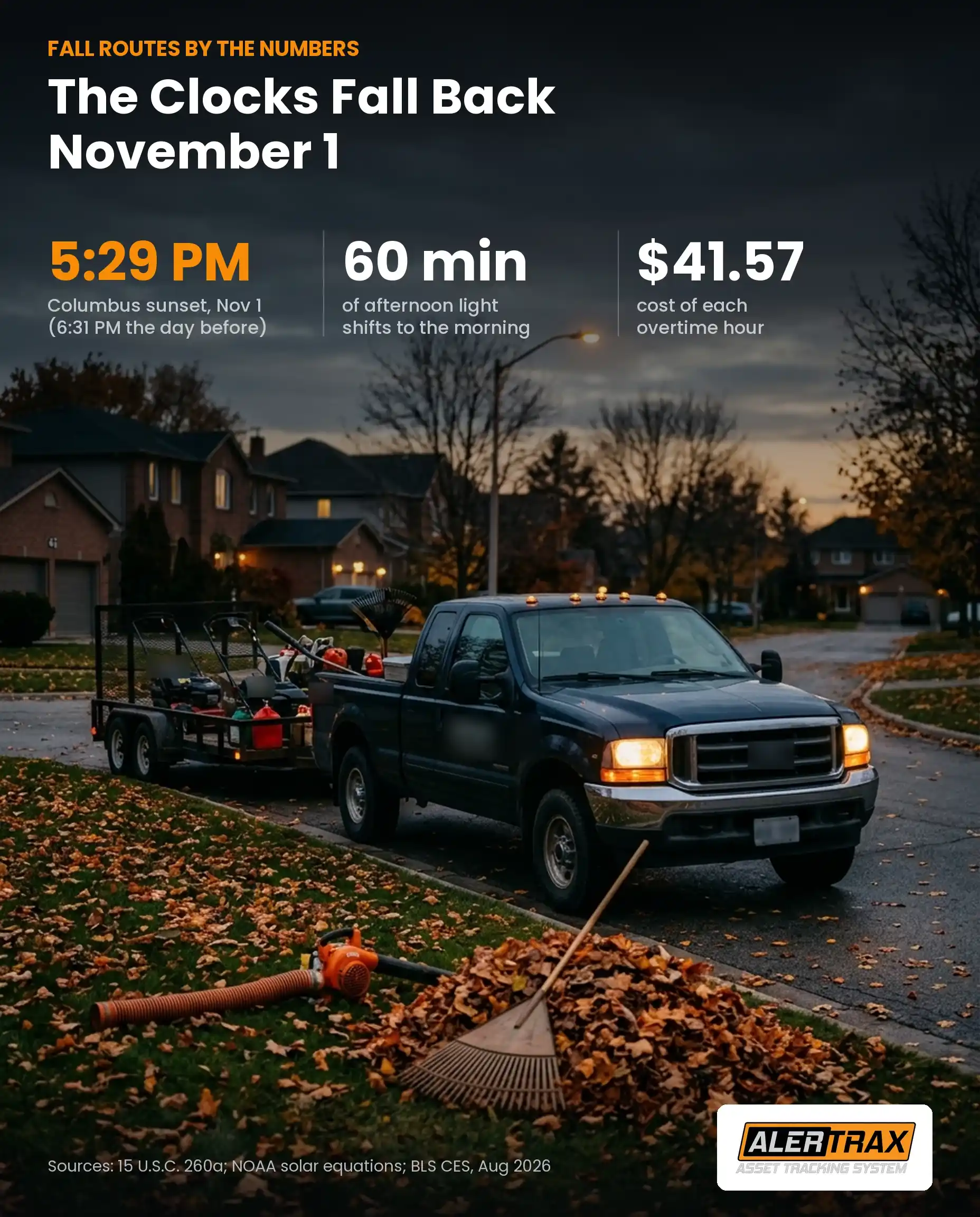
The date is set by federal law. Under the Uniform Time Act, 15 U.S.C. 260a, daylight saving time runs "commencing at 2 o'clock antemeridian on the second Sunday of March of each year and ending at 2 o'clock antemeridian on the first Sunday of November." In 2026, the first Sunday of November is November 1.
The same statute lets a state exempt itself and stay on standard time all year, which is why a few places, including Hawaii and most of Arizona, do not change their clocks. Everywhere else, the shift happens at once, on a Sunday, with Monday's routes built on Friday's daylight.
How Much Afternoon Your Crews Lose
Sunset times move gradually all fall, about a minute or two earlier every day. The time change adds a full hour on top of that in a single night. Here are sunset times for six cities, calculated with the solar position equations NOAA uses in its Solar Calculator (NOAA Global Monitoring Laboratory method, calculated October 2026, local clock time):
| City | Oct 5 | Oct 31 | Nov 1 | Nov 30 |
|---|
| Boston | 6:19 PM | 5:39 PM | 4:37 PM | 4:13 PM |
| Columbus, OH | 7:08 PM | 6:31 PM | 5:29 PM | 5:08 PM |
| Atlanta | 7:16 PM | 6:46 PM | 5:45 PM | 5:29 PM |
| Chicago | 6:25 PM | 5:46 PM | 4:45 PM | 4:21 PM |
| Dallas | 7:06 PM | 6:37 PM | 5:36 PM | 5:21 PM |
| Denver | 6:36 PM | 5:59 PM | 4:58 PM | 4:36 PM |
In Columbus, sunset moves from 7:08 PM on October 5 to 5:29 PM on November 1, about an hour and 40 minutes earlier in under four weeks. Sixty of those minutes disappear between Saturday and Sunday. Civil twilight, the last stretch when there is enough natural light to work outdoors without lights, ends at about 5:58 PM in Columbus on November 1.
The hour does not vanish, though. It moves. Columbus sunrise goes from about 8:00 AM on October 31 to about 7:01 AM on November 1. A crew that has been loading trailers in the dark since early October suddenly has daylight at 7 AM again.
Why It Costs Money, Not Just Daylight
The Bureau of Labor Statistics tracks hours and pay in landscaping services every month. In August 2026, the most recent month published, employees in the industry averaged 41.1 hours a week, and production and nonsupervisory employees, the people on the crews, averaged 40.8 hours. Their average pay was $27.71 an hour, up from $25.53 in August 2025, an increase of about 8.5 percent (BLS Current Employment Statistics, August 2026, not seasonally adjusted).
Federal rules require overtime pay of at least one and one-half times the regular rate for hours over 40 in a workweek (29 CFR 778.107). At the August 2026 industry average, that is about $41.57 for every overtime hour, per person.
Hours do come down in late fall, but not right away. Last year the same survey had landscaping employees averaging 39.4 hours in October 2025 and 38.8 hours in November 2025, before dropping to 37.3 in December (BLS CES, 2025). November is still a full week for most crews, just with less light to do it in.
Here is an example, not survey data. A three person crew runs out of light before its last stop and has to come back the next day. The return trip is 30 minutes each way. Under 29 CFR 785.38, "travel from job site to job site during the workday, must be counted as hours worked," so that is 3 crew hours of paid driving for zero billable work. If the crew is already past 40 hours that week, those 3 hours cost about $125 at the August 2026 overtime average. Do it twice a week for the rest of leaf season and the number gets real.
The Problem Is the Bid, Not the Sunset
Most fall cleanup schedules were built in September, when the last stop could run to 6:30 or later. Those schedules still assume that light on November 2. The time change does not make the work take longer. It moves the deadline for finishing it, and the route never got the memo.
The fix is usually not longer days. It is moving the same day an hour earlier, so the crew uses the morning light it just got back, and putting the stops that cannot be finished in the dark at the front of the route.
What to Do Before November 1
1. Look up your own sunset. Check the November 1 sunset and the end of civil twilight for your area. That is your new hard stop for outdoor work without lights.
2. Find each crew's real last departure. For the past two weeks, when did each crew actually leave its final property? Any crew that regularly leaves after your new sunset time has a route that will not fit next week.
3. Move the start time with the sunrise. If the yard opens at 7 AM in the dark today, it can open at 6:30 or 7 in daylight after the change. Shifting the day earlier usually costs nothing extra. Running past dark, or coming back tomorrow, does.
4. Put the biggest property first. Long cleanups and anything that needs good light go early. Short stops, and stops near the yard, go last.
5. Re-check fall cleanup bids. A bid that assumed one more stop at the end of the day may now assume a return trip. Price it, or re-sequence it.
6. Watch the week, not just the day. Overtime is decided by the workweek. A crew at 32 hours by Thursday is heading for overtime if Friday includes a callback.
Where Alertrax Fits
You cannot re-time a route if you do not know how it actually runs. Alertrax gives you a record of when every truck and trailer arrived at each property, how long it stayed, and when it headed back to the yard, without asking the crew to do anything.
- Automatic Time-on-Site Logging: Every arrival and departure is timestamped automatically, so you can see which crews are finishing after sunset and which stops run long.
- Complete Route History: A full breadcrumb trail of every stop, so you can rebuild a route around the new daylight using how the day really went.
- Trip Reports You Can Export: Pull a date range by vehicle or across the fleet, with start time, stop time, addresses visited, duration, and distance.
- AddressFence: Address-based arrival and departure alerts, so you know when a crew reaches its last property and when it leaves.
- Live Fleet Map: Every tracked truck and trailer on one map in the Alertrax Fleet Portal, with location updates every 2 minutes.
- One-Year Battery, No Wiring Required: Alertrax runs on two AA cells. Put it on the truck or the trailer with nothing to wire in and nothing to charge.
- 100% Waterproof, Covert Magnetic Mounting: Mounts to a steel frame in seconds and keeps working through rain, mud, and wet leaves.
- iOS and Android App: Check the map, the alerts, and the day's history from your phone.
And with dark coming at 5 PM, more trailers sit in the yard for longer stretches of darkness. The same device sends an after-hours movement alert if one of them moves when it should not. For more on the safety side of earlier darkness, see The Dark Hour Just Moved Up.
Pricing
You can equip your fleet with Alertrax for a low monthly rate, no long-term contracts, no hidden fees.
(Want to own it outright? We offer a $599 Lifetime option for permanent, subscription-free tracking.)
Sources
United States Code, 15 U.S.C. 260a, "Advancement of time or changeover dates," retrieved October 2026: daylight saving time ends at 2 AM on the first Sunday of November; states may exempt themselves
National Oceanic and Atmospheric Administration (NOAA), Global Monitoring Laboratory, solar position calculation method used in the NOAA Solar Calculator: sunset, sunrise, and civil twilight times in this article were calculated by Alertrax with those published equations for city-center coordinates in October 2026 and may differ by a minute or so from other published tables
U.S. Bureau of Labor Statistics (BLS), Current Employment Statistics, Landscaping Services (NAICS 56173), not seasonally adjusted, series CEU6056173002, CEU6056173007, and CEU6056173008, retrieved October 2026: average weekly hours of all employees of 41.1 in August 2026, 39.4 in October 2025, 38.8 in November 2025, and 37.3 in December 2025; average weekly hours of production and nonsupervisory employees of 40.8 in August 2026; average hourly earnings of production and nonsupervisory employees of $27.71 in August 2026 and $25.53 in August 2025. August 2026 was the most recent month available at the time of writing, and recent months are subject to revision
Electronic Code of Federal Regulations (eCFR), 29 CFR 778.107, "General standard for overtime pay," retrieved October 2026
eCFR, 29 CFR 785.38, "Travel that is all in the day's work," retrieved October 2026: travel from job site to job site during the workday must be counted as hours worked
This article is provided for general informational purposes and is not legal, payroll, or financial advice. It summarizes federal law only; state and local wage laws may impose different or stricter requirements, and some employees may be exempt from overtime. BLS figures are industry averages and may not reflect your company. The return trip and overtime figures above are an illustration, not survey data.
Move the Day, Not the Deadline
November 1 will arrive on schedule. Whether your routes are ready for it is a question you can answer this week, with the departure times you already have.
Visit www.buyalertrax.com today and see when every crew's day really ends.