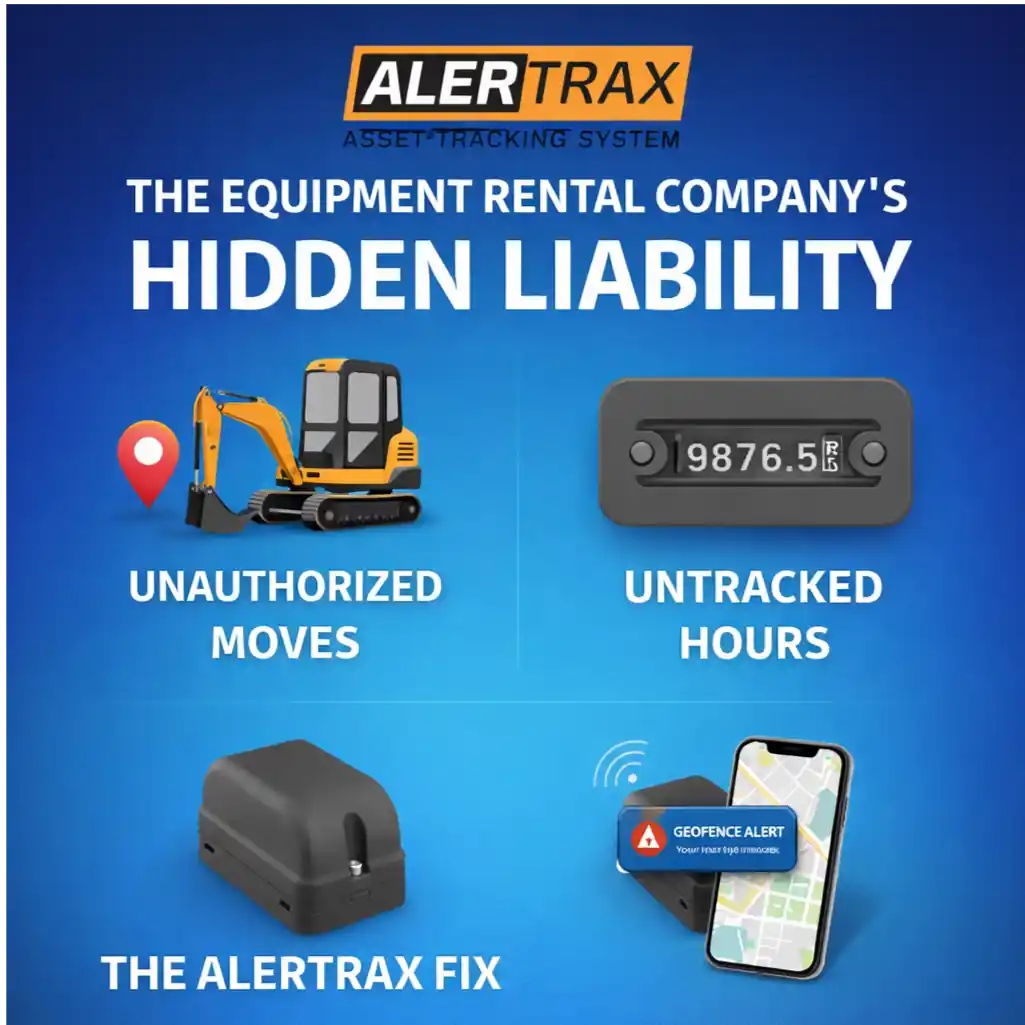
Why Equipment Rental Companies Are Switching to GPS Tracking Before the Season Opens
Equipment Rental Company Liability

Equipment rental is a margin business. The machines in your fleet are only making money when they are out on rent. When they are sitting idle, lost, stolen, or tied up in a dispute, they are costing you money instead.

Most equipment rental companies manage this with a combination of rental agreements, phone calls, and trust. That system works until it does not. And when it fails, it fails expensively.

GPS tracking changes the equation. It gives rental companies real-time visibility into where every asset is, how it is being used, and whether it is where the customer agreed to keep it. That visibility solves three of the most costly problems in equipment rental simultaneously.

1) Utilization is the metric that drives rental profitability

Time utilization — the percentage of available days a piece of equipment is actually out on rent — is the primary driver of rental profitability. Industry benchmarks suggest healthy rental operations target 65 to 75 percent time utilization across their fleet.

GPS tracking supports utilization in two ways. First, it tells you exactly where underutilized equipment is sitting so you can recover it and get it back into the rental cycle faster. Second, it gives you engine-hour data that supports accurate billing and helps you identify machines that are being used far more — or far less — than the rental agreement anticipated.

Both of those data points translate directly into revenue.

2) Customer accountability reduces damage disputes and unauthorized usage

Damage disputes are one of the most time-consuming and margin-eroding problems in equipment rental. A customer returns a machine with damage. They claim it happened at the original job site. You have no way to prove otherwise. The dispute drags on, the machine sits out of service, and someone absorbs the cost.

GPS location history changes that dynamic entirely. You can see exactly where the machine was, when it moved, and whether it was at an authorized location when the damage occurred. That data resolves disputes quickly and fairly — and it deters customers from attempting to misrepresent what happened in the first place.

The same principle applies to unauthorized usage. Engine-hour data tells you how many hours the machine actually ran. If a customer returns a machine with 40 more hours than the rental period should have produced, you have the documentation to bill for it.

3) Theft recovery depends entirely on how fast you know the machine moved

Equipment rental theft costs the industry over $1 billion annually, according to the American Rental Association. Fewer than 25 percent of stolen rental equipment is ever recovered.

The difference between the 25 percent that is recovered and the 75 percent that is not almost always comes down to detection speed. A GPS tracker with real-time alerts fires the moment a machine moves outside its authorized location after hours. You call the police with a live location. Recovery happens while the trail is still warm.

Without that alert, you find out the machine is missing when the customer calls — or when the next renter shows up and it is not there. By then, the window has closed.

4) GPS data supports insurance claims and lowers premiums over time

Equipment rental companies with documented GPS tracking history are in a stronger position with their insurers. When a theft occurs, you have location data, movement history, and alert records that support the claim and accelerate the process.

Over time, companies that demonstrate active GPS monitoring and documented recovery efforts are viewed as lower-risk accounts. That translates into premium stability and, in some cases, reductions at renewal.

One recovered machine often offsets an entire year of tracking costs. One prevented theft can offset several years.

5) The operational case is as strong as the security case

GPS tracking is often framed as a theft-prevention tool. For equipment rental companies, the operational benefits are equally compelling.

Knowing where every machine is at any given moment means you can answer customer questions instantly, schedule pickups accurately, and avoid the situation where a machine is theoretically available but nobody can locate it. That operational clarity reduces phone calls, reduces wasted trips, and reduces the friction that erodes customer relationships over time.

What GPS tracking looks like for an equipment rental company

  • Track every rental machine with a GPS device that provides real-time location, engine hours, and movement alerts.
  • Set geofences around the agreed-upon job site for each rental so unauthorized moves trigger an immediate alert.
  • Use location and usage history to resolve damage disputes, billing questions, and unauthorized relocation incidents with documented data.
  • Monitor your entire rental fleet from a single dashboard so you always know what is out, where it is, and when it last moved.

Sources

  • American Rental Association (ARA) annual theft and recovery reporting.
  • National Insurance Crime Bureau (NICB) equipment recovery rate data.
  • Industry benchmarks for equipment rental time utilization and fleet profitability.
  • ARA-affiliated GPS and telematics reporting on theft prevention and operational ROI.

Every machine in your fleet should be earning. GPS tracking makes sure it is.

When you know where every asset is and how it is being used, you can manage your fleet instead of chasing it.

AlerTrax gives equipment rental companies real-time visibility across every machine in the fleet. Choose a $599 one-and-done purchase for long-term protection, or get started for just $99 upfront on a monthly plan.

Know where it is. Know how it is being used. Know the moment it moves.