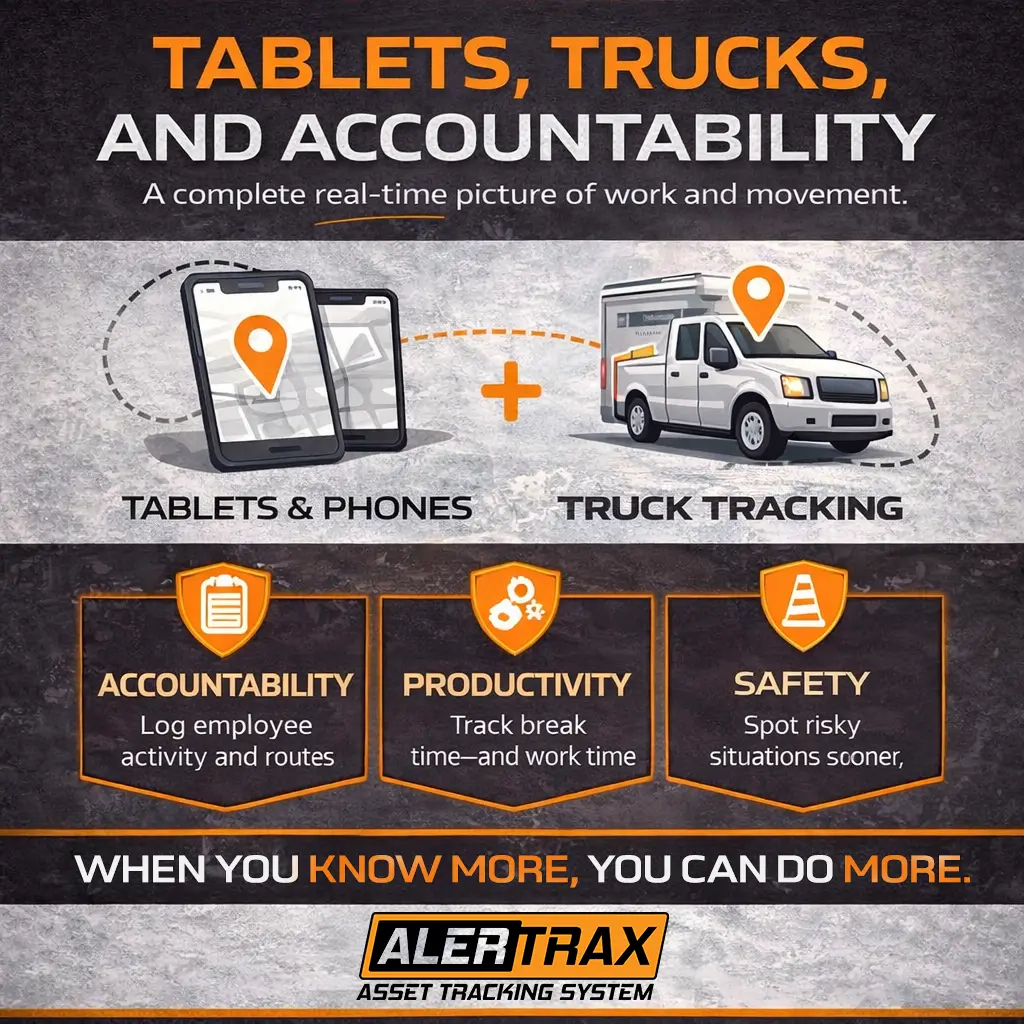
In service businesses, accountability rarely fails all at once. It erodes quietly.
A tablet goes missing. A truck shows up late. A job runs longer than expected, but no one can say exactly why.
For HVAC, plumbing, and electrical contractors, these small gaps add up to lost time, higher costs, and unnecessary tension.
Accountability does not come from more check-ins. It comes from visibility.
That is where combining tablet tracking, phone tracking, and vehicle tracking changes how the entire operation runs.
The Most Common Triggers for Adoption
Industry surveys across construction, service, logistics, and rental businesses show consistent adoption triggers.
The top three are:
- A theft or near-miss theft event
- Payroll disputes or unexplained labor overages
- Growth that outpaces manual systems
In most cases, businesses tolerate inefficiency longer than they tolerate loss. A single visible event often outweighs months of quiet leakage.
This explains why tracking adoption spikes immediately after incidents, not before them.
What Businesses Experience Before They Adopt Tracking
Before tracking is implemented, businesses often report the same symptoms.
- Crews waiting on equipment that should be available
- Owners fielding constant location questions
- Timecards that feel inaccurate but hard to challenge
- Schedules built on assumptions instead of data
Research on operational maturity shows that these symptoms appear when businesses move from informal management to multi-crew coordination.
Nothing feels broken yet. It just feels harder than it used to.
Why Growth Forces the Issue
Data shows that tracking adoption correlates more strongly with asset count than with revenue.
Once a business manages more than five to seven mobile assets or multiple concurrent jobsites, visibility drops sharply. This is the point where memory, trust, and spreadsheets stop scaling.
Studies on small business operations show that error rates increase exponentially as complexity grows linearly. Each additional asset increases the chance of miscommunication, delay, or loss.
Tracking becomes less about security and more about coordination.
What Changes After Tracking Is Implemented
Businesses that adopt tracking consistently report similar outcomes within the first year.
- Reduced time spent locating assets
- Fewer payroll disputes
- More accurate job costing
- Faster response to issues
Productivity studies show measurable improvements in job completion accuracy and scheduling reliability after tracking is introduced. These gains are not driven by working harder. They come from removing uncertainty.
When information is available, decisions improve.
Why Businesses Regret Waiting
Post-adoption surveys reveal a common reflection.
We should have done this sooner.
Businesses that waited until after a major loss report higher implementation stress, higher initial costs, and more urgency. Those that adopted proactively report smoother rollouts and faster returns.
The difference is mindset. Reactive adoption feels like damage control. Proactive adoption feels like system improvement.
The data shows that earlier adoption leads to higher satisfaction.
The Role of Tracking in Customer Experience
Tracking does not just affect internal operations.
Businesses that can confidently answer where equipment is or when a crew will arrive provide better customer communication. Studies link accurate ETAs and proactive updates to higher customer satisfaction and retention.
Customers do not care how tracking works. They care that commitments are met.
Visibility enables consistency.
Why Some Businesses Still Resist
Despite the data, some businesses delay tracking.
Common concerns include cost, complexity, and employee perception. Research shows that these concerns diminish after implementation.
Once tracking becomes part of daily operations, it fades into the background. It becomes infrastructure, not oversight.
The businesses that resist longest often underestimate how much time they already spend managing uncertainty.
Tracking as a Sign of Operational Maturity
Tracking adoption follows a pattern similar to accounting software or CRM adoption.
Early on, informal systems work. As complexity increases, structured systems become necessary.
Tracking is not a sign that a business has a problem. It is a sign that a business has grown.
The data shows that businesses that adopt tracking earlier scale with less stress, fewer losses, and more predictable operations.
The Question Data Helps Answer
The real question is not whether tracking is worth it.
The question is how much uncertainty a business is willing to tolerate.
Tracking replaces guessing with knowing. For small businesses, that shift often marks the transition from reactive management to controlled growth.
The data is clear. Most businesses adopt tracking after the pain. The smarter ones adopt it before the lesson.