It is the first week of September. The mowers are still running six days a week, and somewhere on your desk there is a folder of winter bid packets that have to go back to property managers before October.
So you open last year's spreadsheet. Twenty-two sites. A per-push rate that you set in 2025 and nudged up five percent. A salting rate you have not touched in three years. You look at it for a while, add a little for fuel and wages, and send it.
Here is the question worth asking before you hit send. Of those twenty-two sites, which ones actually made money last winter? Not which ones billed the most. Which ones made money after you count the truck hours, the sidewalk crew, the salt, and the two subcontractors you called in during the February event.
Most snow contractors cannot answer that with any confidence, and it is not a failure of discipline. It is that winter work generates almost no data on its own. A summer route repeats every week and you develop a feel for it. A winter event happens eleven times a season at three in the morning across twenty-two properties simultaneously, and by April the only record is a stack of service tickets and whatever your foremen remember.
You are about to price an entire season on that.
You Are Pricing Before the Forecast Even Arrives
There is an awkward structural fact about the winter bid cycle. Contracts get priced in September and October. NOAA's flagship U.S. Winter Outlook, the December through February temperature and precipitation product, is issued once a year in October. Many contractors have their numbers committed before it lands.
What NOAA has published so far this year is worth knowing while you set rates. On June 11, 2026, NOAA announced that El Niño had developed in the tropical Pacific and issued an El Niño Advisory, with forecasters predicting intensification to moderate or strong levels through the fall (NOAA, June 11, 2026). The Climate Prediction Center's subsequent ENSO Diagnostic Discussion raised that considerably, stating that El Niño is strengthening with a greater than 90 percent chance of a very strong event during Northern Hemisphere fall and winter 2026 and 2027 (NOAA Climate Prediction Center, ENSO Diagnostic Discussion, August 2026).
CPC's long lead discussion describes El Niño teleconnections ramping up through fall 2026 and winter 2026 and 2027, with below normal precipitation favored over the Northwest and north central states, and above normal precipitation over the southern tier with the highest probabilities over parts of the Southeast.
Note what that does and does not tell you. It is a precipitation and temperature signal, not a snowfall forecast, and CPC has left several regions at equal chances because the models disagree. A strong El Niño does not reliably mean more snow or less snow in any given market. What it does tend to mean is a different mix: more marginal temperature events, more freeze and thaw cycles, more ice and mixed precipitation rather than clean plowable accumulations.
For your P&L, that mix matters more than the total. A season with eight plowable events and twenty ice events is a completely different business than a season with sixteen plowable events. It shifts your revenue from per push toward salting and ice management, it multiplies the number of site visits, and it multiplies the number of invoices a property manager might question. If you priced the season as though it were a plowing season, you will find out in January.
In Snow Work, Proof of Service Is the Product
Summer maintenance is billed on a schedule. If you show up Tuesday and mow, the invoice goes out and nobody argues. Winter work is billed by event, by push, by application, or by the hour, which means every single line item on your invoice is a claim about something that happened at 4 AM that the customer did not witness.
That is a structurally different relationship. You are not selling snow removal. You are selling a documented assertion that snow removal occurred, at a stated time, for a stated duration, and the customer is being asked to pay on the strength of that assertion.
Which is why the disputes in winter work are so much sharper than in summer work. A property manager looking at a $14,000 January invoice across twelve properties is not being difficult when she asks for backup. She has her own owner to answer to. And "our guys were there around two" is not backup. Arrival and departure timestamps for each property, generated automatically, are.
There is a revenue side to this that gets overlooked. Contractors who cannot document service tend to undercount it. When a foreman forgets to log the second salting pass at a site because the event ran fourteen hours and he was exhausted, that pass never gets billed. Automatic time on site data does not just defend the invoice. It builds the invoice.
Your Service Records Are Also Your Legal Defense
The other reason winter documentation matters is that slip and fall claims name everyone.
The scale of winter fall injuries is documented by the federal government. The U.S. Bureau of Labor Statistics reported that ice, sleet, and snow related occupational injuries and illnesses resulting in at least one day away from work occurred at a rate of 1.8 cases per 10,000 full time workers in 2017, down from 2.1 in 2016, with the rate ranging from a low of 1.4 in 2012 to a high of 3.9 in 2014 across the preceding decade. In 2017, 18 of the states for which data were available had incidence rates at or above the national rate (U.S. Bureau of Labor Statistics, The Economics Daily, March 4, 2019). Those are occupational injuries only. They do not include the customers, tenants, and members of the public who fall on the properties you service, which is where your liability exposure actually sits.
When one of those falls becomes a claim, the plaintiff typically brings in the property owner, the property manager, and the snow contractor together, and the question becomes which party can document what they did. The industry has a written answer to that question. The Accredited Snow Contractors Association is an ANSI accredited Standards Development Organization, and its standard, ANSI/ASCA A1000-2014, System Requirements for Snow and Ice Management Services, covers training, preseason site inspection reports, in-event documentation, post-event processes and procedures, and weather service reporting. ASCA states that companies adhering to its standards and certification see an average 15 percent discount in insurance rates and a significant rate of dismissal for slip and fall claims (Accredited Snow Contractors Association). That insurance and dismissal figure is the association's own reporting on its members rather than an independent study, and is worth treating as such.
The point that survives regardless of how you weigh that number is simple. The standard that the industry wrote for itself is built around documentation, and in-event documentation is the piece that is hardest to produce by hand at 3 AM in a whiteout. It is also the piece a GPS device produces automatically without anyone remembering to do anything.
This is general information about industry practice and is not legal advice. Talk to your own attorney and your insurance carrier about your contracts and your documentation obligations.
Winter Runs on the Assets Nobody Tracks
Look at what actually moves during a snow event.
Plow trucks, yes, and those are usually the ones with tracking. But also the salt spreaders, the skid steers with box pushers, the loaders staged at the big lots, the sidewalk crews running walk behinds and backpack spreaders, the equipment trailers hauling machines between sites, and in most operations, a handful of subcontractor trucks you called at 11 PM because the event was bigger than forecast.
Most of that list has no vehicle power to plug into, and a meaningful share of it does not belong to you at all. Which means the assets doing the work you are being paid for and sued over are largely the assets generating no record.
The subcontractor piece deserves particular attention, because it is where winter margin quietly disappears. When you bill a property manager for a subcontractor's four hours and the sub invoices you for six, you have no basis to challenge it. When the sub says he hit three of your sites and you can only confirm one, you pay for three. Snow operations lean harder on subcontracted capacity than any other season, and they do it with less verification than any other season.
Putting a tracker on the equipment rather than only the truck closes that. So does handing a sub a device for the duration of the event, which is a conversation most reputable subs will accept without complaint, because it protects their invoice as much as it protects yours.
What One Season of Data Changes at Bid Time
Here is the practical payoff, and here is the arithmetic. The inputs below are illustrative placeholders chosen to show the method, not survey findings. Use your own site count and rates.
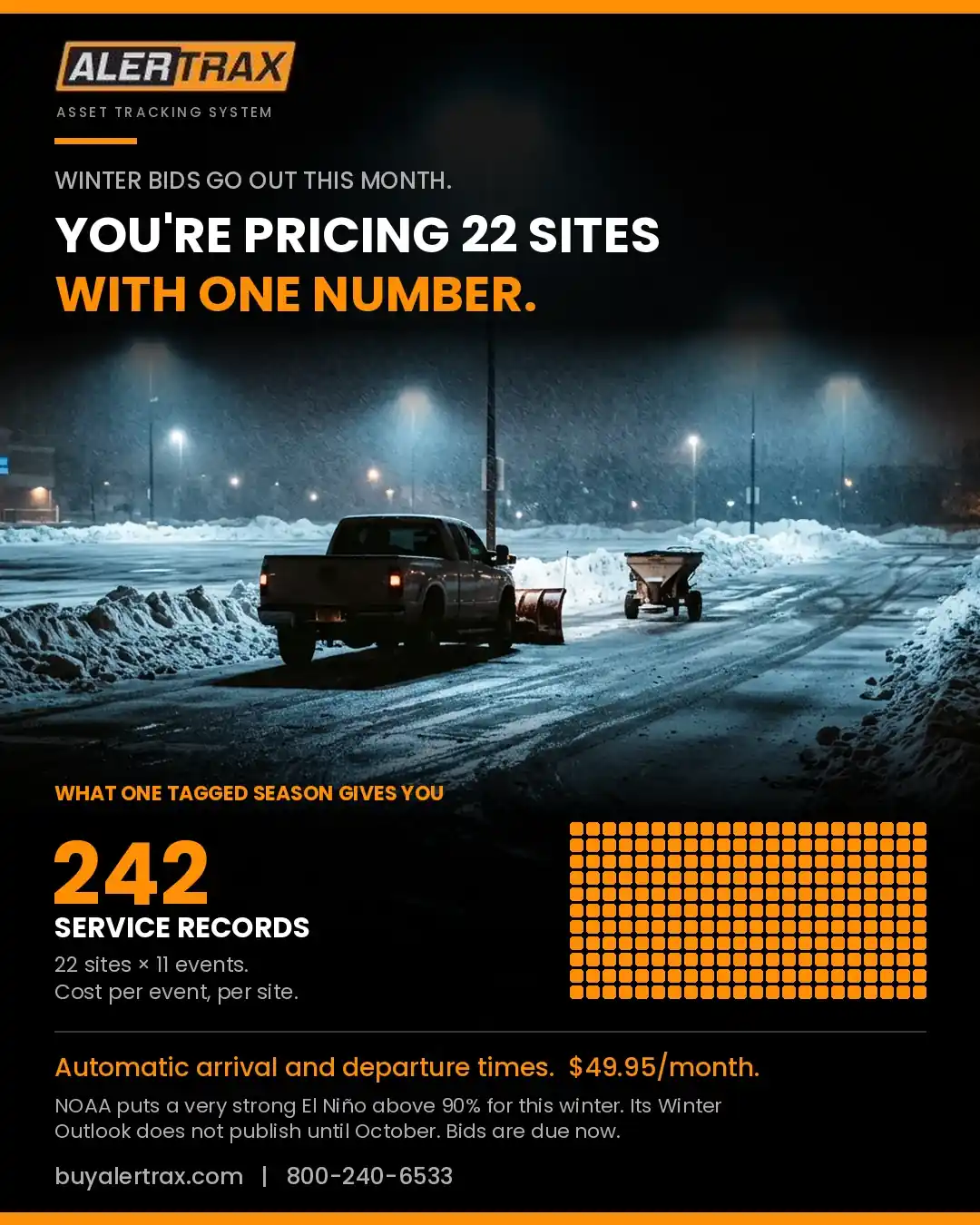
Say you run 22 commercial sites through a season with 11 billable events. Without location data, you know your total winter revenue and your total winter cost, and you can compute one blended margin for the whole operation. That single number is all you have to price next year with, so you raise everything by five percent and hope the mix works out.
With arrival and departure timestamps on every asset at every site, you have 242 individual service records. Now you can compute cost per event per site. And what contractors consistently find when they run that calculation for the first time is that the distribution is far wider than they assumed. The corporate campus that looks like the anchor account turns out to consume 3.5 hours per event against a rate priced for 2. The three small retail strips that felt like filler turn out to be the most profitable sites on the list because they are clustered and take 40 minutes each.
That changes your bid from a blanket five percent to a specific decision on specific properties. Reprice the campus or walk from it. Bid aggressively on more small clustered sites because you now know they carry the season. Neither move is available to you on a blended number.
A season of data does not make winter predictable. It makes your pricing defensible, which is the part you actually control.
What AlerTrax Does in a Snow Operation
AlerTrax was built for equipment that has no power to give, which describes most of what moves during a winter event.
- Automatic time on site logging: Arrival and departure timestamps recorded at every property, for every asset, with no crew input at 3 AM. This is your invoice backup, your in-event documentation, and your cost per event data in one feed.
- AddressFence: Upload your winter site list once and receive arrival and departure alerts for every property on it, without drawing boundaries by hand for twenty-two sites.
- No wiring, no vehicle power: Two AA batteries. Mount it on a spreader, a box pusher, a sidewalk machine, an equipment trailer, or a subcontractor's truck for the duration of an event.
- IP67 waterproof and salt water protected: Relevant in a season where everything you own gets sprayed with brine for four months.
- Magnet, screw, or zip tie mounting: An 8 lb magnet holds through plowing vibration. Screw mounts for anything you want permanent.
- Live fleet map: Every truck, machine, and sub on a single view in the AlerTrax fleet portal or the mobile app, with updates as often as every 2 minutes when an asset is moving. During a 14 hour event, that is the difference between dispatching and guessing.
- Exportable trip reports: Pull a date range after an event and hand the property manager a document instead of an assurance.
- TeamTrax: A free companion app that puts crew phones on the same map as the equipment, which matters most for sidewalk crews who are on foot and not attached to any machine.
One honest note on cold weather. Alkaline AA batteries lose meaningful capacity in sustained sub-freezing temperatures. That is chemistry, not a product defect, and it applies to every battery powered device you own. AlerTrax also runs on single-use lithium AA cells, which hold up far better in cold. If you are deploying for a Northeast winter, use lithium. It is a few dollars more per device and it is the difference between a tracker that reports through a February cold snap and one that does not.
Pricing
AlerTrax is $49.95 per month per device, with no long term contract and no hidden fees. (A $599 Lifetime option is available if you would rather own the tracking outright with no subscription.)
For a snow operation, the honest way to think about the cost is against a single disputed invoice. If documented arrival and departure times settle one $2,000 billing argument over the course of a season, the devices covered themselves several times over before you count anything else.
And Yes, Winter Is When Equipment Walks
Worth a brief mention. Winter equipment sits staged at properties for months, often overnight, often unattended, and often nowhere near your yard. A box pusher parked at the back of a retail lot from November to March is an asset with no eyes on it for four months.
Geofence and after hours movement alerts cover that. Draw a boundary around each staging location and get notified if something crosses it when nothing should be moving. Tamper notification tells you if the device is pulled off the machine. Neither prevents a theft, but both compress the gap between the theft and your phone call, and that gap is what determines whether the equipment comes back.
Bid This Season, Then Measure It
You are going to send those bids in the next few weeks with the information you have, which is fine. Everyone does. But you have a choice about whether you are in the same position next September.
Tag the trucks and the equipment before the first event. Let the season generate its own record. Next September, open a report instead of a memory, and price twenty-two sites individually instead of raising everything five percent.
Visit www.buyalertrax.com to get set up before the season starts, or call 800-240-6533 and we will talk through what to tag for a snow operation. You can also reach us at sales@buyalertrax.com.
Paul
NautAlert, LLC
Sources
NOAA, news release, June 11, 2026. El Niño developed in the tropical Pacific; El Niño Advisory issued; forecasters predicted intensification to moderate or strong levels through fall 2026.
NOAA Climate Prediction Center, ENSO Diagnostic Discussion, August 2026. El Niño strengthening, with a greater than 90 percent chance of a very strong event during Northern Hemisphere fall and winter 2026 and 2027. CPC long lead discussion describes below normal precipitation favored over the Northwest and north central states and above normal precipitation over the southern tier, highest probabilities over parts of the Southeast, with several regions left at equal chances.
NOAA Climate Prediction Center, U.S. Winter Outlook publication schedule. The flagship December through February temperature and precipitation outlook is issued annually in October.
U.S. Bureau of Labor Statistics, The Economics Daily, "Ice, sleet, and snow-related occupational injury and illness rate down in 2017," published March 4, 2019. Rate of 1.8 cases per 10,000 full time workers in 2017, down from 2.1 in 2016; decade range of 1.4 (2012) to 3.9 (2014); 18 states at or above the national rate in 2017.
Accredited Snow Contractors Association. ASCA is an ANSI accredited Standards Development Organization. ANSI/ASCA A1000-2014, System Requirements for Snow and Ice Management Services, covers training, preseason site inspection reports, in-event documentation, post-event processes and procedures, and weather service reporting. ASCA reports that companies adhering to its standards and certification see an average 15 percent discount in insurance rates and a significant rate of dismissal for slip and fall claims. This figure is the association's own reporting on its member companies and is not an independent study.
Note on illustrative arithmetic: The bid analysis in "What One Season of Data Changes at Bid Time" uses placeholder inputs (22 sites, 11 billable events, sample per-site durations) chosen to demonstrate how cost per event per site is calculated. These are illustrative examples, not survey data, and are not drawn from any published study of snow contractor site economics.
Disclaimer: This article provides general information about industry practice and documentation. It is not legal advice. Consult your own attorney and insurance carrier regarding your contracts, liability exposure, and record keeping obligations.