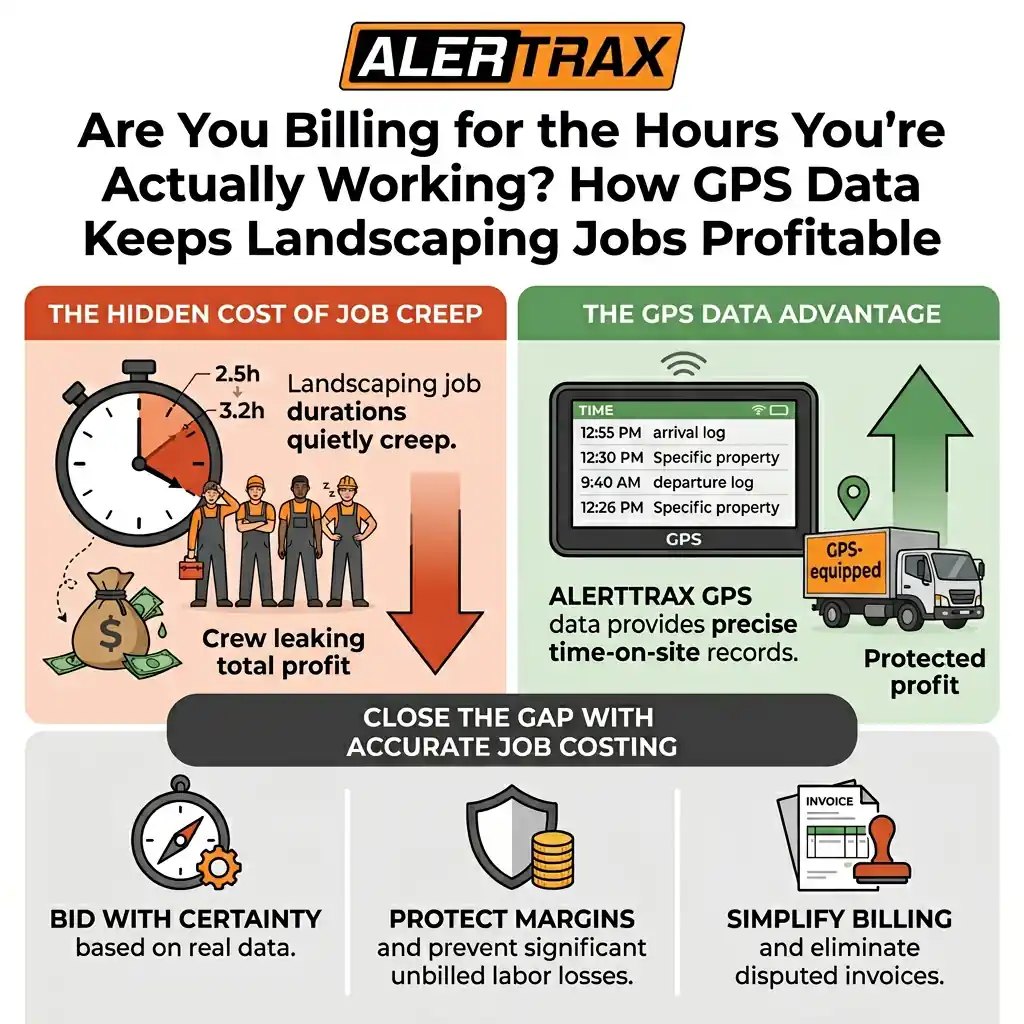
You bid a residential property at two and a half hours for a three-person crew. You priced it based on the walkthrough, your experience, and what felt right. The client signed. The crew shows up every Thursday. Invoice goes out at the end of the month.
But here's the question nobody is asking: does that job actually take two and a half hours? Or has it quietly crept to three hours and fifteen minutes — every single week — without anyone noticing?
In an industry where 1 in 5 landscaping jobs is unprofitable (Duranta, 2025) and average profit margins sit around 6.2% (Wifitalents, 2023), the difference between what you estimated and what actually happened on the job site is often the difference between making money and quietly losing it.
GPS tracking closes that gap. Not by watching your crews — but by giving you the job costing data you need to bill accurately, price confidently, and protect every dollar of margin your company earns.
The Pricing Problem Hiding in Plain Sight
Every landscaping company prices jobs before they happen. You estimate labor hours, factor in materials, add overhead, and apply your margin. It's the foundation of the entire business model.
But how often do you go back and check whether your estimate was right?
For most landscaping companies, the honest answer is: rarely. And that's where the problem starts. Labor is the single largest expense in the landscaping business, consuming 30% to 50% of total revenue (Aspire, 2025). When you factor in the full labor burden — payroll taxes, workers' comp, insurance, benefits — a $20-per-hour employee actually costs $24 to $27 per hour before they touch a single mower (Service Autopilot, 2026).
That means every extra thirty minutes a crew spends on a job beyond the estimate isn't costing you $10. It's costing you $36 to $40 in fully loaded labor for a three-person crew. And if that overage happens every week on a recurring maintenance contract, you're bleeding $1,900 to $2,100 per year on a single property — money that comes straight off your bottom line.
Many landscaping companies undercharge because they've never fully accounted for the true cost of delivering their services (Grow Group, 2025). The estimate looked profitable on paper. The reality on the ground told a different story. But without time-on-site data, nobody knew.
What GPS Data Actually Shows You
A GPS tracker on a landscaping truck does something deceptively simple: it logs when the vehicle arrives at an address and when it leaves. That's it. But from those two data points, an enormous amount of business intelligence flows.
Over the course of a few weeks, you start seeing patterns for every property on your route. You can pull up the Ridgewood HOA and see that your crew has averaged three hours and twelve minutes per visit over the last month — not the two and a half hours you estimated. You can look at the commercial lot on Route 9 and discover it's consistently done in an hour forty-five, even though you bid it at two and a half.
This is the kind of data that changes how you run your business. According to fleet tracking industry data, GPS-equipped operations report the ability to eliminate 2 to 5 disputed invoices per month using timestamped arrival and departure records (Spytec GPS, 2026). At an average service ticket of $150 to $300, even preventing two billing disputes per month saves $300 to $600 monthly for the operation.
But the real value isn't in settling disputes. It's in knowing — with certainty — whether your pricing model is actually working.
The Job Costing Gap That's Eating Your Margins
Job costing is the process of tracking all expenses associated with a specific project and comparing them to the revenue it generated. In theory, every landscaping company does this. In practice, most don't — at least not with the precision that matters.
The biggest gap is almost always labor hours. Most landscaping companies track direct costs reasonably well, but overhead allocation — which typically represents 20% to 30% of total costs — often gets missed or underestimated (Grow Group, 2025). And without accurate time-on-site data, even the direct labor component is based on what the crew says happened, not what actually happened.
Consider what this looks like across a full book of business. If you're running 60 recurring maintenance accounts and your estimates are off by an average of just 25 minutes per visit, that's 25 hours of unbilled labor per week. At a fully loaded crew cost of $75 to $80 per hour for a three-person team, that's roughly $2,000 per week in labor you're delivering but not billing for. Over a 30-week season, that gap adds up to $60,000 in lost margin.
No landscaping company would write a check for $60,000 and throw it away. But without time-on-site data, that's effectively what's happening — just slowly enough that nobody notices.
Settling the "Did You Show Up?" Dispute — Permanently
Every landscaping company owner has gotten the call: a property manager or homeowner claims the crew didn't show up last week. Maybe they did, maybe they didn't. Without data, it's one person's word against another.
One fleet manager at a maintenance company put it simply: telematics data guarantees whether or not a crew visited a site, and if it shows they didn't, you can ask the crew member why — because the proof is there either way (Quartix / M&Y Maintenance).
GPS timestamps turn every "did you show up" conversation from a relationship-straining argument into a five-second data lookup. The truck arrived at 8:47 AM and departed at 11:03 AM. Case closed. This protects your revenue, protects your client relationships, and protects your crews from false accusations.
For landscaping companies managing dozens or hundreds of residential and commercial accounts, this alone can save thousands of dollars per year in credited invoices and hours of administrative time spent investigating complaints. Service fleet operators report that GPS-based proof of service eliminates up to 95% of service verification disputes (FleetRabbit, 2026).
Repricing with Confidence
Once you have a few months of GPS time-on-site data, something powerful happens: you can reprice your entire book of business based on what jobs actually cost — not what you guessed they would cost.
Properties that are consistently running over estimate get repriced to reflect reality. Maybe it's a conversation with the client about scope. Maybe it's a rate adjustment. Maybe it's a decision to let that account go because it was never profitable to begin with. But now you're making that decision with data, not gut feeling.
Properties that are running under estimate present the opposite opportunity. If a crew is consistently finishing a job forty minutes early, that's capacity you can redeploy. Tighten the route, add a property, and generate incremental revenue without adding a single labor hour. Industry benchmarks show that well-run landscaping operations target 10% to 14% net profit margins (Fieldcamp, 2025) compared to the industry average of 6.2%. The difference between the two almost always comes down to tighter operational data and better pricing discipline.
GPS tracking doesn't make you more expensive. It makes you more accurate. And accuracy is what separates landscaping companies that are busy from landscaping companies that are profitable.
Drive Time: The Hidden Margin Killer
Time on site is only half the equation. The other half is what happens between job sites.
Drive time is a labor cost that most landscaping companies absorb without ever measuring it. Your crew is on the clock from the moment they leave the shop until the moment they return, but you're only billing for time on property. Every minute spent driving between jobs is a minute of labor you're paying for but not recovering.
GPS route history makes drive time visible for the first time. You can see exactly how long crews spend traveling between stops, which routes they're taking, and where the schedule has them zigzagging across town instead of working in a tight geographic cluster. Industry data shows fleets typically reduce fuel costs by 15% to 25% after implementing GPS tracking (Spytec GPS, 2026), and much of that saving comes from eliminating unnecessary mileage through smarter route sequencing.
But the labor savings dwarf the fuel savings. If route optimization shaves thirty minutes of drive time per crew per day, and you're running five crews, that's 12.5 hours of recovered labor per week. At a loaded cost of $25 per hour per crew member, that's over $16,000 per season in labor that was previously lost to windshield time. Reinvest that time into additional job site hours and it becomes billable revenue instead of dead cost.
The Compounding Effect of Better Data
The landscaping companies that pull ahead aren't doing one thing differently. They're doing many small things better, and the advantages compound over time.
GPS time-on-site data feeds into more accurate estimates, which leads to better pricing, which protects margins. Route data reduces drive time, which frees up labor hours, which generates additional revenue capacity. Proof-of-service records eliminate billing disputes, which protects cash flow, which keeps the business healthy during the seasonal swings that define the green industry.
Seventy percent of fleets using GPS tracking report significant operational benefits, and 41% achieve positive ROI in under 12 months (Heavy Duty Journal, 2026). For landscaping companies specifically, fleet tracking systems typically deliver 200% to 400% annual ROI through combined savings across labor, fuel, maintenance, and billing accuracy (Traxelio / Spytec GPS).
In an industry with nearly 700,000 businesses competing for work (NALP, 2025), the companies with the best data win. Not because they work harder, but because they know exactly where their money is going — and where it's leaking.
And Yes — It Protects Your Equipment Too
While GPS tracking is paying for itself through better billing and tighter operations, it's also standing guard over your assets around the clock. The landscaping industry loses an estimated $400 million annually to equipment theft, and 40% of stolen equipment is never recovered (AMAROK). A single stolen truck can cost up to $4,000 per day in lost revenue while it's out of service.
The same GPS device that logs your crew's arrival time at 8:47 AM sends you an instant alert if that truck moves at 2:00 AM. Geofence alerts, after-hours movement notifications, and live location data dramatically improve your chances of recovering stolen assets — and the deterrent effect alone is significant.
But the daily financial impact of better job costing, accurate billing, and optimized routes is where GPS tracking delivers its most consistent, compounding return. Theft prevention is the safety net. Profitability data is the engine.
How Alertrax Makes It Simple
This is exactly why we built Alertrax.
Alertrax gives landscaping companies the time-on-site data, route history, and live fleet visibility they need to run a tighter, more profitable operation — without complicated software or fragile hardware.
- Automatic Time-on-Site Logging: Alertrax records when each vehicle arrives at and departs from every address. No manual entry, no crew check-ins, no paperwork. Just accurate, timestamped data you can use for job costing, billing verification, and estimate calibration.
- Ruggedized for the Job Site: Alertrax features a 100% waterproof, ruggedized housing built to survive the daily punishment of landscaping work — rain, mud, dust, vibration, and high-pressure washdowns.
- One-Year Battery Life, No Wiring: A massive self-contained battery lasts a full year on a single charge. Mount it on a truck, trailer, mower, or skid steer — no electrical connections required.
- Geofence and After-Hours Alerts: Draw a boundary around your shop, your yard, or any location. If equipment moves outside that boundary during off-hours, you get an instant alert on your phone.
- Fleet Map — All Crews, One Screen: Open the Alertrax app and see every asset on a single map. Know which crews are on site, which are between jobs, and which are running behind — all without making a call.
Pricing That Pays for Itself
Alertrax makes professional GPS tracking accessible to landscaping companies of every size — from three-truck operations to large multi-crew fleets.
You can equip your fleet today for a low monthly rate with no long-term contracts and no hidden fees.
(Prefer to skip the subscription? We also offer a one-and-done $599 Lifetime option for permanent, subscription-free tracking).
Consider the math: if GPS data helps you identify just one property that's been running forty minutes over estimate every week, correcting that single pricing error recovers $1,900 to $2,100 per year. One correction on one property more than pays for tracking your entire fleet. Everything else — the fuel savings, the route efficiency, the dispute elimination, the theft protection — is pure upside.
The Bottom Line
You can't bill accurately for work you can't measure. And you can't protect margins you can't see.
GPS tracking gives landscaping companies the one thing that separates profitable operations from busy ones: certainty. Certainty about how long jobs take. Certainty about which properties are making money and which ones aren't. Certainty that when a client questions an invoice, you have the data to back it up.
Stop estimating. Start knowing.
Visit www.buyalertrax.com today to equip your landscaping fleet with the GPS tracking system that turns time-on-site data into real dollars on your bottom line.
Sources: Duranta (2025), Aspire 2025 Landscaping Industry Report, Service Autopilot (2026), Grow Group (2025), Spytec GPS (2026), Quartix / M&Y Maintenance, FleetRabbit (2026), Fieldcamp (2025), Heavy Duty Journal (2026), Traxelio, NALP (2025), AMAROK, Wifitalents (2023).