It is 6:15 on a Monday morning. You pull up to your jobsite with a coffee in one hand and a punch list in the other. You are three weeks into a grading job, and your crew is supposed to start moving dirt at seven sharp.
But your skid steer is gone. The trailer it was sitting on is gone, too. The only thing left is a set of tire tracks through the mud where somebody backed in, hitched up, and drove away with $65,000 worth of your equipment sometime over the weekend.
You file a police report. You call your insurance company. You start calling rental yards to find a replacement so your crew isn't standing around burning payroll. And somewhere in the back of your mind, you already know the truth: you are probably never seeing that skid steer again.
If you run a construction company with equipment spread across multiple jobsites, this is not a hypothetical. It is a statistical inevitability. And the cost goes far beyond the sticker price of the machine.
The Numbers Nobody Talks About
Construction equipment theft is not a fringe issue. It is a billion-dollar crisis that has been growing steadily for years, and the data is staggering.
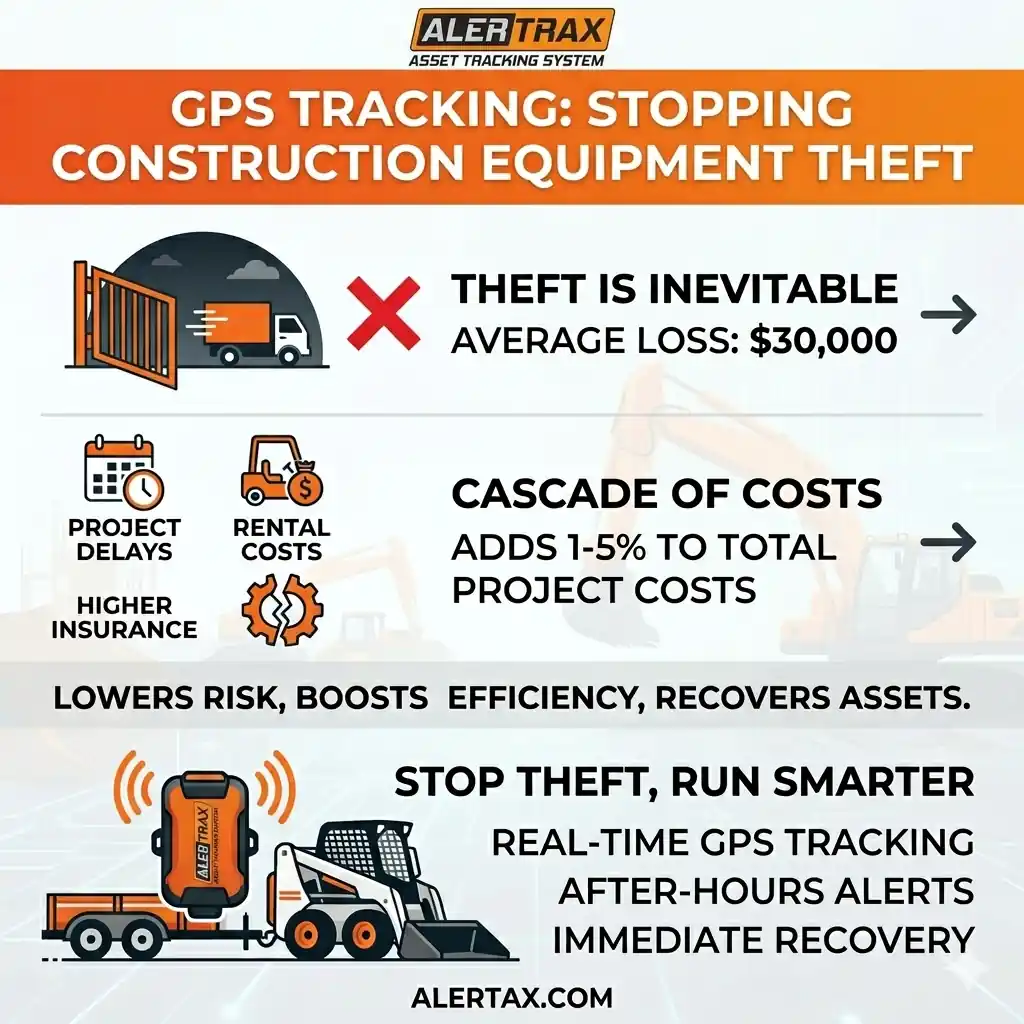
According to the National Equipment Register (NER) and the National Insurance Crime Bureau (NICB), construction equipment theft costs the U.S. industry somewhere between $300 million and $1 billion every single year. The NER pegs the average cost of a single equipment theft incident at approximately $30,000 (Construction Equipment Guide, 2025). And that figure only covers the replacement value of the machine itself. It does not include the project delays, the emergency rental costs, the idle labor, or the insurance premium increases that follow.
The volume is relentless. The NICB reports more than 11,000 equipment theft incidents per year, roughly 1,000 per month, or more than 30 per day across the country (CONEXPO-CON/AGG, 2023). And these are only the reported incidents. The actual number is almost certainly higher, because many small contractors absorb the loss without filing a claim, especially when the stolen item falls under their insurance deductible.
Perhaps the most devastating number is the recovery rate. Only 20 to 21 percent of stolen construction equipment is ever recovered (NER / NICB). For single-item thefts, a generator off a flatbed, a plate compactor from an unlocked trailer, the recovery rate drops below 7 percent (NICB). Unlike cars, which have standardized VINs and are registered in national databases, construction equipment relies on serial number and PIN systems that are not uniformly recorded. Once a machine crosses a state line or gets a new coat of paint and a fake serial plate, it effectively disappears.
What They Actually Target
If you assume thieves are going after the biggest, most expensive equipment on your site, think again. They want speed and anonymity, not spectacle.
According to the LoJack Construction Equipment Theft Recovery Report, wheeled and tracked loaders are the most commonly stolen type of construction equipment, followed closely by towable equipment, light towers, generators, welders, and compressors that can be loaded onto a trailer or towed off a site in minutes. Skid steers, excavators, and utility vehicles round out the top five.
Notice a pattern? Every one of those categories is something that can be moved quickly, is often left at a jobsite overnight without supervision, and can be resold or rented out with relatively little scrutiny. Half of all stolen construction equipment consists of models five years old or newer, because newer machines command higher resale prices on the black market.
The NER and NICB consistently identify California, Texas, and Florida as the top three states for construction equipment theft, all states with massive construction activity and high concentrations of equipment in the field. But theft happens in every state and in every season. It spikes during long weekends and holidays, Memorial Day, Labor Day, and Thanksgiving, when jobsites sit empty and unsupervised for days at a time (NER trend data).
It Is Not Just Theft. It Is the Three Weeks After
The replacement cost of a stolen machine is just the beginning. For most small to mid-size contractors, the real damage comes from the cascade of problems that follow.
Project delays. A missing excavator or skid steer does not just slow down one task. It halts entire phases of work. Crews stand idle. Subcontractors who were scheduled to follow your grading work have nothing to start on. If you are working against a deadline with liquidated damages in the contract, every lost day has a dollar figure attached to it. According to research from the Associated Schools of Construction and industry data compiled by CONEXPO-CON/AGG, theft adds an estimated 1 to 5 percent to overall project costs when you factor in the full downstream impact.
Emergency rental premiums. You cannot wait three weeks for an insurance check to clear. You need a replacement machine tomorrow morning. That means paying rush delivery and premium daily rates at the rental yard, costs that rarely get fully reimbursed by insurance. The American Rental Association (ARA) reports that the equipment rental industry itself loses over $100 million per year to theft, with more than 360 pieces of rental equipment vanishing every month (ARA, 2025). When you are the one scrambling to rent a replacement, you are competing for the same tight inventory that rental companies are already struggling to protect.
Insurance consequences. File a claim, and your premiums go up. File two claims in a year, and your carrier may non-renew your policy entirely. Many contractors absorb smaller losses out of pocket specifically to avoid triggering premium increases, which means the true financial impact of theft across the industry is significantly underreported.
The hidden line items. Industry researchers consistently find that the indirect costs of equipment theft, idle labor, missed milestones, expedited rentals, and increased insurance, typically exceed the sticker price of the stolen asset itself (Construction Equipment Guide, 2025; CONEXPO-CON/AGG, 2023; Associated Schools of Construction, 2019). A $30,000 skid steer theft can easily become a $50,000 to $75,000 problem by the time the dust settles.
The Inside Job Problem
Here is a statistic that nobody in the construction industry likes to talk about: according to a survey published by the Associated Schools of Construction, 25 to 40 percent of employees steal from their employers, and roughly 30 percent of business failures are attributed to employee theft.
In construction, this does not always look like someone driving a loader off the site in the middle of the night. More often, it is small tools disappearing from gang boxes, fuel being siphoned from equipment tanks, or materials walking off the site one load at a time. But it also includes employees or subcontractors sharing information about jobsite layouts, security gaps, and equipment locations with outside parties.
The NICB has noted a rise in organized theft operations that use insider knowledge, drone reconnaissance, and falsified documentation to target construction sites. This is not petty crime. It is sophisticated, organized, and deliberate.
The only way to combat this is with a system that operates independently of your crew's knowledge. A tracking device that nobody knows is there, that requires no wiring to the machine's electrical system, and that alerts you the moment equipment moves outside of an authorized area, whether that movement happens at 2:00 PM or 2:00 AM.
Where Is Your Equipment Right Now?
Here is a question that trips up most contractors who run equipment across multiple sites: if someone asked you right now to account for every piece of equipment your company owns and tell them exactly which jobsite each one is sitting on, could you do it?
For most small to mid-size operations, the honest answer is no. Equipment gets shuffled between sites based on daily needs. A mini excavator gets moved to a different job on Friday afternoon and nobody updates the whiteboard. A trailer with a generator on it gets borrowed by a subcontractor and does not come back for a week. The foreman at one site assumes a missing compressor is at the other site, and vice versa.
This is not just a theft prevention problem. It is an operational efficiency problem. When you do not know where your assets are, you cannot optimize their utilization. You rent equipment you already own because nobody can confirm where the one you have is located. You send a crew to pick up a trailer that turns out to be at a different address. You burn fuel and labor hours on logistics that a simple live map would eliminate.
Research from the Aberdeen Group found that companies using equipment monitoring systems experienced a 20 percent reduction in equipment downtime and a 30 percent increase in service profitability. That has nothing to do with theft. It is purely the operational value of knowing where your assets are and how they are being used.
GPS tracking on every piece of mobile equipment gives you a live fleet map. Every skid steer, every trailer, every generator, all on one screen. You see which assets are at which jobsite, when they arrived, and how long they have been sitting. You can make smarter decisions about where to deploy equipment tomorrow morning, instead of spending the first hour of every day figuring out where everything ended up yesterday.
The Accountability Layer
Beyond asset location, GPS tracking creates an automatic accountability system across your entire operation.
Time-on-site logging. The system records when a piece of equipment arrives at a jobsite and when it leaves. If a crew is supposed to be running a mini excavator from 7:00 AM to 3:30 PM, you have an automatic record of whether that actually happened. No phone calls. No check-ins. No relying on handwritten timesheets.
After-hours alerts. Set a geofence around your jobsite. If any piece of tracked equipment moves outside that boundary after hours, you get an instant notification. This is not something you check in the morning. It hits your phone live, so you can call the police while the thief is still on the road.
Route and movement history. Every piece of equipment has a complete movement log. If a trailer was supposed to go from Site A to Site B but took a detour to a personal address, you will see it. If equipment was running on a Saturday when nobody was authorized to be working, you will see that too.
This is not about micromanaging your crew. According to a survey by TSheets (Intuit QuickBooks) and HR C-Suite, 95 percent of employees rate GPS tracking as positive or neutral, and 50 percent say it actually helps build trust with their employer. Good crews welcome accountability because it protects them from false accusations and proves the work they are doing.
Why Alertrax Is Built for the Jobsite
Most GPS trackers on the market were designed for the inside of a car glove box. They are not built for the brutal reality of a construction site, the mud, the rain, the vibration, the dust, and the fact that the equipment you need to track does not have a convenient 12-volt outlet to plug into.
This is exactly why we built Alertrax.
- 100% Waterproof, Ruggedized Housing: Alertrax is engineered to survive everything a construction site can throw at it, torrential rain, high-pressure washdowns, deep mud, concrete dust, and constant vibration. You mount it and forget about it.
- One-Year Battery Life, No Wiring Required: This is the critical difference. Because Alertrax has a self-contained battery that lasts a full year, you do not need to splice into any electrical system. That means you can track equipment that has no electrical system at all, trailers, generators, scaffolding rigs, material containers, and any towable asset on your site.
- Covert Magnetic Mounting: Alertrax mounts magnetically to any steel surface. Tuck it inside the frame rail of a trailer, behind the counterweight of a skid steer, or inside the housing of a generator. No wires to trace, no antennas to spot. The thief will never know it is there.
- Geofence and After-Hours Movement Alerts: Draw a virtual boundary around every jobsite. If a tracked asset moves outside that boundary, day or night, you get an instant alert on your phone. You are not discovering the theft Monday morning. You are discovering it live and directing law enforcement to the thief's exact location.
- Live Fleet Map: See every tracked asset on a single screen. Know which equipment is at which site, confirm deliveries, and optimize deployment across your entire operation without a single phone call.
- Complete Route History: Every movement is logged with timestamps. Use it to verify deliveries, settle disputes, and create an auditable record of equipment utilization for job costing and billing.
Alertrax works on trucks, trailers, skid steers, mini excavators, generators, light towers, compressors, welders, anything that moves and has a steel surface to mount to.
Protection That Fits a Contractor's Budget
You can protect your equipment with Alertrax for a low monthly rate, no long-term contracts, no hidden fees.
(Prefer to own it outright? We also offer a $599 Lifetime option for permanent, subscription-free tracking.)
Think about the math. The NER says the average equipment theft costs $30,000. The indirect costs push that to $50,000 or more. Your insurance deductible is probably $5,000 to $10,000. And if the machine is never recovered, which happens 79 percent of the time, you are absorbing the full impact while you wait for a claims process that can take months.
For a fraction of the cost of a single day's equipment rental, Alertrax gives you 24/7 visibility into every asset you own. It is not just theft prevention. It is the operational intelligence that lets you run a tighter, more profitable operation every single day, and the insurance policy that actually gets your equipment back if someone tries to take it.
And Yes. It Prevents Theft Too
We have spent most of this article talking about the operational value of GPS tracking, the fleet visibility, the accountability, the job costing data. But let us not lose sight of the most visceral benefit: when someone steals your equipment, you know exactly where it is, live, and you can guide law enforcement directly to it.
No waiting for an insurance payout. No hoping the police stumble across your machine at a traffic stop six months later. No accepting a total loss on a piece of equipment you are still making payments on.
With Alertrax, the moment your equipment moves, you know. The moment it leaves your geofence, your phone buzzes. And from that second forward, you are tracking the thief, not the other way around.
In an industry where only 21 percent of stolen equipment is recovered through traditional means, that changes everything.
Stop Losing Equipment. Start Running Smarter.
Construction equipment theft is not slowing down. The recovery rates are not improving. And every day your equipment sits untracked across multiple jobsites, you are running your business blind.
You do not need a six-figure security system. You do not need to rewire your equipment. You need a ruggedized, waterproof GPS tracker with a one-year battery that you can mount in seconds and monitor from your phone.
Visit www.buyalertrax.com today to put Alertrax on every piece of equipment you own.
Sources
National Equipment Register (NER) & National Insurance Crime Bureau (NICB), Construction Equipment Theft Data, annual reports
CONEXPO-CON/AGG (2023), "Nearly 1,000 construction equipment pieces stolen per month" industry briefing
Construction Equipment Guide (2025), Equipment theft cost analysis and $30,000 average loss per incident
U.S. Department of Energy, $1 billion annual copper theft estimate
Associated Schools of Construction (2019), Construction theft impacts research, employee theft statistics
LoJack Corporation, Construction Equipment Theft Recovery Report, most-stolen equipment categories
American Rental Association (ARA, 2025), Equipment rental industry theft losses, $100M annually
National Equipment Register (NER), Holiday theft spike trend data (Memorial Day, Labor Day, Thanksgiving)
Aberdeen Group, 20% reduction in equipment downtime and 30% increase in service profitability with monitoring
TSheets / Intuit QuickBooks & HR C-Suite, Employee GPS tracking perception survey (95% positive/neutral, 50% builds trust)
2025 Fleet Technology Trends Report (Bobit Business Media), Industry-wide fleet technology adoption and ROI survey