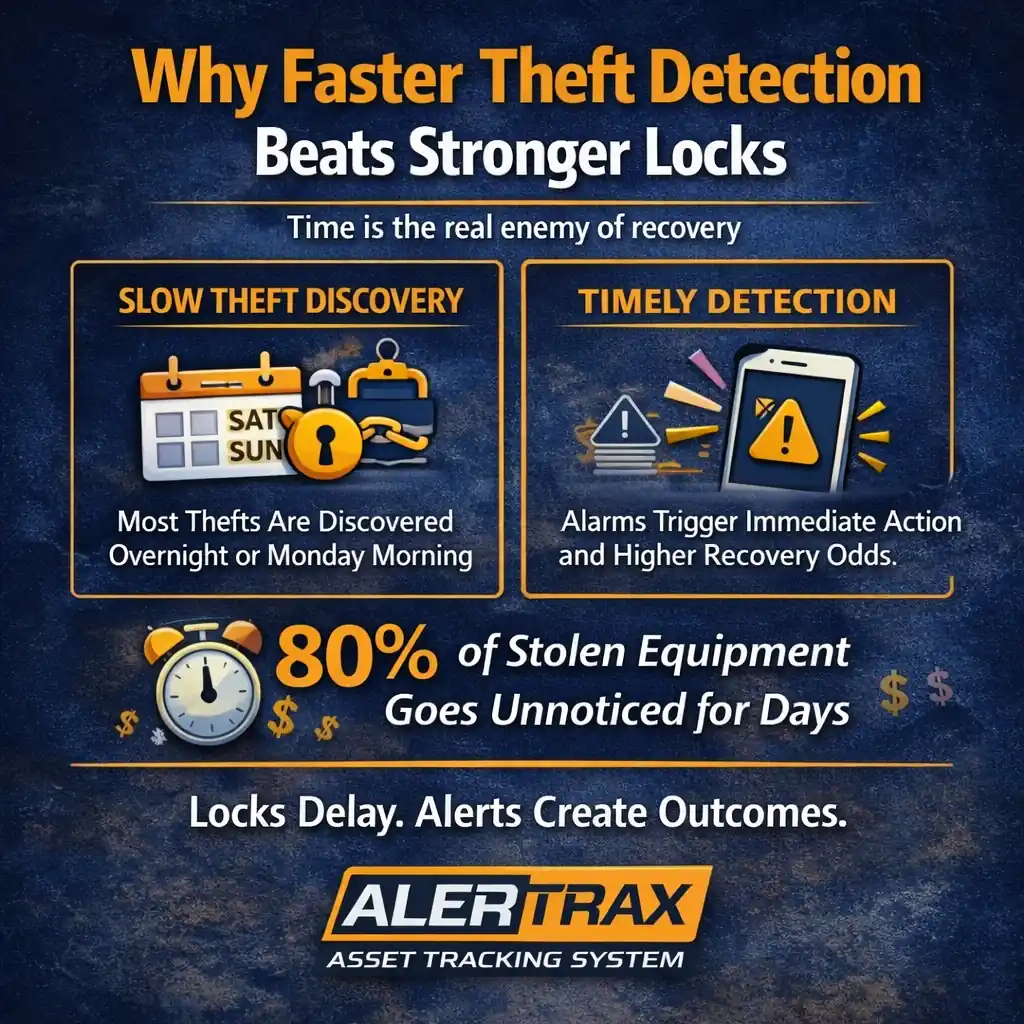
Most theft prevention conversations focus on barriers.
Better locks.
Heavier chains.
More lighting.
Those things matter. But they all share the same assumption.
That someone will notice the theft right away.
For many small businesses, that assumption is wrong.
The difference between recovering stolen equipment and writing it off often comes down to how fast the theft is detected, not how hard it was to steal.
What the Data Shows About Theft Recovery
Law enforcement data on vehicle and equipment recovery is consistent across industries.
The first 24 hours matter more than any other factor.
Assets reported stolen within the first day have significantly higher recovery rates than those reported later. After 48 hours, recovery odds drop sharply. After a week, many assets are never seen again.
The problem is not just theft. It is delayed awareness.
Most businesses do not realize something is missing immediately.
Why Locks Fail Quietly
Locks do their job silently.
When a lock is defeated, nothing alerts the owner. There is no notification. No timestamp. No context.
The theft often goes unnoticed until:
- A crew shows up and something is missing
- A job cannot start
- A trailer spot is suddenly empty
For overnight or weekend thefts, discovery often happens days later. By then, the asset is far from the original location.
Locks may slow thieves. They do not shorten response time.
The Cost of Not Knowing Right Away
Delayed detection creates cascading losses.
By the time a theft is discovered:
- Law enforcement has less actionable information
- GPS-free assets have no recovery trail
- Jobs are already delayed
- Rental equipment is needed immediately
- Customers are already impacted
Industry studies show that many businesses take 12 to 72 hours to notice missing equipment. That delay alone is often the difference between recovery and replacement.
Insurance pays later. The damage happens immediately.
Why Most Thefts Happen When No One Is Watching
Crime data shows clear patterns.
The majority of equipment theft occurs overnight, on weekends, or during holidays. These are periods when sites are unattended and checks are infrequent.
Temporary locations and jobsite transitions are especially vulnerable. Assets parked briefly are often left without follow-up until the next workday.
Thieves rely on delay. They count on the fact that no one is checking.
Detection Changes Behavior Without Confrontation
Businesses that implement faster detection systems do not just recover more assets. They change how theft impacts operations.
Early awareness allows businesses to :
- Report theft while information is fresh
- Provide accurate last-known locations
- Alert nearby crews or managers
- Coordinate faster responses
Law enforcement recovery success increases when reports include recent movement data. Even small time advantages matter.
Detection does not require confrontation. It simply reduces uncertainty.
Why Detection Beats Deterrence in the Real World
Deterrence assumes perfect behavior from thieves.
Detection assumes theft will happen.
That difference is important.
Locks, cameras, and signage aim to discourage theft. Detection systems aim to limit damage when deterrence fails.
Real-world data shows that layered strategies work best, but detection is the layer that determines outcomes.
If something is stolen and no one notices, deterrence has already failed.
The Businesses That Recover Quickly All Do One Thing
They shorten the time between theft and awareness.
Whether through alerts, location visibility, or regular automated checks, they know when something moves unexpectedly.
This changes the timeline entirely.
Instead of discovering theft days later, they respond in minutes or hours. Recovery odds increase. Downtime decreases. Insurance claims become simpler.
The system does not prevent every theft. It prevents extended disruption.
Why Monday Morning Is Often Too Late
One of the most common theft discovery times is Monday morning.
Crews arrive. Equipment is gone. No one knows when it happened.
At that point:
- The trail is cold
- The asset has likely changed locations
- Recovery becomes unlikely
This is not a failure of responsibility. It is a failure of visibility.
Systems that only rely on human checks leave large blind spots.
Rethinking Theft Protection as a Time Problem
Theft is often framed as a strength problem.
Stronger locks.
Heavier barriers.
In practice, it is a time problem.
How long does it take to notice something is wrong?
Every hour of delay increases cost. Every day reduces recovery odds. Faster detection does not eliminate theft. It limits damage.
That is the difference between inconvenience and crisis.
The Smarter Question to Ask
Instead of asking how hard an asset is to steal, the better question is how fast you would know if it moved.
Insurance replaces assets. Detection protects operations.
Small businesses that understand this stop chasing perfect prevention and start designing for faster response.
That shift is where outcomes change.