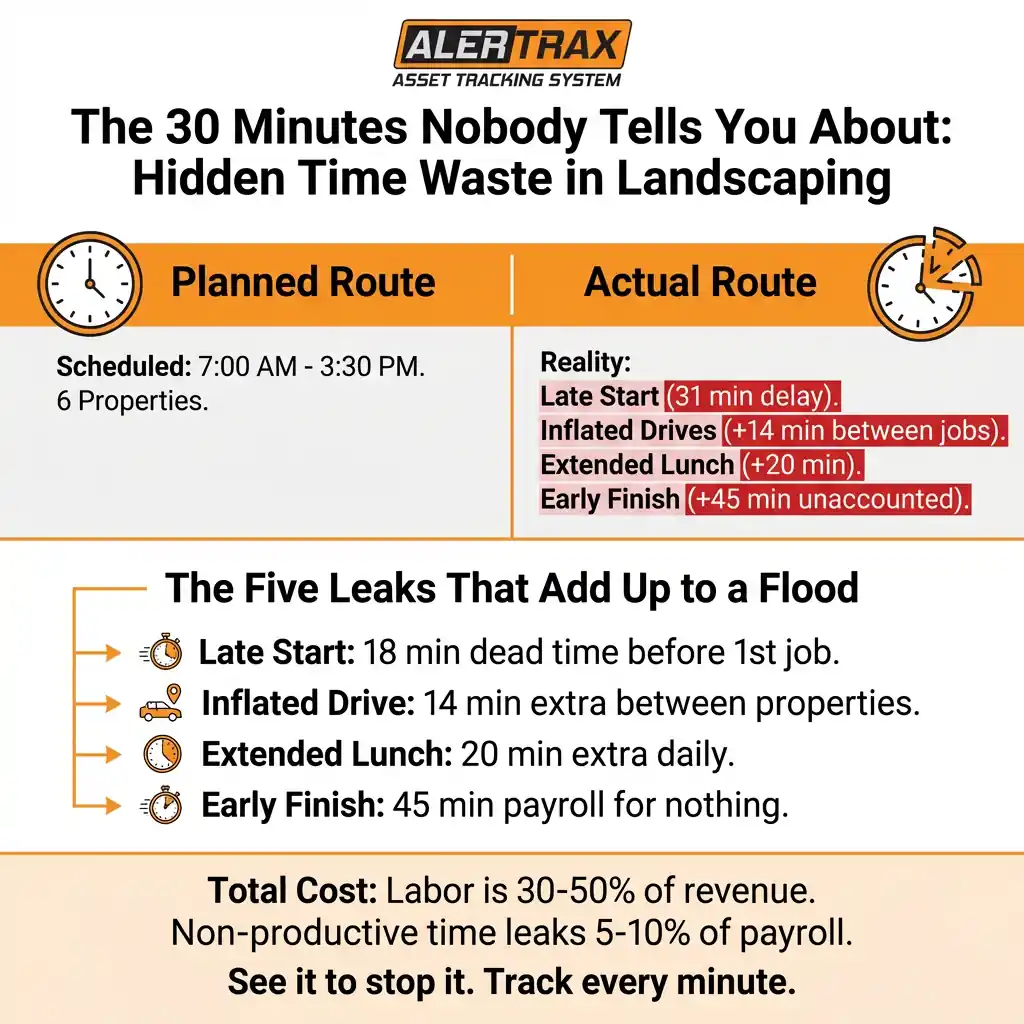
Your crews left the yard at 7:00 this morning. They are scheduled for 6 properties today. The route should have them finishing the last property by 3:30 and back at the shop by 4:00.
But here is what actually happened.
They pulled out of the yard at 7:00, drove four minutes to the gas station, and sat in the drive-through at Dunkin' for 12 minutes. They arrived at the first property at 7:31, 31 minutes after leaving the yard for a job site that is 15 minutes away. Between properties two and three, there was a 22-minute gap that should have been an 8-minute drive. After the last property, they clocked out at 3:45 but did not arrive back at the yard until 4:20, and the GPS would show them parked at a convenience store for 25 of those 35 minutes.
Nobody called you about any of this. Nobody mentioned it on the timesheet. As far as you know, the day went fine. Six properties, all completed. Normal day.
But you just paid for 30 to 45 minutes of time that produced absolutely nothing. And it happened yesterday, too. And the day before that. And it will happen again tomorrow, across every crew you run, unless you can see it.
The Time You Pay For vs. The Time That Produces
In a landscaping business, you have two kinds of time: billable time and everything else. Billable time is when your crew is on a property doing the work you quoted and the client is paying for. Everything else, driving between properties, fueling up, loading materials, sitting in a parking lot, running personal errands, is time you are paying for but cannot bill.
Every landscaping owner understands this in theory. But very few have ever measured the actual split.
Labor is the single largest expense in a landscaping business, consuming 30 to 50 percent of total revenue (Aspire, 2025). And the true cost goes beyond base wages, labor burden (payroll taxes, workers' comp, unemployment insurance, benefits, and training) adds an additional 20 to 35 percent on top (Service Autopilot, 2026). A crew member you are paying $20 per hour is actually costing you $24 to $27 per hour when you factor in the full burden.
That means every minute of non-productive time is more expensive than you think. And the American Payroll Association and Workpuls estimate that businesses across all industries lose 5 to 10 percent of total payroll to time theft annually. For a landscaping company with $600,000 in annual labor costs, that is $30,000 to $60,000 per year, not stolen in one dramatic incident, but leaked out in 10- and 15-minute increments across every crew, every day, all season long.
The Five Leaks That Add Up to a Flood
Time waste in a landscaping operation does not come from one big problem. It comes from five small ones that happen every day, on every crew, and compound into a staggering number by the end of the season.
Leak #1: The Late Start. Your crews are supposed to leave the yard at 7:00 AM and arrive at the first property by 7:15 or 7:20. But the morning routine tells a different story. Someone forgot to load the edger blades. Someone else is sitting in the truck finishing breakfast. The crew leader is on his phone. They actually pull out at 7:12, stop for gas, and do not arrive at the first property until 7:38.
That is 18 minutes of dead time. Multiply it by a 3-man crew and you have burned 54 crew-minutes before the first mower blade spins. Do that across 5 crews, 5 days a week, for 35 weeks: that is 787 crew-hours per season, gone before the workday even starts.
Leak #2: The Inflated Drive Time. The route says 8 minutes between Property 2 and Property 3. The GPS shows 22 minutes. Where did the other 14 minutes go? Maybe traffic. Maybe a detour for a personal errand. Maybe they just sat in a parking lot and scrolled their phones for a few minutes. Whatever the reason, 14 minutes between every pair of properties on a 6-property route means 70 extra minutes per crew per day that you are paying for and getting nothing in return.
Leak #3: The Extended Lunch. The crew gets 30 minutes for lunch. They take 50. Nobody is watching. Nobody knows. On paper, the schedule is built around a 30-minute break. In reality, you are losing an extra 20 minutes per crew per day. Across 5 crews over a 35-week season, that is 2,916 crew-hours, the equivalent of hiring an extra full-time crew member and having them do nothing all year.
Leak #4: The Early Finish. The crew wraps up the last property at 3:15. They clock out at 4:00. For the next 45 minutes, the truck is parked, at a gas station, a convenience store, or the crew leader's house. The timesheet says 4:00 PM. The GPS would say 3:15 PM. That is 45 minutes of payroll per crew per day that you are lighting on fire.
Leak #5: The Personal Stop. A quick run into a store between properties. A 10-minute detour to drop something off at a crew member's house. A stop at the ATM that turns into a 15-minute break. These stops are individually small and easy to justify, but they happen constantly, and they are completely invisible unless you have route data showing where your trucks go between job sites.
Let Us Add It Up
For a landscaping company running 5 crews, here is what the five leaks look like when you combine them, using conservative estimates:
Late starts: 18 minutes/day × 3-man crews × 5 crews × 175 days = 787 crew-hours
Inflated drive time: 14 minutes/gap × 5 gaps/day × 5 crews × 175 days = 1,020 crew-hours
Extended lunch: 20 minutes/day × 3-man crews × 5 crews × 175 days = 875 crew-hours
Early finish: 30 minutes/day × 3-man crews × 5 crews × 175 days = 1,312 crew-hours
Personal stops: 10 minutes/day × 5 crews × 175 days = 145 crew-hours
Total: 4,139 crew-hours per season.
At a fully burdened rate of $25 per hour, that is $103,475 per season in labor you paid for but got nothing from.
To put that in perspective: the average landscaping company nets 6.2 percent (Wifitalents, 2023). For a company doing $1.5 million in revenue, that is $93,000 in net profit. The invisible time waste, $103,475, is larger than the entire bottom line.
This is not theoretical. This is basic arithmetic applied to behaviors that every landscaping owner suspects are happening but cannot prove. The difference between a company earning 6 percent and one earning 14 percent is not working harder. It is eliminating the 30 minutes per crew per day that nobody tells you about.
Why Nobody Tells You
Here is the uncomfortable truth: your crews are not going to self-report time waste. Not because they are bad people. Because they are human.
The crew leader who stops at the gas station every morning does not think of it as time theft. He thinks of it as part of his routine. The crew that takes 50 minutes for lunch instead of 30 does not think they are costing you $875 per season. They think they are taking a reasonable break on a hot day. The crew that wraps up at 3:15 and sits until 4:00 is not trying to rob you. They just finished early and do not feel like starting another property with only 45 minutes left in the day.
None of these are fireable offenses in isolation. None of them will ever show up on a timesheet. And none of your crew leaders are going to call you and say "Hey boss, we wasted about 30 minutes today." It is just the way things have always been, and it stays that way until you have data.
The landscaping industry has a 42 percent annual employee turnover rate (Wifitalents, 2023). 76 percent of companies have at least one open position at any given time (2024 State of the Landscape Labor Market). 72 percent of owners say labor availability is their biggest barrier to growth (Aspire, 2025). In an industry where finding and keeping good people is the hardest part of the job, you cannot afford to address time waste with accusations and confrontation. You need a system that makes the patterns visible so the behavior self-corrects, and so good crews get the credit they deserve.
What GPS Data Makes Visible
A GPS tracker on each crew truck does not fix time waste by watching your employees. It fixes time waste by giving you information you have never had before.
Departure time from the yard. Not "the crew left at 7:00" from the timesheet. The actual, GPS-verified moment the truck pulled out. If the pattern shows that Crew 2 consistently leaves 12 minutes late, you do not need to stand in the parking lot every morning. You just pull up the data and have a 2-minute conversation about what is causing the delay.
Arrival time at the first property. The gap between yard departure and first-property arrival tells you exactly how much time is being lost to morning stops. If the drive should take 15 minutes and it consistently takes 35, there is a 20-minute stop hiding in there. You can see it on the route history without asking a single question.
Drive time between properties. This is where the inflated gaps live. GPS route data shows the exact path the truck took between properties, with timestamps. Eight-minute drive that took 22 minutes? The breadcrumb trail shows exactly where the truck went and how long it was stopped. No accusations needed. The data speaks for itself.
Departure from the last property vs. clock-out time. This is the single most revealing data point in any landscaping operation. If your crew departs the last property at 3:12 PM and does not return to the yard until 4:05 PM, but the drive is 18 minutes, there are 35 minutes unaccounted for. Over a season, across multiple crews, this is where tens of thousands of dollars disappear.
None of this requires a camera. None of it requires an app. None of it requires the crew to do anything different. The tracker is on the truck. It records where the truck goes and when. You look at the data when you want to, and patterns emerge on their own.
How It Actually Changes Behavior
Here is what most landscaping owners discover when they start looking at GPS data: the problem is not as bad as they feared, and it is easier to fix than they expected.
The most common pattern is that one or two crews have significant time waste habits, and the rest are pretty close to where they should be. Once the data makes the pattern visible, the fix is usually a single conversation, not a confrontation, but a clear, data-backed discussion about expectations.
"Hey, the data is showing a consistent 20-minute gap between the yard and the first property. The drive is 12 minutes. What is happening in that window?" That is a very different conversation than "I think you guys are slacking off in the morning." One is a question backed by data. The other is an accusation backed by suspicion. The first one works. The second one creates resentment and turnover.
And here is the part that surprises most owners: the good crews actually perform better once the tracking is in place. According to a survey by TSheets (Intuit QuickBooks) and HR C-Suite, 95 percent of employees rate GPS tracking as positive or neutral, 75 percent say it helps track mileage and time more accurately, and 50 percent say it actually builds trust with their employer.
Why? Because your best crew leaders know they are doing good work. They want the company to see it. They are frustrated when the crew down the road wastes half the day and gets the same treatment. GPS data does not punish good employees. It validates them. And it gives the underperformers a clear, objective standard to meet.
The 2025 Fleet Technology Trends Report (Bobit Business Media) found that 52 percent of all fleets using GPS tracking report improved productivity as the number one benefit. Not theft prevention. Not cost savings. Productivity, because when crews know the data exists, the 30 minutes of daily waste tends to shrink dramatically without a single policy change.
The Compound Effect on Your Bottom Line
Let us revisit that 5-crew operation losing 4,139 crew-hours per season to hidden time waste.
You are not going to eliminate all of it. Some drive time variability is real. Some morning delays are legitimate. But if GPS data helps you reduce that number by even 40 percent, from 4,139 hours down to 2,483 hours, here is what you recover:
1,656 crew-hours × $25/hour = $41,400 per season in recovered labor productivity.
That $41,400 does not require hiring anyone. It does not require buying new equipment. It does not require a single new account. It is money you are already spending. You are just getting work out of it now instead of watching it evaporate in parking lots and drive-throughs.
But the compound effect goes further. Those recovered hours translate into more properties serviced per day. If each crew picks up even one additional property per week because they are not wasting 30 minutes in transit, and that property is worth $75 per visit, here is the math:
1 extra property × $75 × 5 crews × 35 weeks = $13,125 per season in additional revenue, from the same crews, the same trucks, and the same hours.
Labor savings of $41,400 plus revenue gains of $13,125 = $54,525 per season. For a company netting 6.2 percent on $1.5 million, that is the equivalent of adding $879,000 in new revenue, except you did not have to sell a single new account to get it.
Why Alertrax Makes This Easy
Time waste tracking does not need to be complicated. You do not need fleet management software with 47 features you will never use. You do not need an app that your crew has to remember to open every morning. You need a GPS tracker on each truck that records where it goes and when, automatically, silently, and without any crew involvement.
That is exactly what Alertrax does.
- Automatic Time-on-Site Logging: Every arrival and departure at every property is recorded with a timestamp. No app. No button. No check-in system. The data flows in automatically and builds a complete picture of where every crew spends their day.
- Complete Route History: A full breadcrumb trail showing everywhere each truck went, with timestamps. See the morning stop at the gas station. See the 22-minute gap that should have been 8. See the 35 minutes after the last property departure. All of it, on one screen.
- One-Year Battery Life, No Wiring Required: Alertrax runs on a self-contained battery that lasts a full year. Mount it on a truck, a trailer, a skid steer, any steel surface. No wiring. No OBD-II ports. No installation appointments.
- 100% Waterproof, Ruggedized Housing: Built for the conditions landscaping equipment lives in, rain, mud, dust, heat, and pressure washing. It does not quit because the job is dirty.
- Covert Magnetic Mounting: Mounts magnetically to any steel surface and stays hidden. No visible hardware, no wires to trace. The crew does not need to interact with it.
- Live Fleet Portal and Mobile App: See every truck on a live map from any browser or your phone. Check on crew locations from a client meeting, from the supply house, or from your couch at the end of the day. The Alertrax Fleet Portal puts your whole operation on one screen.
- Geofence and After-Hours Alerts: Set virtual boundaries around your yard, your storage lot, or any job site. If a truck or trailer moves after hours, you know immediately.
The Cost of Not Knowing vs. The Cost of Knowing
You can put Alertrax on every truck in your fleet for a low monthly rate, no long-term contracts, no hidden fees.
(Want to own it outright? We offer a $599 Lifetime option for permanent, subscription-free tracking.)
The cost of not knowing is $103,475 per season for a 5-crew operation, conservatively. The cost of knowing is a fraction of what you spend on fuel in a single month.
The 2025 Fleet Technology Trends Report (Bobit Business Media) found that 47 percent of fleets see a full return on their GPS investment in under 12 months. For landscaping companies dealing with daily time waste, the payback is usually visible in the first two weeks, because the data starts flowing immediately, and the patterns are obvious from day one.
And Yes. It Prevents Theft Too
This entire article has been about the 30 minutes per crew per day that nobody tells you about, the daily time waste that compounds into six figures of lost productivity per season. That is the benefit that hits your bottom line Monday through Friday, all season long.
But landscaping companies also park trucks, trailers, mowers, and equipment in driveways, on streets, and at unsecured job sites every night. Equipment theft costs the landscaping and construction industries hundreds of millions of dollars per year, and the recovery rate for stolen equipment is below 21 percent (NER / NICB).
With Alertrax, if any tracked asset moves outside its geofence after hours, you get an instant alert on your phone. You can track it live and direct police to its exact location before your equipment disappears for good.
Productivity protection by day. Theft protection by night. Same device. Same investment.
The 30 Minutes Is Real. The Question Is Whether You Want to See It.
Every landscaping owner suspects time waste is happening. The morning stop. The long lunch. The early checkout. You know it is there. You just do not know how much it is costing you because you have never been able to measure it.
A GPS tracker does not change what your crews do. It shows you what they have always been doing. And once you can see it, you can fix it, calmly, professionally, and with data instead of guesses.
The companies running at 14 percent margins are not luckier than you. They are not working harder than you. They just know where their 30 minutes is going.
Visit www.buyalertrax.com today and find yours.
Sources
Aspire (2025), Labor = 30–50% of total revenue; 72% of owners cite labor as biggest growth barrier
Service Autopilot (2026), Labor burden adds 20–35% on top of base wages; $20/hr employee costs $24–$27/hr
Workpuls / American Payroll Association, Businesses lose 5–10% of payroll to time theft annually
Wifitalents (2023), 42% annual employee turnover; industry average profit margin 6.2%
Fieldcamp (2025). Well-run companies target 10–14% net profit
2024 State of the Landscape Labor Market, 76% of companies have at least one open position
TSheets (Intuit QuickBooks) / HR C-Suite, 95% of employees rate GPS tracking positive or neutral; 75% say it tracks time accurately; 50% say it builds trust
2025 Fleet Technology Trends Report (Bobit Business Media), 52% of fleets cite improved productivity as #1 GPS benefit; 47% achieve ROI in under 12 months
NER / NICB, Equipment theft recovery rate below 21%