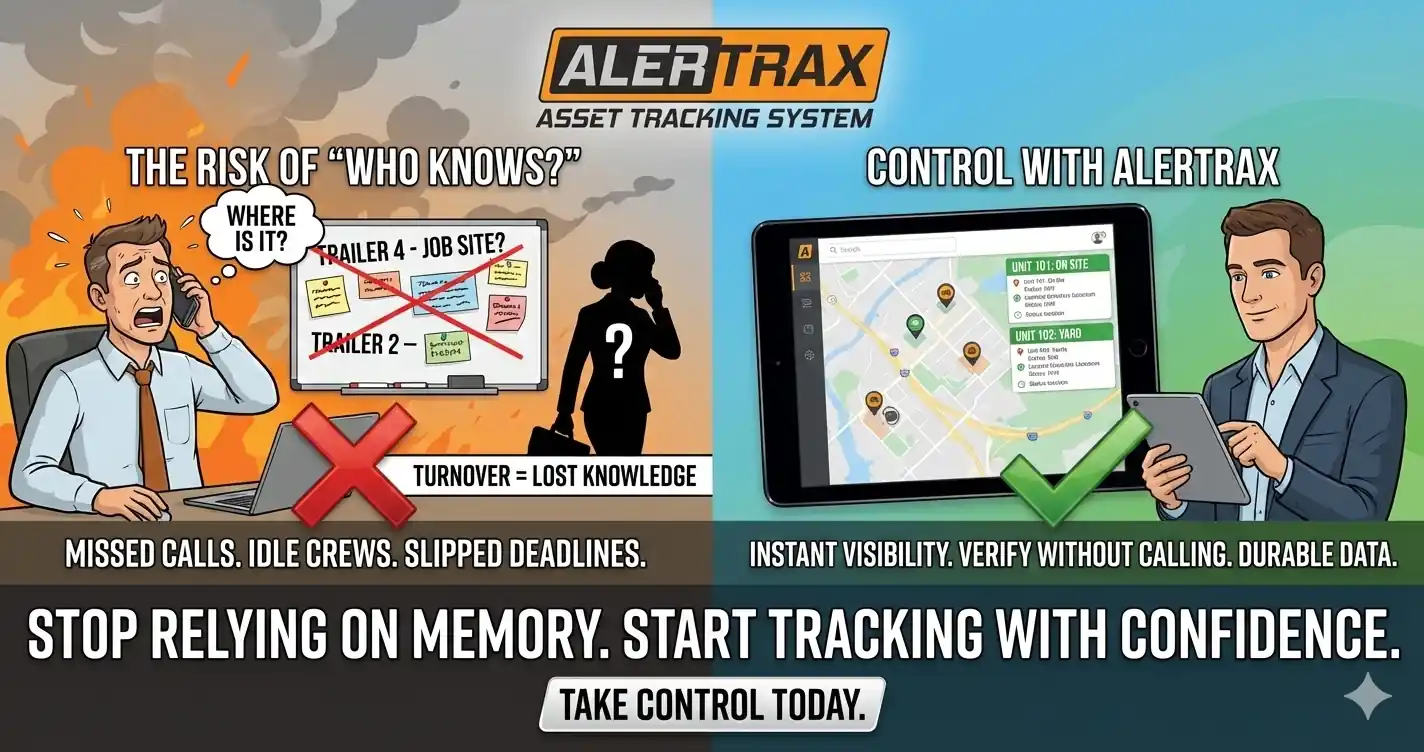
Ask most business owners how they track trailers and vehicles, and the answer sounds reasonable.
- “The foreman knows.”
- “It’s on the whiteboard.”
- “Someone texted me where it was last week.”
And for a while, that works.
Until it doesn’t.
The Hidden Risk of Tribal Knowledge
In many growing operations, asset tracking lives in people’s heads. One supervisor knows where a trailer was dropped. Another remembers moving it after hours. Someone else assumes it went back to the yard.
This kind of tribal knowledge feels efficient because it avoids systems and software. But it creates a silent risk that only shows up under pressure.
The moment one person is unavailable, distracted, sick, or no longer with the company, visibility disappears.
Growth Turns Memory Into a Liability
With one or two trailers, informal tracking is manageable. With five, eight, or twelve, it becomes fragile.
Here is what starts happening as fleets grow :
- Locations are shared verbally or via text
- Updates are not logged consistently
- Managers spend time chasing information instead of running jobs
- Everyone assumes someone else knows
The problem is not negligence. It is scale.
Human memory does not scale with your business.
When “Just Call Someone” Stops Working
Many owners assume they can always make a quick call if they need to find something.
But calls fail when:
- Crews are already on the job
- Phones are off or unanswered
- Responsibility is unclear
- The person who moved the trailer is no longer available
What should be a simple question turns into a chain of messages, guesses, and delays.
Meanwhile, jobs wait. Crews idle. Deadlines slip.
Turnover Makes the Problem Worse
Employee turnover is not just an HR issue. It is an operational one.
When tracking lives with individuals :
- Knowledge walks out the door
- New hires inherit incomplete information
- Managers are forced to reconstruct history
- Mistakes compound quietly
By the time something is officially “missing,” it is often unclear when or how it happened.
Systems Do Not Forget
This is where many business owners have a realization.
They are not actually tracking assets. They are tracking people who track assets.
That distinction matters.
A system does not forget to update.
It does not take a vacation.
It does not assume someone else handled it.
Visibility that depends on memory is temporary. Visibility that depends on data is durable.
The Real Question to Ask
Instead of asking, “Who knows where it is?”
Ask this instead:
Can I verify it without calling anyone?
If the answer is no, then your operation is one missed call away from uncertainty.
And uncertainty costs time, money, and credibility.
Control Comes From Independence
Strong operations reduce dependency on individuals for basic visibility.
That does not replace people. It protects them.
When location data is always available :
- Crews stop fielding unnecessary calls
- Managers stop guessing
- Accountability improves without confrontation
- Growth feels controlled instead of chaotic
You are no longer hoping someone remembers. You are simply checking.
Take Control Without Adding Complexity
If you are managing multiple trailers or vehicles, relying on memory and messages is a risk that grows with your business.
AlerTrax gives you independent, always-on visibility without relying on any single person. You can choose a $599 one-and-done purchase for long-term protection, or start for just $99 upfront on a monthly plan.
If your operation depends on knowing where assets are, it should not depend on who happens to be available.