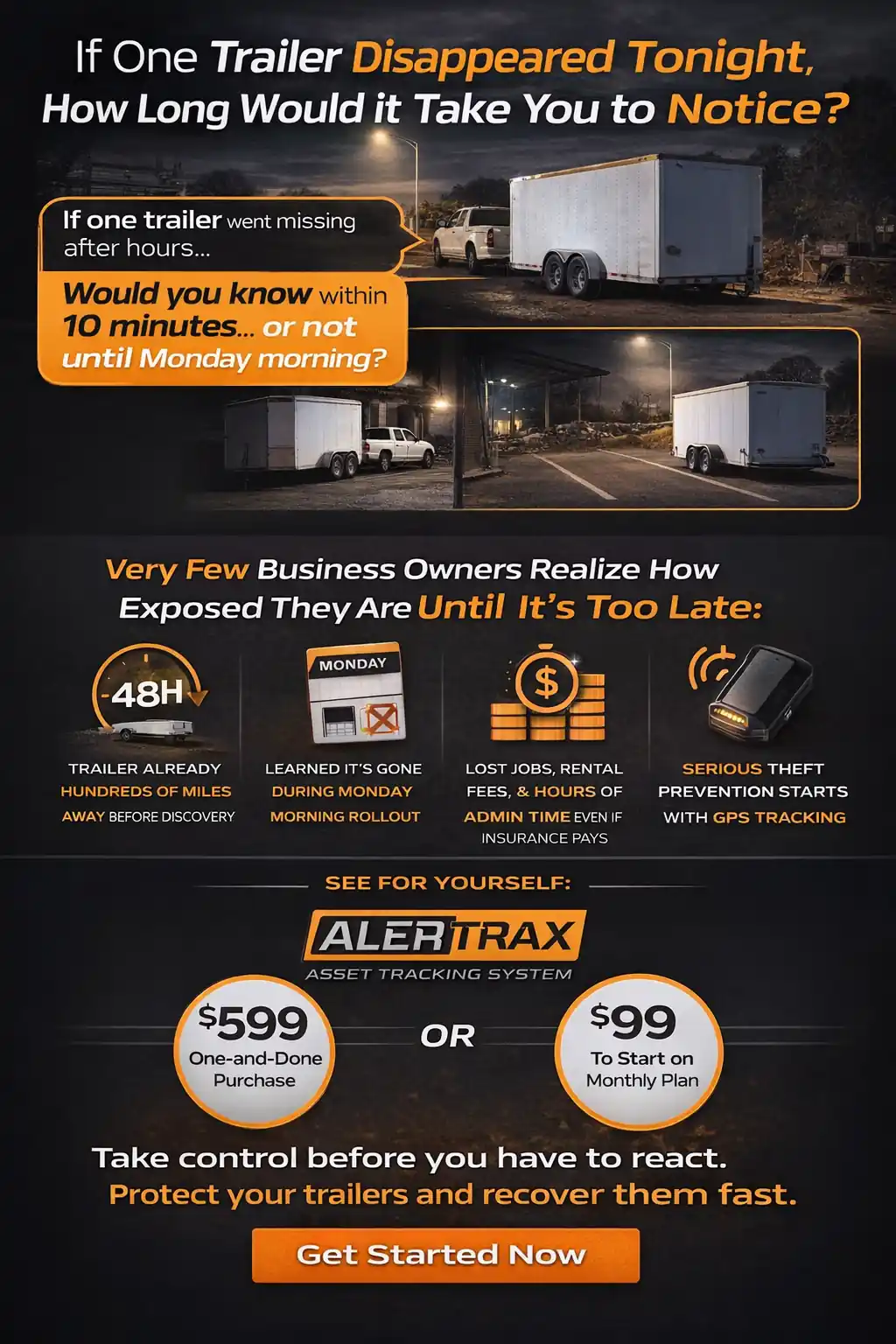
Most business owners assume they would know immediately if something went missing.
The truth is less comfortable.
For companies running three, five, or ten trailers, theft rarely announces itself. There is no alarm. No call. No text message. There is just an empty space where a trailer used to be and the realization that it could have been gone for hours or days.
By the time you notice, the damage is already done.
The Delay Is the Real Problem
Trailer theft is not just about the asset itself. It is about time.
Time between when the trailer moves and when you realize it has moved.
Time between discovery and response.
Time lost while you call crews, retrace steps, file reports, and reshuffle jobs.
Most theft recoveries fail for one simple reason: the trailer is already far away before anyone knows it is missing.
The longer that delay, the lower the odds of recovery.
Why Multi-Trailer Operations Miss It
When you have one trailer, awareness is easy. You know where it is because you see it every day.
Once you scale past three, visibility changes:
- Trailers rotate between jobsites
- Crews move equipment after hours
- Supervisors assume someone else knows where it is
- Yard checks get skipped on busy days
No one is being careless. The system simply does not exist.
Instead of live visibility, you rely on memory, routine, and assumptions. That works until it doesn’t.
“Someone Would Have Noticed” Is Not a Strategy
This is one of the most common beliefs we hear from business owners after a theft.
The reality is that trailers are often discovered missing during:
- Monday morning rollouts
- Jobsite arrivals
- End-of-day load-ups
By then, the trailer may have been gone since Friday night.
Thieves understand this window. They do not need to be fast. They just need to move when no one is watching.
The Compounding Costs of Late Discovery
Even if insurance eventually pays, delayed discovery multiplies the damage :
- Jobs delayed or canceled
- Crews standing idle or reassigned
- Emergency rentals at premium rates
- Administrative time with police and insurers
- Higher premiums after repeat claims
None of this shows up on the initial theft report. But it hits your margins immediately.
Insurance replaces equipment. It does not replace lost momentum.
The Question That Changes Everything
Instead of asking, “How do I stop theft?”
The better question is:
How quickly would I know something is wrong?
Speed is the difference between recovery and replacement.
Businesses that recover stolen trailers almost always have one thing in common: they knew right away.
Not Monday morning.
Not after three phone calls.
Not after someone finally checked the yard.
Immediately.
Visibility Is Control
As operations grow, manual checks stop scaling. You cannot be everywhere. You cannot call everyone. And you cannot afford blind spots.
Live visibility is not about watching a map all day. It is about removing uncertainty.
Knowing:
- When a trailer moves
- Where it goes
- Whether that movement makes sense
That certainty changes how you respond and how thieves think about targeting you.
Before Tonight, Ask Yourself
If a trailer moved after hours, would I know?
Would I get alerted, or would I find out later?
How much would a delay cost me, even if insurance pays?
Most owners do not realize how exposed they are until they are already dealing with the fallout.
The goal is not to react faster after a theft.
The goal is to notice before it becomes a loss.
That single shift is what separates businesses that replace trailers from those that recover them.
Take Control Before You Have to React
If you are managing multiple trailers or vehicles, visibility is no longer optional. It is an operational requirement.
With AlerTrax, you can choose a $599 one-and-done purchase for long-term protection, or get started for just $99 upfront on a monthly plan. No guesswork. No waiting until Monday morning to find out something went wrong.
If knowing immediately matters to your business, now is the time to act.