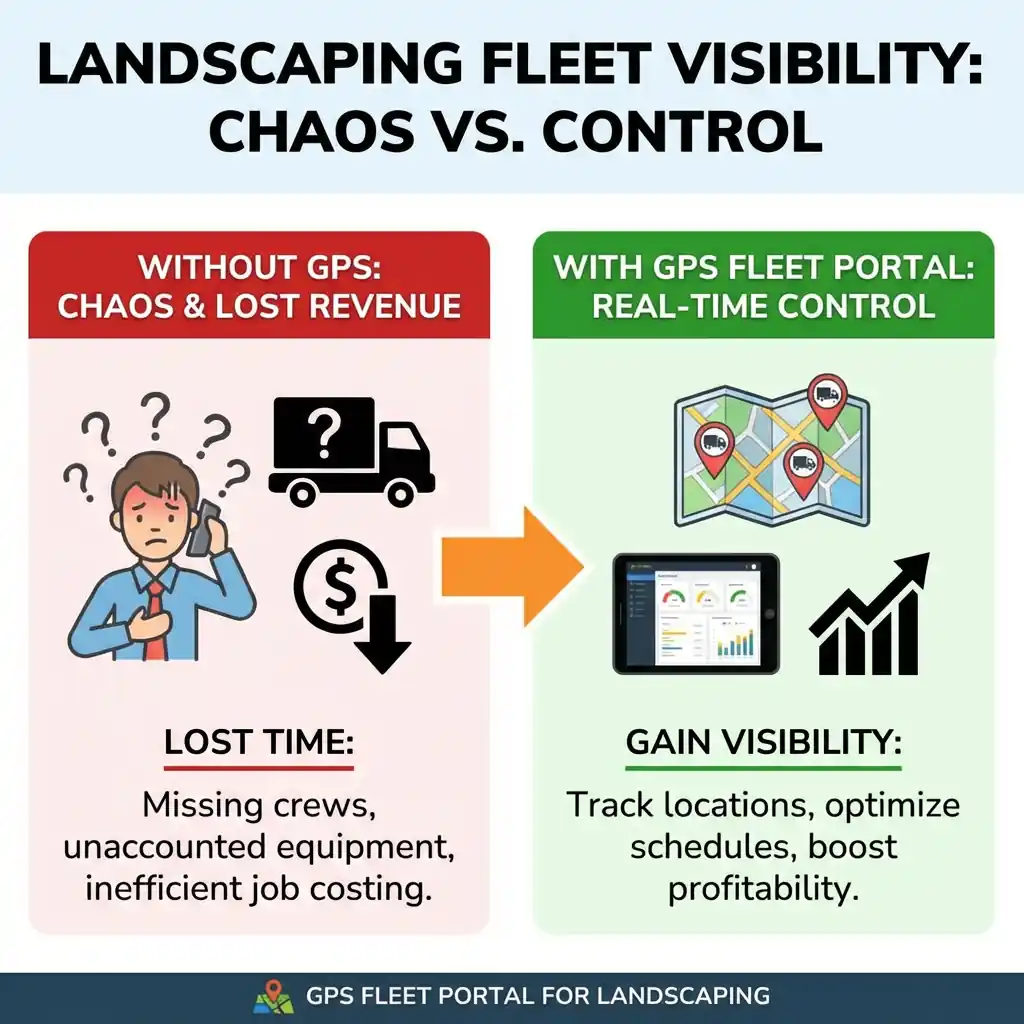
It is 7:45 on a Tuesday morning. You are sitting in your truck at a property manager's office, about to walk in and pitch a commercial maintenance contract that could be worth $40,000 a year. Your phone rings.
It is your office. Crew 2 never showed up at the HOA job on Maple Ridge. The property manager is calling. Crew 3 took the dump trailer to a job site but nobody can confirm which one. And your skid steer, the one that is supposed to be at the hardscape install on Route 9, is apparently still sitting in your yard because the crew that was supposed to pick it up thought it was already on-site.
You spend the next 40 minutes on the phone trying to figure out where your people and equipment are instead of walking into that sales meeting prepared and focused. By the time you sort it out, the property manager has moved on to his next appointment. You reschedule for next week. He cancels the day before.
If you run a landscaping or hardscaping company with more than a few crews in the field, this kind of morning is not unusual. It is the cost of operating without visibility, and in a $188.8 billion industry where labor is your biggest expense and margins depend on every billable hour, the cost is enormous.
A $188 Billion Industry Running on Phone Calls and Whiteboards
The U.S. landscaping services industry hit $188.8 billion in 2025, with nearly 700,000 businesses employing more than 1.4 million people (NALP / IBISWorld). The industry has been growing at an average of 6.5 percent per year since 2020, driven by rising property values, commercial demand, and homeowners who are spending an average of $300 per month on landscaping services (Angi / Jobber).
But here is the problem hiding behind those growth numbers: most landscaping companies, especially those in the 3-to-15-crew range, are still managing their daily operations the same way they did 20 years ago. A whiteboard in the shop. A group text at 6:00 AM. A phone call when something goes sideways. Maybe a shared Google Sheet if the operation is "tech-forward."
Meanwhile, labor costs eat 30 to 50 percent of total revenue (Aspire, 2025). The average employee turnover rate in the industry is roughly 42 percent (Wifitalents, 2023). And 51 percent of landscaping businesses say staffing shortages are a major risk to their business (Aspire, 2025). You are paying more than ever for labor that is harder than ever to find, and you have almost no way to verify how that labor is being used once the trucks leave the yard.
Well-run landscaping companies target 10 to 14 percent net profit (Fieldcamp, 2025). But the industry average sits at just 6.2 percent (Wifitalents, 2023). The gap between those two numbers is not talent or hustle. It is visibility. The companies hitting 14 percent know where their crews are, how long they are spending at each property, and whether the schedule on the whiteboard matches what is actually happening in the field. The companies stuck at 6 percent are guessing.
The Three Questions You Cannot Answer Right Now
If you are running a landscaping operation with trucks, trailers, skid steers, and crews spread across multiple job sites, there are three questions you need to be able to answer at any moment during the workday. Most owners cannot answer any of them.
1. Where are my crews right now? Not where they are supposed to be. Where they actually are. Did Crew 1 arrive at the first property on time, or did they stop for breakfast and show up 30 minutes late? Is Crew 3 still at the commercial job or did they leave early? You do not know unless someone calls and tells you, and they are not going to call if the answer makes them look bad.
2. Where is my equipment? The skid steer was at the hardscape job on Monday. Someone moved it to the new construction site on Wednesday. Or did they? Is it back in the yard? Who has the dump trailer? Is the landscape trailer with the 60-inch mowers at the HOA or at the church property? When you own $200,000 or more in mobile equipment and it is scattered across a dozen job sites, the only way to know where it all is, without calling four people, is to see it on a map.
3. How long are my crews actually spending at each job? This is the question that separates profitable landscaping companies from companies that are busy but broke. If you estimated 2.5 hours for a weekly maintenance property and your crew is consistently spending 3.5 hours, you are losing money on that account every single week. But you do not know that unless you have time-on-site data, and a crew member's verbal estimate of "about two and a half hours" is not data.
What the Data Says About Fleet Visibility
The landscaping industry has been slower to adopt GPS fleet tracking than industries like trucking and field services, but the data on what it does for operations is overwhelming, and it applies directly to how landscaping companies run.
According to the 2025 Fleet Technology Trends Report (an independent survey of fleet operators conducted by Bobit Business Media), 52 percent of all fleets using GPS tracking report improved productivity as the number one benefit. Not cost savings. Not theft prevention. Productivity, getting more done with the same number of trucks and people.
That same report found that 69 percent of fleets across all industries now use GPS tracking, and 72 percent rate it as extremely or very beneficial. Among fleets that have implemented GPS, the average cost reductions are striking: fuel savings of 16 percent, labor cost savings of 14 percent, maintenance savings of 16 percent, and insurance savings of 11 percent. Fuel savings alone have nearly doubled since 2021, when the same survey measured them at 8 percent.
For a landscaping company running 8 trucks and spending $120,000 a year on fuel, a 16 percent reduction is $19,200 back in your pocket. For a company with $800,000 in annual labor costs, a 14 percent improvement in labor efficiency is worth $112,000, the equivalent of adding revenue without adding a single crew member.
The Aberdeen Group found that companies using fleet monitoring systems saw a 20 percent reduction in equipment downtime and a 30 percent increase in service profitability. In landscaping terms, that means your skid steer is not sitting in the wrong yard for two days because nobody knew where it was. It means your trailer is not making a 45-minute round trip to the shop because the crew forgot materials that were actually on a different trailer at a different site. It means downtime shrinks and billable hours expand.
And 47 percent of fleets achieve a full return on their GPS investment in under 12 months (2025 Fleet Technology Trends Report). For most landscaping companies, the payback period is measured in weeks, not months.
The Real Cost of Not Knowing
Let us translate these industry-wide numbers into landscaping-specific scenarios that happen every single day.
The late start you do not see. A crew leaves the yard at 7:00 AM but does not arrive at the first property until 7:45 because they stopped for coffee and sat in the drive-through for 20 minutes. That is 20 minutes multiplied by a three-man crew, multiplied by five days a week, multiplied by 40 weeks of the season. That is 200 crew-hours per year, burned on a coffee stop you never knew about.
The early departure you cannot prove. A crew wraps up their last property at 2:30 PM but does not clock out until 3:30. They are sitting in a parking lot, scrolling their phones, on your payroll. The American Payroll Association and Workpuls estimate that businesses lose 5 to 10 percent of payroll to time theft annually. For a landscaping company with $500,000 in annual labor costs, that is $25,000 to $50,000 in wages paid for time not worked.
The pricing mistake you keep repeating. You bid a commercial property based on 3 hours of crew time per visit. Your crew is consistently spending 4 hours because the site is larger than you estimated, or the crew is working slowly, or drive time between properties is eating into production. Without time-on-site data, you do not know. You just know that account "feels" like it is not making money. According to Duranta (2025), 1 in 5 landscaping jobs is unprofitable, and most owners do not know which ones until it is too late.
The equipment hunt. Every hour your crew spends driving around looking for a trailer, a skid steer, or a set of materials that got left at the wrong job site is an hour they are not mowing, grading, or laying pavers. Every hour of vehicle idling during that search costs up to $2.50 in fuel (American Transportation Research Institute). Multiply that by multiple crews across a full season and the waste is staggering.
What a Fleet Portal Looks Like for a Landscaping Company
A fleet portal is simply a live map, accessible from a browser on your office computer, your dispatcher's tablet, or your phone, that shows every tracked vehicle and piece of equipment as a pin on a screen. Here is what it gives a landscaping or hardscaping company owner:
- Every truck, every trailer, every skid steer, one screen. Your F-350s, your landscape trailers, your dump trailer, your skid steer, your mini excavator, your backhoe. If it has a steel surface and it leaves your yard, it shows up on the map.
- Live crew location. You do not need to call Crew 2 to find out if they made it to the HOA. You look at the map and see the truck parked at the property. Arrived at 7:12 AM. Been there 47 minutes.
- Time-on-site data for every property. The system automatically logs when a vehicle arrives at a job site and when it departs. Over time, this builds a dataset that tells you exactly how long each property takes, not how long the crew says it takes, but how long it actually takes. That is the data you need to reprice accounts, restructure routes, and identify which jobs are making money and which ones are bleeding it.
- Equipment location without phone calls. The skid steer is at the Route 9 hardscape job. The backhoe is still at the new construction site on Elm. The dump trailer is in the yard. All confirmed in five seconds, no calls made.
- Route history. A full breadcrumb trail showing everywhere every vehicle has been that day, with timestamps. Use it to verify job completion, settle client disputes, evaluate route efficiency, or identify crews that are taking scenic detours on your fuel budget.
This is what the Alertrax Fleet Portal was built to do. Every vehicle and asset with an Alertrax tracker appears on a single, live map, so you can run your operation from your phone instead of running it from the driver's seat of your truck.
Accountability That Actually Works
One of the reasons landscaping company owners resist GPS tracking is the fear that crews will see it as surveillance. The data says the opposite.
According to a survey by TSheets (Intuit QuickBooks) and HR C-Suite, 95 percent of employees rate GPS tracking as positive or neutral. 75 percent say it helps track mileage and time more accurately. And 50 percent say it actually builds trust with their employer.
Here is why: your best crew leaders already want accountability. They want the company to know they showed up on time, worked the full day, and hit every property on the schedule. They are tired of being lumped in with the crew that leaves 45 minutes early and nobody says anything. GPS data does not create conflict. It eliminates the ambiguity that causes conflict.
And for the crews that are padding hours, taking extended breaks, or leaving early? The data addresses that too, quietly, objectively, and without a single accusation. You do not need to spy on anyone. The arrival and departure logs speak for themselves.
With 42 percent annual turnover in the landscaping industry (Wifitalents) and 76 percent of companies carrying at least one open position (2024 State of the Landscape Labor Market), you cannot afford to lose good employees because your management systems are based on guesswork and suspicion. GPS data replaces guesswork with facts. Good crews stay. Problem crews either improve or self-select out. Either way, your operation gets better.
Scaling Without Losing Control
The 2026 Aspire Commercial Landscape Industry Report found that 79 percent of landscaping company owners are focused on growing revenue, but only 41 percent are actively optimizing their processes for sustainable growth. That gap, between wanting to grow and being operationally ready to grow, is where most companies stall.
When you go from 3 crews to 6, or from 6 to 10, the complexity does not double. It compounds. More trucks. More trailers. More job sites. More equipment moving between sites. More crew leaders making independent decisions that you cannot see.
Without a fleet portal, every crew you add is another set of phone calls, another potential miscommunication, another piece of equipment that ends up at the wrong site. The owner becomes the bottleneck, answering his phone 30 times a day to play traffic controller instead of selling jobs, managing clients, and building the business.
A fleet portal breaks that bottleneck. The owner stops being the person everyone calls to find out where things are, because everyone can see where things are. The office manager handles dispatch adjustments from a screen. The crew leaders confirm their own equipment locations on the app. The owner walks into that sales meeting at 7:45 AM and does not get pulled out by a phone call, because the system is handling the visibility that used to require his constant attention.
According to Bain & Company, businesses that prioritize better customer service experiences grow revenues 4 to 8 percent above their market average. For a landscaping company doing $1.5 million in revenue, that is an additional $60,000 to $120,000 per year, simply from being more responsive, more reliable, and more professional in how you operate.
Why Alertrax Is Built for Landscaping and Hardscaping Companies
Most GPS tracking systems require hardwired installation or an OBD-II port connection. That works for a pickup truck. It does not work for a landscape trailer. It does not work for a skid steer. It does not work for a dump trailer, a backhoe, a utility trailer full of mowers, or any of the other non-powered assets that landscaping companies depend on every day.
Alertrax was designed for exactly this problem.
- One-Year Battery Life, No Wiring Required: Alertrax runs on a self-contained battery that lasts a full year. No wiring. No OBD-II ports. No installation appointments. Mount it on a truck, a trailer, a skid steer, a backhoe, anything with a steel surface, and it starts reporting immediately.
- Track Every Asset, Not Just Trucks: Your F-250 has an OBD port. Your landscape trailer does not. Your dump trailer does not. Your skid steer does not. With Alertrax, it does not matter. One tracker per asset. One fleet portal. Every vehicle, trailer, and piece of equipment on one map.
- 100% Waterproof, Ruggedized Housing: Landscaping equipment lives in mud, rain, dust, and direct sun. Alertrax was engineered for these conditions. It is fully waterproof and built to take the same abuse your equipment does, season after season.
- Covert Magnetic Mounting: Alertrax mounts magnetically to any steel surface. Tuck it inside the frame of a trailer, behind the counterweight of a skid steer, or under the bumper of a truck. No visible hardware. No wires to trace. Nobody needs to know it is there.
- Live Fleet Portal: The Alertrax Fleet Portal puts every tracked asset on a single live map. See crew locations, equipment positions, time on site, and route history, from any browser on your computer, tablet, or phone.
- Automatic Time-on-Site Logging: Every arrival and departure at every property is recorded automatically. Use it for crew accountability, job costing, client billing verification, and route optimization. No manual entry. No app the crew has to remember to open.
- Geofence and After-Hours Alerts: Set virtual boundaries around your yard, your storage lot, or any job site. If a truck, trailer, or piece of equipment moves outside that boundary after hours, you get an instant alert on your phone.
- iOS and Android App: Pull up your fleet map from anywhere. In the office, on a job site, at a client meeting, or at home after hours. Same data, same map, same alerts, right in your pocket.
Pricing That Works for Landscaping Companies
You can put Alertrax on every truck, trailer, and piece of equipment in your fleet for a low monthly rate, no long-term contracts, no hidden fees.
(Want to own it outright? We offer a $599 Lifetime option for permanent, subscription-free tracking.)
Consider the math. If GPS-verified time-on-site data helps you identify and reprice just two unprofitable accounts, turning a $200/month loss into a $200/month profit on each, that is $9,600 per year recovered from two accounts alone. If eliminating 30 minutes of daily unproductive time across 8 crews saves you 20 crew-hours per week at $25/hour, that is $20,000 per season.
The 2025 Fleet Technology Trends Report found that 47 percent of fleets see a full return on their GPS investment in under 12 months. Most landscaping companies running Alertrax see it in the first month.
And Yes. It Prevents Theft Too
Everything in this article has been about operations, crew visibility, equipment tracking, time on site, job costing, and scaling your business without losing control. Those are the benefits that hit your bottom line every single day.
But landscaping companies also park a lot of expensive assets in a lot of unsecured places. Trucks in driveways. Trailers on the street overnight. Skid steers and backhoes at open job sites over weekends. Equipment theft costs the construction and landscaping industries hundreds of millions of dollars every year, and the recovery rate for stolen equipment is below 21 percent (NER / NICB).
With Alertrax, if any asset moves outside its geofence after hours, you know immediately. You can track it live and direct law enforcement to its exact location before your equipment ends up on Craigslist.
Fleet intelligence by day. Theft protection by night. One device. One portal. One investment that pays for itself in every direction.
Stop Running Your Business From Your Phone
You started a landscaping company because you are good at the work. But somewhere along the way, the job became less about the work and more about playing traffic controller, figuring out where crews are, where equipment is, and whether the schedule is holding together.
A fleet portal gives you that time back. It puts every truck, every trailer, and every piece of equipment on one screen. It answers the questions you spend half your morning chasing. And it gives you the data to make your operation measurably more profitable, property by property, crew by crew, season by season.
Visit www.buyalertrax.com today and put your entire operation on one map.
Sources
NALP / IBISWorld, $188.8B U.S. landscaping services market (2025); 700,000 businesses; 1.4 million employed
Aspire (2025), Labor = 30–50% of revenue; 51% cite staffing shortages as major risk
Aspire (2026), 79% focused on growing revenue; only 41% optimizing for sustainable growth
Wifitalents (2023), 42% annual employee turnover; 6.2% average profit margin
Fieldcamp (2025). Well-run landscaping companies target 10–14% net profit
Duranta (2025), 1 in 5 landscaping jobs is unprofitable
Angi / Jobber, Average homeowner spends $300/month on landscaping
2024 State of the Landscape Labor Market, 76% of companies have at least one open position
2025 Fleet Technology Trends Report (Bobit Business Media), Fleet GPS adoption (69%), productivity benefits (52%), fuel savings (16%), labor savings (14%), insurance savings (11%), ROI under 12 months (47%)
Aberdeen Group, 20% reduction in equipment downtime; 30% increase in service profitability with fleet monitoring
American Transportation Research Institute (ATRI), Vehicle idling costs up to $2.50/hour in fuel
TSheets (Intuit QuickBooks) / HR C-Suite, 95% of employees rate GPS tracking positive or neutral; 75% say it tracks mileage/time accurately; 50% say it builds trust
Workpuls / American Payroll Association, Businesses lose 5–10% of payroll to time theft annually
NER / NICB, Equipment theft recovery rate below 21%
Bain & Company, Companies prioritizing service experience grow revenues 4–8% above market average