The Hidden Cost of Rechargeable GPS Trackers and Why AA Battery Swaps Win
Rechargeable GPS trackers sound convenient until you run them in the real world.
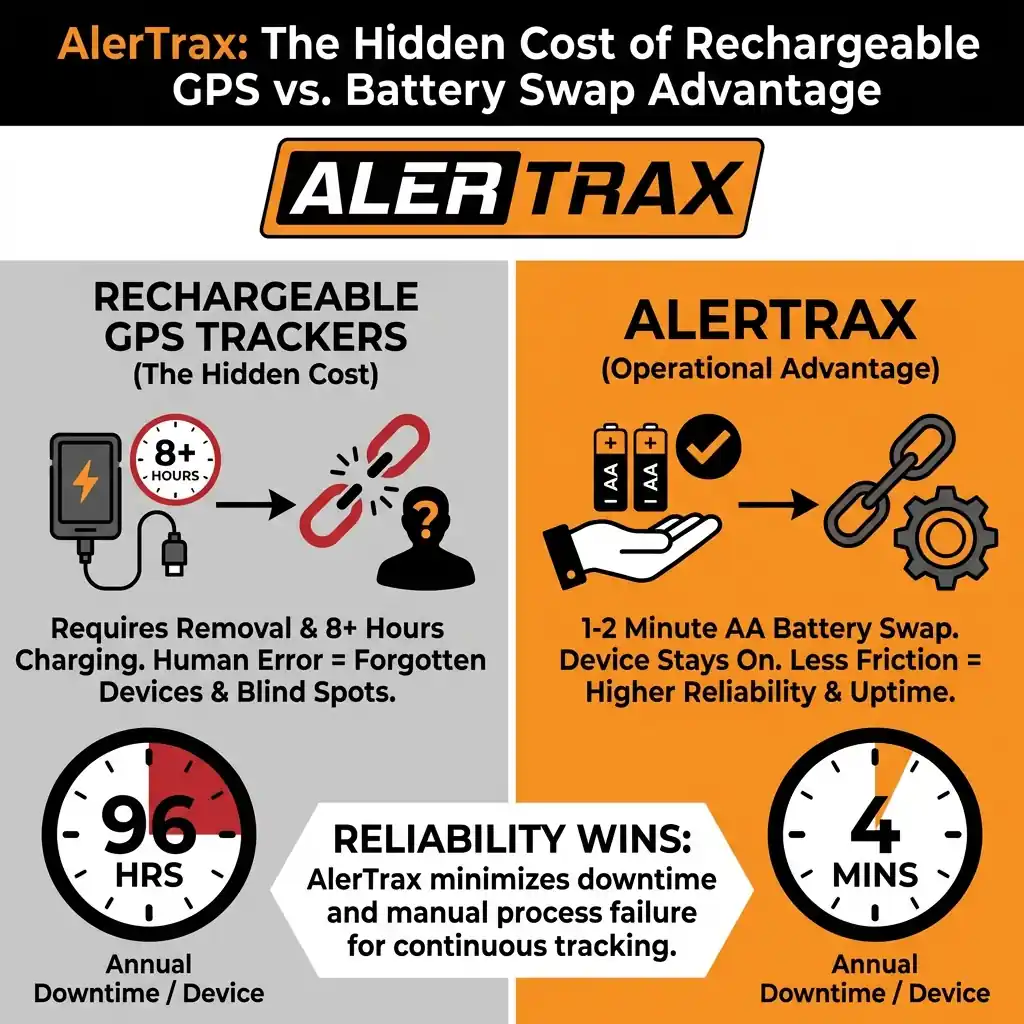
If a device has to be removed, charged for 8 or more hours, and reinstalled, you are creating predictable blind spots.
AlerTrax uses common AA batteries so a battery swap takes about one to two minutes, with far less downtime and fewer human errors.
Rechargeable trackers create planned downtime
When a tracker is on a charger, it is not on the asset. That is 100 percent downtime during the charge window.
Many rechargeable units require 6 to 10 hours to fully recharge. If a device is charged monthly, that is roughly 96 hours of downtime per year per asset.
The real failure point is human workflow
Rechargeables add steps. Remove it. Find the cable. Charge it. Remember it. Put it back.
In field operations, that is where tracking quietly fails. Devices get left on benches, tossed in glove boxes, or reinstalled late.
If the tracker is not on the asset, you do not have visibility, even if the software looks fine.
Recharge cycles never happen on schedule
Manufacturers advertise recharge intervals like 30, 60, or 90 days. In practice, runtime depends on reporting frequency, signal strength, movement, and temperature.
Cold weather can reduce battery performance. Poor cellular coverage increases power draw. Higher alert frequency drains faster.
The result is unexpected dead devices and coverage gaps at the worst time.
Battery degradation turns into maintenance
Lithium batteries lose capacity over time. After enough cycles, the same device that used to last weeks now lasts days.
That means more removals, more charging, and eventually device replacement or service.
Why a quick AA battery swap is different
With AlerTrax, you do not take the tracker off the vehicle or equipment. You swap common AA batteries in about one to two minutes.
That turns hours of downtime into minutes. It also reduces dependence on employee follow-through.
AA batteries are easy to stock, easy to source, and easy to standardize across a fleet.
The math makes the decision
Example: 8 hours per charge, 12 charges per year equals 96 hours of downtime per asset annually.
Example: a two minute battery swap twice per year equals about 4 minutes of downtime per asset annually.
Minutes of maintenance beat hours of downtime.
Sources
- Fleet operations research on process compliance and human error in maintenance workflows.
- Battery engineering references on lithium cycle life and capacity fade over time.
- Asset tracking field experience showing missed charging and reinstallation as a primary driver of tracking blind spots.
Choose visibility you can trust
If a tracker requires charging, it will eventually create blind spots. Not because your team is careless, but because the workflow is fragile.
AlerTrax is built for real operations. Quick AA battery swaps keep devices on the asset and keep visibility online.
AlerTrax gives you clear visibility with simple, business-grade tracking. Choose a $599 one-and-done purchase for long-term protection, or get started for just $99 upfront on a monthly plan.
You should be able to check, not guess.