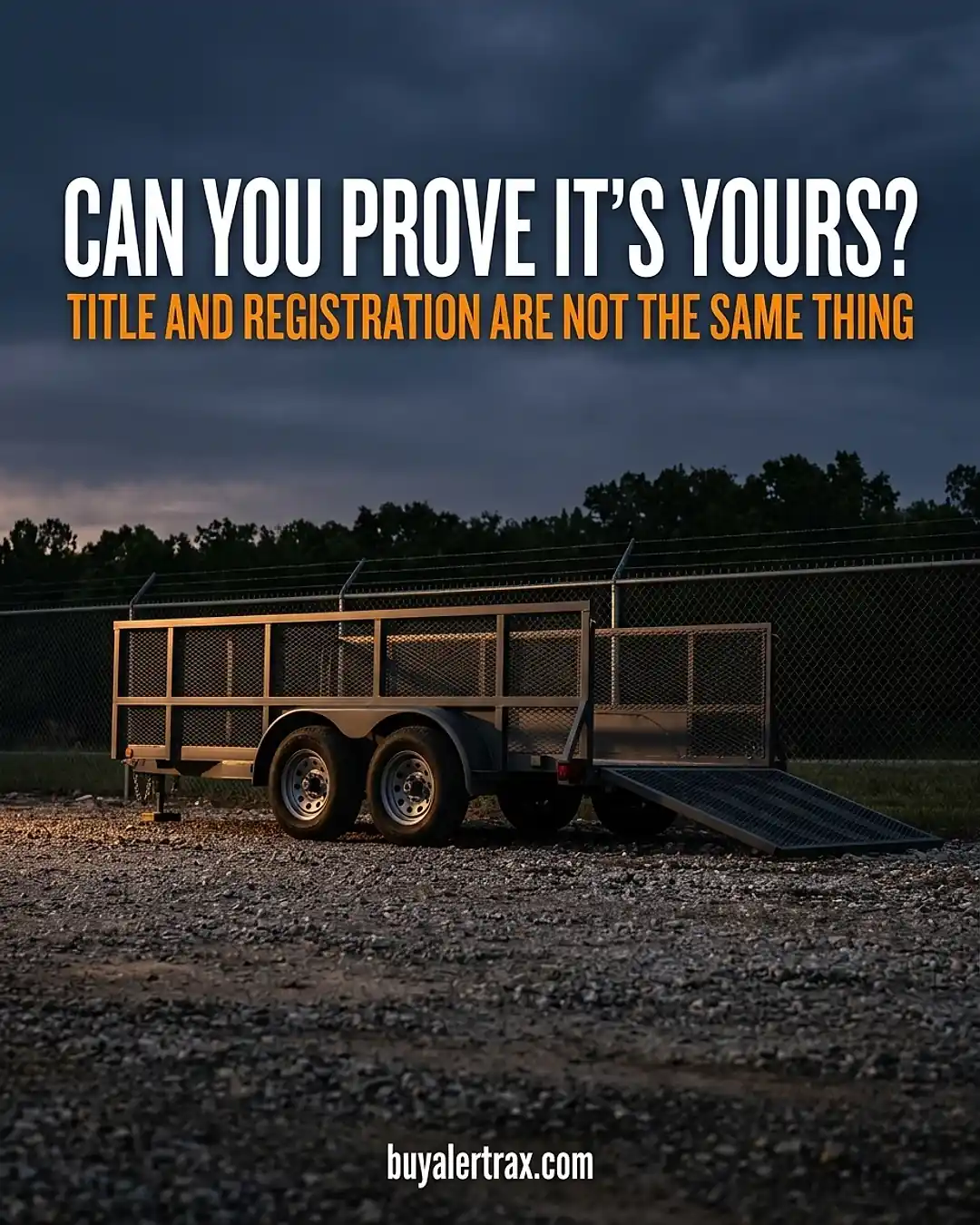
You bought the trailer four years ago from a guy in a parking lot. Cash, a handwritten bill of sale on a piece of notebook paper, a handshake. It has hauled a mower deck five days a week ever since and it has never given you a minute of trouble.
Then something happens that requires you to prove it is yours.
Maybe you are selling it and the buyer wants a title. Maybe your insurer asks for documentation before adding it to a policy. Maybe a state trooper runs the plate at a weigh station. Or maybe it is gone one Monday morning and the officer taking the report asks for the VIN and the title, and all you have is a photograph of it hitched to your truck.
At that moment the notebook paper is worth about what it cost.
This is one of the most common gaps in small fleet paperwork, and it is almost always invisible until the day it matters. Here is how the rules actually work, and what it takes to fix it after the fact.
Title and Registration Are Not the Same Thing
Nearly every conversation about trailer paperwork goes sideways in the first thirty seconds because two different documents get treated as one.
A title is proof of ownership. It says who owns the trailer. It is what a buyer needs, what an insurer wants, and what law enforcement uses to establish that a recovered trailer belongs to you rather than to whoever was towing it.
Registration is permission to be on the road. It produces a plate and a sticker. It says the state knows this trailer exists and that somebody paid the fee this year.
They are issued separately, they are required under separate rules, and in a large number of states a working trailer is legally registered and legally on the road while having no title at all. That is not a loophole or an oversight. It is how the statutes are written. The problem only appears when you need the document you never got.
The Weight Number That Decides Everything
Most states hang the titling requirement on a single weight threshold, and the number is different in every state that uses one.
In Texas, the Texas Department of Motor Vehicles sets the line at 4,000 pounds gross weight, which it defines as the trailer weight plus the weight it can carry. At or below that figure a manufactured trailer does not have to be titled. Above it, it does. Registration is a separate matter entirely: TxDMV states that registration is required for all non-farm trailers operating on public highways, title or no title.
In Florida, the threshold is half that. Florida Highway Safety and Motor Vehicles procedure TL-13 states that trailers weighing 2,000 pounds or more must be titled, and lists trailers under 2,000 pounds among those not subject to the titling requirement.
California does not fit the pattern at all. Utility and commercial trailers there run through the California DMV Permanent Trailer Identification program, a separate registration track with its own identification numbers and its own renewal cycle, where titling is handled as a distinct option rather than an automatic consequence of registering.
So a landscaper running a 3,000 pound tandem axle is required to hold a title in Florida, is not required to hold one in Texas, and in California is dealing with a program that does not look like either.
We are deliberately not publishing a fifty state table. The thresholds move, several states carve out farm and utility use separately, and a table that is confidently wrong about your state is worse than no table. Call your own DMV, or pull the titling page for your state, and get the number in writing before you act on anything you read here.
Shop-Built Trailers Have Their Own Path
Plenty of the trailers doing real work in this country were welded up in somebody's shop. Those trailers were never issued a manufacturer's certificate of origin, and they have no factory VIN, so the state has to assign one before any paperwork can exist.
The process is broadly similar across states and it is more involved than people expect. TxDMV notes that all assembled trailers now require a VIN obtained through inspection by an authorized law enforcement officer. Virginia handles VIN assignment through DMV customer service centers, with its own application forms and fees, and is explicit that a trailer built by a manufacturer is not eligible to receive a VIN plate that way.
Typically you will need receipts or a bill of sale for the materials, a physical inspection by law enforcement or a DMV examiner, a weight slip from a certified scale, and an application for an assigned VIN. None of it is difficult. All of it takes longer than the afternoon you were hoping to spend on it, and none of it can be started after the trailer has already disappeared.
When There Is No Title at All: The Bonded Title
This is the expensive one, and it is where the notebook paper finally gets priced.
If you cannot produce a properly assigned title and one was never issued, most states offer a bonded title: you post a surety bond, the state issues a title with a notation on it, and after a set period the notation comes off. It works. It is also a real process with real cost.
The Nebraska Department of Motor Vehicles publishes its requirements plainly, and they are representative of what this looks like. The surety bond must be written for one and one half times the current value of the vehicle. The bond must run for three years. Along with it, the applicant submits certified letters and return receipts documenting the search for the prior owner, the original bill of sale or cancelled check, a photograph showing the front and side of the trailer, a sheriff's inspection certificate valid for ninety days, and an application and title fee.
Read that list again with a stolen trailer in mind. Certified letters to a previous owner you bought from in a parking lot. A sheriff's inspection of a trailer that is not there. A photograph of the front and side.
The bonded title is a fix for a trailer sitting in your yard. It is not a fix for one that is already gone.
Four Things to Do This Week
- Photograph the VIN plate on every trailer you own. Wire brush it first if you have to. Put the photos somewhere that is not only on your phone.
- Pull your folder and sort it. Title, registration, bill of sale, or nothing. Most fleets find at least one trailer in the "nothing" pile.
- Check your state's threshold against the weight of each trailer, and find out whether the ones in the nothing pile were ever supposed to have a title.
- Start the bonded title now on anything that should have one and does not. It takes weeks, and every requirement on the list gets harder once the trailer is missing.
Paperwork Proves Ownership. It Does Not Find the Trailer.
A title answers the question "is this yours." It does nothing at all for the question that comes first, which is "where is it."
That gap is worth understanding, because the recovery numbers for equipment are not encouraging. The National Insurance Crime Bureau has long put recovery rates for stolen heavy equipment well under 25 percent, a fraction of the rate for stolen passenger vehicles, largely because equipment and trailers lack the registration and tracking paper trail that follows a car through its life.
A tracker closes the other half. AlerTrax is built for exactly the assets that fall through this gap:
- Geofence and after-hours alerts: A notification when a trailer leaves the yard, whether that is a Tuesday afternoon or three in the morning on a Sunday.
- Live fleet map: Every asset visible in the AlerTrax Fleet Portal and the iOS and Android app, updating as often as every 2 minutes.
- Route history: A location record to hand an officer, so a report starts with an address instead of a description.
- Tamper alerts: Notification if a device is disturbed or disconnected.
- Over a year of battery life, no wiring: Magnetic mount, about a minute per unit, which matters on a trailer with no power of its own.
- 100% waterproof and ruggedized: Built to sit outside on a trailer frame year round.
Pricing
AlerTrax is $49.99 per month for 12 months, with no long-term contract and no hidden fees.
(Want to own it outright? There is a $599 Lifetime option for permanent, subscription-free tracking. No fees, ever.)
Go Look in the Folder
Most of the contractors we talk to have between two and ten trailers and can account for the paperwork on roughly half of them. That is not carelessness. Trailers get bought used, inherited from a bought-out competitor, welded up in the shop, or handed over with a key and a handshake, and none of those roads ends at a title.
The folder takes twenty minutes to go through. Do that this week, and put a tracker on the ones that matter, so that the question you have to answer is never "can you prove it was yours."
Visit www.buyalertrax.com, or email sales@buyalertrax.com with what you are running and we will tell you what it takes to cover it.
Sources
Texas Department of Motor Vehicles, Trailers, retrieved September 2026: titling required above 4,000 lbs gross weight; registration required for all non-farm trailers on public highways; assembled trailers require a VIN obtained through law enforcement inspection
Florida Highway Safety and Motor Vehicles, Division of Motorist Services Procedure TL-13, retrieved September 2026: trailers weighing 2,000 lbs or more must be titled; trailers under 2,000 lbs not subject to titling
California Department of Motor Vehicles, Vehicle Industry Registration Procedures Manual, Chapter 14, Permanent Trailer Identification, retrieved September 2026
Maryland Department of Transportation Motor Vehicle Administration, Title & Registration for Trailers & Mobile Homes, retrieved September 2026
Virginia Department of Motor Vehicles, Homemade Trailer VIN Verification and Install, retrieved September 2026
Nebraska Department of Motor Vehicles, Bonded Certificate of Title, Motor Vehicle/Trailer, retrieved September 2026: surety bond at one and one half times current value, three year bond term, sheriff's inspection certificate, certified letters and return receipts
National Insurance Crime Bureau: recovery rates for stolen heavy equipment historically well under 25 percent, compared with a substantially higher rate for stolen passenger vehicles
Disclaimer: AlerTrax is a GPS tracking company, not a law firm, and this article is general information rather than legal advice. Titling and registration requirements vary by state, change over time, and depend on how a trailer is used. Confirm the rules with your own state motor vehicle agency before acting.