When small business owners talk about theft, the conversation usually starts and ends with insurance.
Was it covered?
What is the deductible?
How long until the check shows up?
Those are important questions. They are also the wrong place to stop.
Insurance reports and police statistics capture only a fraction of what theft actually costs a small business. They account for replacement value. They do not account for disruption, downtime, lost opportunities, or the slow bleed that happens after the initial incident.
For many small businesses, the real damage begins after the claim is filed.
What the Data Says About Small Business Theft
According to FBI Uniform Crime Reporting data, larceny and equipment theft account for billions in annual losses across the United States. Construction, transportation, landscaping, utilities, and service businesses are among the most affected.
The National Insurance Crime Bureau consistently reports rising commercial theft claims, especially for trailers, tools, and mobile equipment. These numbers are often cited as proof of the problem.
But they only tell you what was insured.
Insurance data reflects replacement value, not business impact. It measures what disappeared, not what stopped working.
That distinction matters.
Why Insurance Numbers Understate the Real Cost
Insurance claims focus on physical assets. Businesses operate on time, schedules, crews, and customer commitments.
When an asset disappears, several things happen immediately that never show up on a claim form.
Jobs get delayed. Crews stand around. Phones start ringing. Decisions that should take minutes stretch into days.
Studies from the U.S. Chamber of Commerce show that disruptions, even short ones, have an outsized impact on small businesses. Unlike large enterprises, small operations do not have excess capacity sitting idle.
When one trailer goes missing, it often takes an entire crew with it.
Downtime Is the Most Expensive Line Item
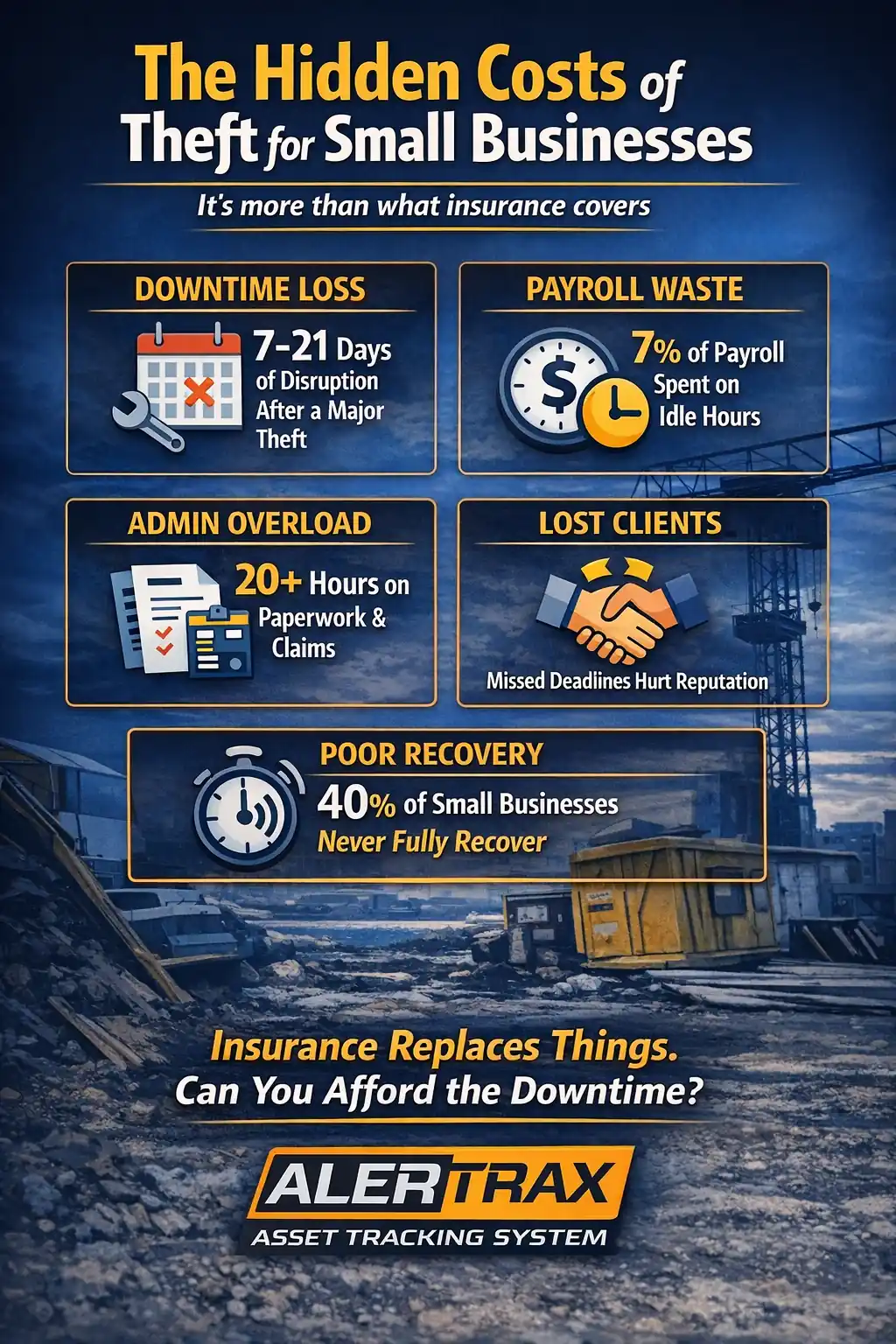
Industry studies estimate that after a significant equipment theft, small businesses experience between 7 and 21 days of operational disruption. That number varies by trade, but the pattern is consistent.
The business is technically open, but it is not fully productive.
Here is what downtime actually looks like:
- Crews reassigned to lower value work
- Jobs postponed or canceled entirely
- Emergency rentals at premium rates
- Owners spending hours on paperwork instead of revenue
- Missed deadlines that affect future bookings
None of this is reimbursed.
If a contractor bills $1,500 per day per crew and loses one crew for a week, that is $7,500 in lost revenue. Multiply that by two or three weeks and the numbers quickly exceed the value of the stolen asset.
Insurance replaces things. It does not replace time.
Payroll Does Not Stop When Work Does
One of the least discussed costs of theft is payroll waste.
Employees still show up. They still clock in. But without the right equipment, productivity drops sharply.
American Payroll Association data estimates that inefficiencies and lost time can quietly consume up to 7 percent of payroll even without theft. Add a disruption event and that number spikes.
Good employees feel it immediately. They want to work. They want to finish jobs. Standing around waiting for replacement equipment creates frustration and disengagement.
Bad morale does not show up on a balance sheet, but it shows up in turnover.
The Administrative Black Hole After a Theft
After a theft, small business owners often become part-time administrators.
Police reports. Insurance adjusters. Rental companies. Vendors. Customers. Employees.
Each interaction takes time. Each one pulls attention away from sales, planning, and growth.
Research on small business resilience shows that owners typically spend 10 to 20 hours dealing with post-theft administration in the first week alone. That time has an opportunity cost.
For many owners, those are the same hours normally spent quoting jobs or closing new work.
Customer Trust Takes a Hit
Customers rarely see theft as an excuse.
They may sympathize, but they still need the job done.
Missed deadlines and rescheduled work erode confidence, especially in service businesses that rely on reliability and referrals. Studies on customer retention consistently show that delays and communication breakdowns are among the top reasons customers switch providers.
One missed job can ripple outward. A delayed project can cost future work that never appears in any report.
Insurance does not cover reputation.
Why Recovery Time Matters More Than Replacement Cost
Law enforcement and insurance data both point to a critical factor in theft outcomes: time.
Recovery rates for stolen equipment drop sharply after the first 24 hours. Assets recovered quickly are often returned intact. Assets recovered late are frequently damaged, stripped, or never found.
The problem is that many businesses do not realize something is missing until hours or days later.
Overnight thefts often go unnoticed until Monday morning. Weekend jobsites may not be checked at all. By the time the theft is discovered, the window for recovery has closed.
The cost is no longer the asset. It is the aftermath.
The Businesses That Recover Fast Share One Trait
When you look at case studies of businesses that recover quickly from theft, one pattern stands out.
They knew something was wrong early
Whether through location visibility, movement alerts, or simple awareness, they reduced the time between theft and response. That single change dramatically improved outcomes.
Faster awareness leads to:
- Faster police reports
- Better recovery odds
- Less downtime
- Fewer missed jobs
- Lower secondary losses
This is not about catching thieves. It is about shortening disruption.
Why Small Businesses Feel Theft More Than Large Ones
Large companies absorb losses differently. They have spare equipment, backup crews, and layered processes.
Small businesses run lean by necessity.
When one asset disappears, it often represents a meaningful percentage of operational capacity. That is why research shows that nearly 40 percent of small businesses never fully recover from a major disruption event.
It is not the theft alone that causes failure. It is the cascade of secondary effects.
Rethinking Theft as an Operational Risk
The mistake many small business owners make is viewing theft as a rare, external event.
In reality, it is an operational risk that increases with growth, mobility, and complexity. The more assets move between jobsites, the more exposure exists.
Risk management is not about eliminating every threat. It is about reducing impact when something happens.
Visibility shortens recovery time. Faster recovery reduces damage. Reduced damage preserves momentum.
The Real Question Small Businesses Should Ask
The question is not whether insurance will pay.
The real question is how long the business can afford to be disrupted.
Every hour between theft and awareness increases cost. Every day without answers compounds losses that never appear in a report.
Small businesses that understand this stop thinking about theft as a replacement problem and start treating it as a response problem.
That shift is where the real savings live.