A homeowner calls. They want a quote on a weekly maintenance property: half-acre lot, some beds, a slope out back. You drive out, walk it, and do the thing every landscaping owner does. You look at it, picture your crew working it, and pull a number out of your head. "We can do that for $185 a visit."
Where did $185 come from? If you are honest, it came from a gut feel built on a similar job you did a couple of years ago, plus whatever you charged the last guy on that street, plus a little cushion you hope covers it. It was not built on how long your crew will actually spend there. You do not know that number. You are guessing, and you are going to live with that guess every week for the entire season.
That is bidding blind. And in an industry running on razor-thin margins, it is the single most expensive habit an owner can have, because a bad bid does not cost you once. It costs you every single time that crew shows up.
A Bad Bid Is the Gift That Keeps on Taking
Here is what makes a mispriced job so dangerous. A one-time mistake stings and then it is over. A mispriced recurring contract is a slow leak you signed up for on purpose.
Say you bid that property at $185 assuming 45 minutes of crew time. In reality, with the slope, the trimming, and the cleanup, your crew spends 70 minutes there every visit. At a fully burdened crew cost, you are now losing money on that stop, and you will lose it again next week, and the week after, for 30-plus visits a season. You did not lose one job. You locked in a loss and put it on a recurring schedule.
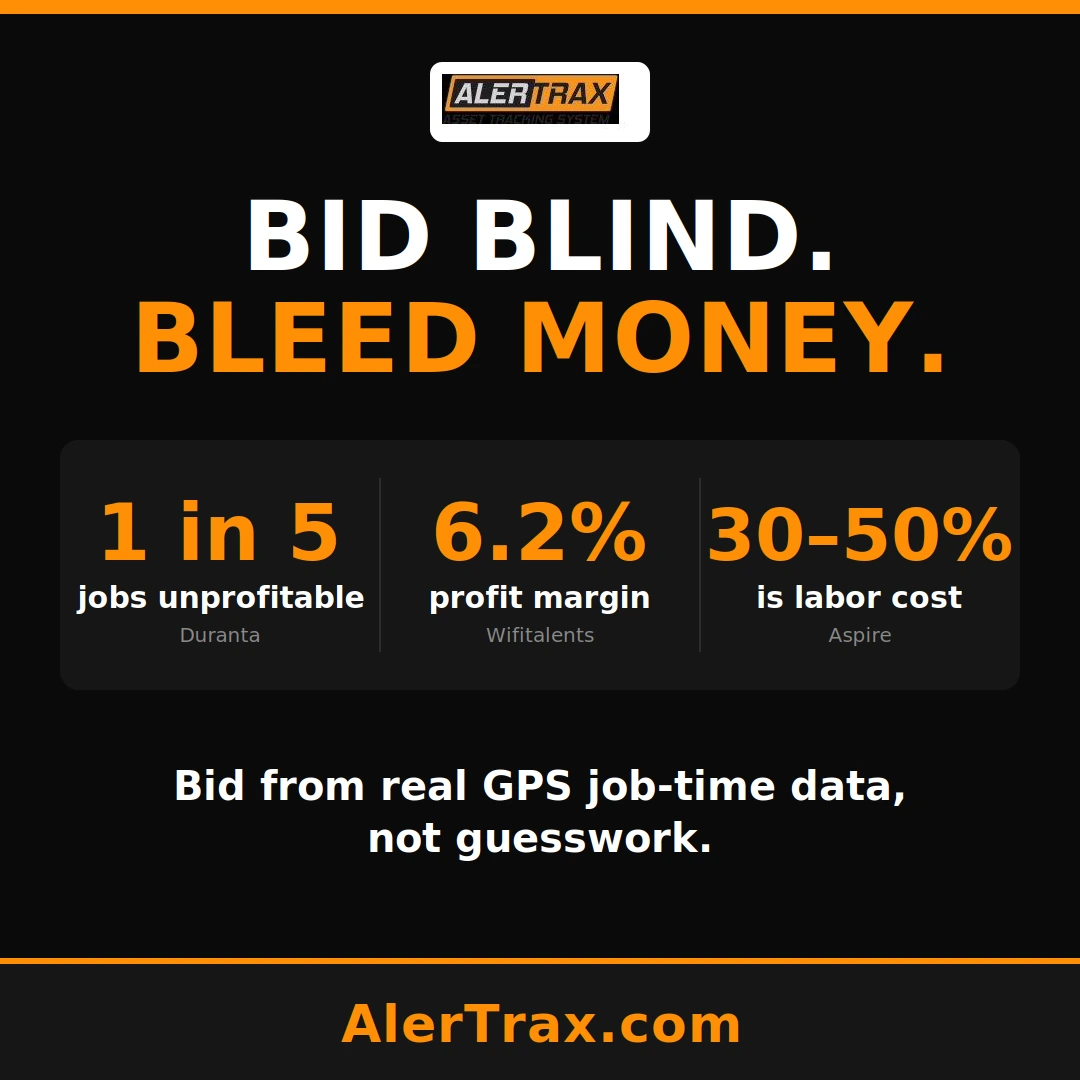
The industry data says this is not rare, it is the norm. Analysis from Duranta found that 1 in 5 landscaping jobs is unprofitable, and the most common cause is the most preventable one: actual labor hours quietly exceeded the estimate, and nobody caught it until the season was already over. Twenty percent of the work you fought to win is losing money, and most owners cannot tell you which twenty percent.
This matters because labor is the number you are guessing at, and labor is enormous. It runs 30 to 50 percent of total revenue (Aspire), and once you add labor burden, the payroll taxes, insurance, and overhead, a crew member you pay $20 an hour actually costs $24 to $27 an hour (Service Autopilot, 2026). When you misjudge crew time on a bid, you are misjudging the biggest, most expensive variable in the whole equation.
At a 6.2% Margin, There's No Room to Guess
The reason bidding blind is fatal and not just sloppy comes down to how little cushion this industry actually has. The average landscaping company runs a 6.2 percent profit margin (Wifitalents). Well-run companies target 10 to 14 percent net (Fieldcamp). At 6.2 percent, you have to generate about $16 in revenue to keep a single dollar of profit. There is simply no room in that math for jobs that run 50 percent longer than you bid them.
And the pressure is getting worse, not better. 48 percent of owners cite material costs as their top concern for 2026, and 37 percent anticipate cost increases of 10 percent or more (Aspire 2026). On the labor side, 70 percent of companies plan wage increases in 2026, with 44 percent planning increases of 4 percent or more (Aspire 2026). Your costs are climbing on both sides of the ledger. If your bids are built on a two-year-old gut feel, they are already underwater before the crew turns a wheel.
Bidding from memory was survivable when margins were forgiving and costs were flat. Neither of those things is true anymore.
Your Trucks Have Been Collecting the Answer All Along
Here is the good news. The exact number you have been guessing at, how long your crew actually spends on a given type of property, is a number your operation produces every single day. You have just never captured it.
The moment your trucks have GPS tracking, every job becomes a data point. The device logs arrival and departure automatically, so you build a running record of real crew time on real properties: the half-acre residential with the slope took 68 minutes on average across the season; the flat quarter-acre takes 31; the commercial strip mall takes a crew of three exactly 2 hours and 10 minutes. No clipboard, no foreman estimate, no honor-system timesheet. Just the actual time, captured automatically, job after job.
This is the difference between this and simply tracking hours for billing. Capturing what already happened protects you on the jobs you already have. But the real leverage is forward: once you have a season of verified job times, you stop bidding from memory and start bidding from your own history. A new property comes up, you match it to the closest profile in your data, and you price it to a known labor cost and a target margin instead of a hopeful guess.
What your trip reports give you for estimating:
- Real crew-time averages by property type, so a new bid starts from a number you have actually measured, not one you remember.
- Drive time between jobs, which is real paid labor most bids ignore entirely. A cheap-looking job 25 minutes from your other work may be your worst account.
- The true cost of the "problem" properties, the slope, the tight access, the chatty client, so you can price the difficulty instead of eating it.
- Hard data to reprice renewals, so when a money-losing contract comes up again, you raise it with confidence or let it go, instead of re-signing the same loss.
From Hoping a Bid Holds to Knowing It Will
Picture the same homeowner calling next season, after you have a year of data behind you. You drive out, walk the property, and instead of reaching for a gut number you reach for what you know. Half-acre, moderate slope, that matches a profile your crews have run dozens of times, and your data says it takes about 65 minutes door to door including the trimming. You know your burdened crew cost per minute. You apply your target margin. You quote a number you can actually live with for 30 visits, because it is built on arithmetic, not optimism.
Multiply that across every bid you write. The jobs you take are priced to make money. The renewals are repriced from evidence. The accounts that were quietly bleeding you get raised or released. You are not working any harder. You are just no longer the owner who finds out in November which jobs lost money all summer.
That is how the gap between a 6 percent year and a 12 percent year closes. Not with more trucks or longer hours, but with bids that are right the first time.
Why Alertrax Is Built for Landscaping Fleets
Most GPS systems were designed for over-the-road logistics: hardwired installs, constant 12-volt power, dedicated drivers. Your operation is nothing like that. Trucks, trailers, mowers, and skid steers move between crews and job sites every day, and you do not have time for installation appointments.
Alertrax was engineered for the way landscaping fleets actually run.
- Automatic Time-on-Site Logging: Arrival and departure timestamps at every stop, recorded automatically, the raw material for accurate bids and confident repricing.
- Complete Trip Reports: Date, address, arrival, departure, duration, and mileage for every vehicle, every day, exportable to PDF or CSV so you can build your own job-time library.
- One-Year Battery Life, No Wiring Required: Runs over a year on two AA batteries. No splicing, no OBD-II port, no install appointment. Mount it and it works.
- Track Anything That Moves: Trucks, trailers, mowers, skid steers, and equipment, one platform for the whole fleet.
- Live Fleet Map: Every asset on one live map from the Fleet Portal or the iOS and Android app.
- Geofence and After-Hours Alerts: Set boundaries around the yard, job sites, and customer properties, and get notified on arrivals, departures, and movement that shouldn't be happening.
- 100% Waterproof, Ruggedized Housing: IP67 rated, covert magnetic mounting, built to survive mud, rain, and pressure washing.
Pricing That Earns Its Keep on a Single Repriced Contract
You can equip your entire fleet for a low monthly rate, with no long-term contracts and no hidden fees.
(Want to own it outright? We offer a $599 Lifetime option for permanent, subscription-free tracking.)
Think about what one corrected bid is worth. If your data catches a single recurring contract that was losing $40 a visit and you reprice it, that is well over $1,000 recovered across a season, from one account. Find two or three of those, and the tracking system has paid for itself many times over before you count any of the day-to-day operational savings. Better bids are not a soft benefit. They are the highest-leverage dollar in the whole business.
And Yes, It Protects Your Equipment Too
The same device building your job-time library is watching your equipment around the clock. Equipment theft costs the industry an estimated $400 million annually, and 40 percent of stolen landscaping equipment is never recovered (AMAROK / NER), with a single truck out of service costing up to $4,000 a day in lost revenue (AMAROK). With after-hours movement alerts you know within minutes if a trailer leaves the yard overnight, and you have a live location to give law enforcement. It is not the reason to buy GPS tracking. It is the bonus that rides along with it.
Bid From What You Know, Not What You Hope
Every bid you write is a promise you make to your own margin for an entire season. Right now most owners make that promise on a gut feel and find out months later whether it held. The data to make it on purpose already runs through your operation every day. You just need to capture it.
It does not take new habits from your crews or new software for anyone to learn. It takes one device per asset, mounted in under a minute, quietly building the job-time history that turns your next bid from a guess into a calculation.
Visit www.buyalertrax.com today and stop bidding blind.
Sources
Duranta, "1 in 5 landscaping jobs is unprofitable"
Aspire (2025), "Labor = 30-50% of total revenue"
Aspire Commercial Landscape Industry Report (2026), "48% cite material costs as top concern; 37% anticipate 10%+ cost increases; 70% plan wage increases; 44% plan increases of 4%+"
Service Autopilot (2026), "Labor burden adds 20-35% on top of base wages; a $20/hr employee costs $24-$27/hr"
Wifitalents, "6.2% average profit margin"
Fieldcamp, "Well-run companies target 10-14% net profit"
AMAROK / NER, "$400M annual equipment theft losses; 40% never recovered; up to $4,000/day lost revenue per truck"