A guy gave notice on Friday. Good worker, three seasons in, knew the Ridgefield route cold, knew which gate code was wrong in the system and which customer wanted the side yard skipped. He is gone in two weeks, right as you are staffing up for fall cleanup.
So you do what everyone does. You post the job, you ask the crew if their cousin needs work, and you tell yourself you will find somebody by mid-September.
Maybe you will. But here is the part worth sitting with: even if you fill that slot next week, the thing you actually lost is not a pair of hands. It is everything that was in his head about how those properties run. The new guy will show up with a strong back and no idea that the Ridgefield job takes forty minutes longer than the estimate says, because the only place that fact ever lived was in the memory of the person who just quit.
The labor market is not going to bail you out of this. The numbers say so pretty clearly. What follows is what the federal data actually shows about the workforce you are hiring from, and the one lever that is still fully under your control with eleven weeks left in the season.
This Occupation Replaces Itself Constantly
Start with the shape of the workforce, because it explains why hiring feels the way it does.
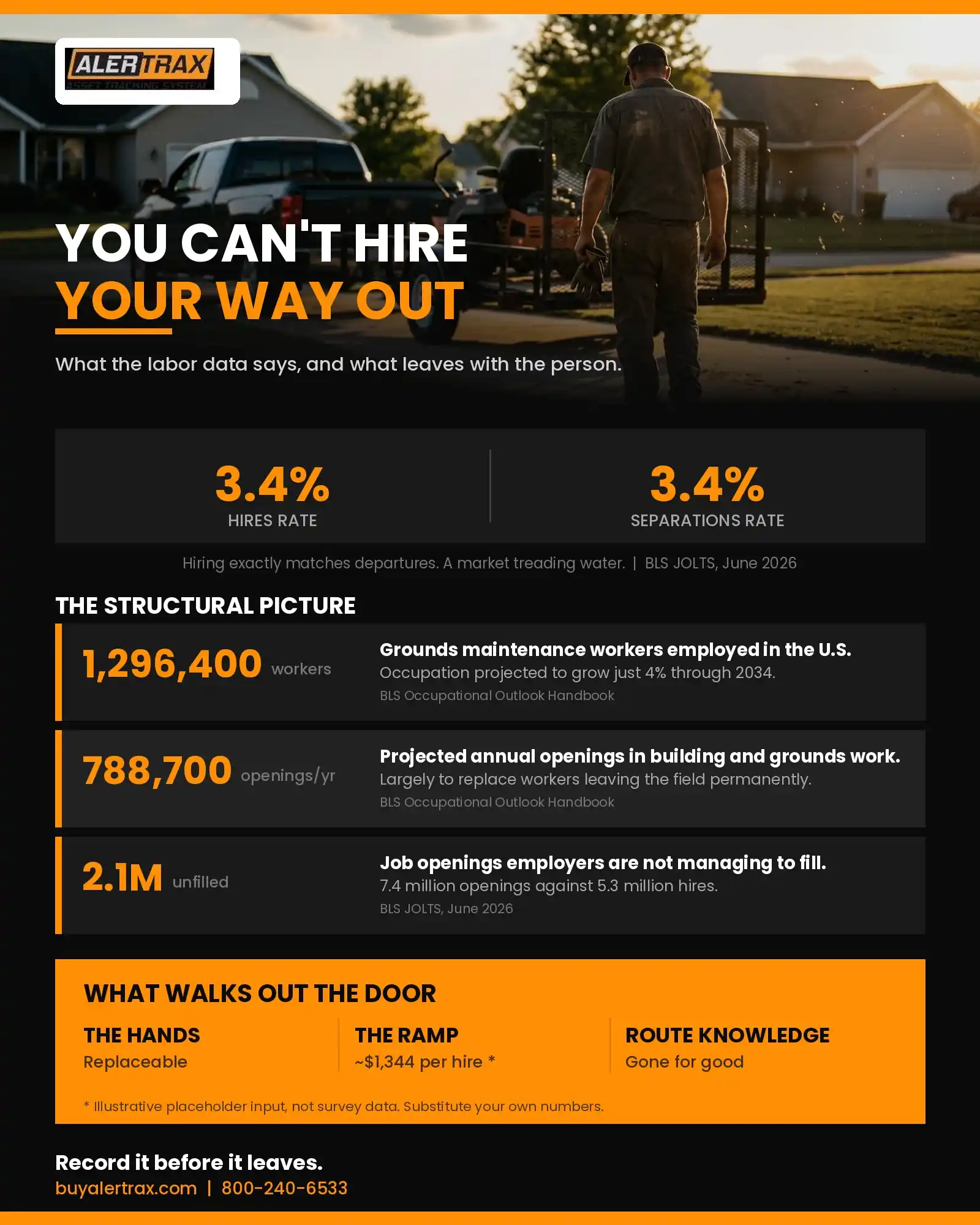
There were 1,296,400 grounds maintenance workers in the United States as of 2024. The Bureau of Labor Statistics projects the occupation will grow 4 percent between 2024 and 2034, adding 45,900 jobs across the entire decade (U.S. Bureau of Labor Statistics, Occupational Outlook Handbook, Grounds Maintenance Workers).
Do that division and it comes out to roughly 4,600 net new jobs per year nationally, against a base of nearly 1.3 million. That is about a third of one percent. In other words, essentially flat.
So if the occupation is barely growing, why does everyone in this industry feel like they are hiring constantly? Because the openings are not coming from growth. Across building and grounds cleaning occupations as a whole, BLS projects about 788,700 openings every year, and describes them as arising largely from the need to replace workers who leave the occupations permanently (BLS, Occupational Outlook Handbook, Building and Grounds Cleaning Occupations).
That is the entire dynamic in one sentence. You are not hiring into expansion. You are hiring onto a treadmill, replacing people who are exiting the line of work altogether. And every one of those exits takes accumulated job knowledge with it.
The wage context matters too. The median grounds maintenance worker earned $18.50 per hour, or $38,470 per year, as of May 2024 (BLS). That is the number you are competing against when somebody decides whether this work is worth staying in.
The Hiring Market Cooled, Which Cuts Both Ways
Now the current conditions, which are genuinely unusual and worth understanding before you build a fall staffing plan around assumptions from two years ago.
In the most recent federal figures, covering June 2026 and released on August 4, there were 7.4 million job openings nationally, 5.3 million hires, and 5.4 million total separations. Within those separations, quits were 3.2 million and layoffs and discharges were 1.8 million (BLS, Job Openings and Labor Turnover Survey).
The rates tell the story more plainly. The hires rate and the total separations rate were both 3.4 percent. The quits rate was 2.0 percent. Earlier this year, in February, the hires rate fell to 3.1 percent, the lowest it has been since April 2020 (BLS, JOLTS).
Two things follow from that, and they pull in opposite directions.
The good news: with quits at 2.0 percent, fewer people are voluntarily walking out the door than during the churn of a few years ago. Your existing crew is somewhat less likely to be poached this fall than they were in 2022.
The bad news: hiring has slowed to match separations almost exactly. A hires rate equal to the separations rate describes a market that is treading water. There are 7.4 million openings against 5.3 million hires, a gap of more than two million positions that employers want filled and are not filling. Those openings are not sitting there because employers stopped trying. They are sitting there because the match is not happening.
Which means the September plan that starts with "we will just add two guys" is a plan resting on an assumption the data does not support.
What Actually Walks Out the Door
Here is the part almost nobody puts a number on, because it does not appear on any line of a P&L.
When an experienced crew member leaves, you lose three distinct things, and only one of them is labor.
The hands. Obvious, replaceable, and the only piece most owners actually plan for.
The ramp. A replacement does not produce at full rate on day one. Suppose it takes three weeks to get there and the new hire runs at 60 percent of full output during that stretch. At a fully burdened $28 an hour across a 40-hour week, that shortfall is roughly $1,344 per replacement. Lose four people between now and the end of the season and you are at about $5,400. Every number in that calculation is a placeholder input chosen to demonstrate the method, not a research finding. Substitute your own ramp time, productivity estimate, and labor rate.
The route knowledge. This is the expensive one, and it is invisible. Which properties actually take longer than they are priced for. Which sequence of stops avoids the school traffic at 2:45. Which customer needs a heads-up text before you arrive. Which gate is the one that sticks. How long the Ridgefield job really takes.
None of that is written down anywhere in most companies. It lives in a person. And when the person leaves, it does not transfer to the replacement, it simply evaporates, and your new hire spends the next two months rediscovering things your company already knew.
Route Knowledge Is an Asset. Most Companies Never Record It.
Think about how strange this is compared to how you treat every other asset in the business.
You would never let a $12,000 mower leave the yard without knowing where it went. But you routinely let years of accumulated operational knowledge walk off the property with two weeks' notice, and you have no system that captures any of it.
The reason is not negligence. It is that until recently there was no practical way to record it. Asking a foreman to log arrival times, durations, and route sequences by hand is asking him to do paperwork instead of work, and it does not survive contact with a real Tuesday.
But if your trucks and equipment are tracked, that record builds itself. Every arrival timestamp, every departure, every duration at every property, every route sequence across the season, all captured without anyone writing anything down.
Which means the answer to "how long does Ridgefield actually take" stops being a question you have to ask a specific person. It becomes a report you pull.
That is the difference between institutional knowledge and personal knowledge. Personal knowledge quits. Institutional knowledge stays.
Onboarding a Replacement With Data Instead of Hope
Concretely, here is what changes when you hand a new crew leader documented history instead of a truck key and a customer list.
Realistic time expectations per property. Instead of "this route should take you about six hours," you can say "the last crew averaged 6 hours 40 minutes on this route across 22 visits, and here is the property that runs long." The new person is measured against reality rather than against an estimate everybody privately knew was wrong.
The proven stop sequence. Route history shows the order that actually worked, including the detour around the construction on the main road that the last foreman figured out in May and never mentioned to anybody.
A fair evaluation window. When you can see that a new hire is running 15 percent over the established average in week two and 4 percent over in week six, that is a person learning the job normally. Without that baseline, you are managing on impressions, and impressions are where both unfair firings and overlooked problems come from.
Faster diagnosis when something is off. If the new crew is consistently long at one specific property but on pace everywhere else, that is a property problem or a training problem, and you can tell which within two weeks instead of two months.
Continuity for the customer. The property manager does not care that you had turnover. She cares that service did not change. Documented arrival windows make that a lot easier to deliver.
The Only Lever Fully Under Your Control
Step back and look at the levers available to a landscaping owner in late August.
You cannot change the labor supply. BLS is telling you the occupation is flat and the openings are replacement-driven. You cannot much change the hiring market either, with the national hires rate sitting at 3.4 percent and openings going unfilled by the millions. You have limited control over wages, since you are bidding against a market median and your own margins.
What you do control is how much useful output you get from the crew hours you are already paying for, and how quickly a replacement becomes productive.
That is not a motivational statement. It is arithmetic. If you cannot add hands, the only way to get more work done is to lose less of the time you are already buying, which means knowing where it currently goes.
The System That Records It
AlerTrax exists to make that record automatic, so it accumulates whether or not anyone remembers to keep it.
- Time-on-site logging: Arrival and departure timestamps at every stop, with no check-in required from the crew. This is the raw material of route knowledge.
- AddressFence: Upload your customer address list once and get arrival and departure notifications per property automatically.
- Trip reports: Start time, stop time, addresses, distance, and duration for every trip, exportable by date range or by vehicle. This is what you hand a new crew leader.
- Route history: The complete sequence of stops for any day, so the order that worked is preserved after the person who worked it out is gone.
- Live GPS tracking: Location updates as often as every 2 minutes on the fleet map and in the app.
- Over a year of battery life on two AA batteries: No wiring, no OBD-II port, no install appointment.
- Track anything that moves: Trucks, trailers, mowers, and skid steers, so the record covers the whole operation.
- 100 percent waterproof, ruggedized housing: IP67 rated, built for mud, rain, and pressure washing.
There is also a people layer. TeamTrax is a free companion app that puts crew phones in the same dashboard as your equipment, on scheduled work hours only. It is useful during onboarding specifically, because it distinguishes between a crew that is on site and equipment that is on site, which are not the same thing when you have new people finding their footing.
Everything exports from the AlerTrax Fleet Portal.
What It Costs
AlerTrax is $49.95 per month for 12 months per device, no long-term contract and no hidden fees. (A $599 Lifetime option is available if you would rather own the device outright with no subscription.)
Compare that against the placeholder ramp figure above. If documented route history shortens a single new hire's learning curve by even a week, the arithmetic works out before you get to any of the other benefits.
Order at checkout.alertrax.com, or call 800-240-6533 and we will help you figure out how many devices you actually need.
A Note on Departures
One practical point that comes up whenever turnover is the subject. Most people who leave your company leave normally, and this is not about suspecting them. But equipment does occasionally fail to come back with a departing employee, and having a location record on every asset turns an awkward conversation into a short one. It is a small benefit compared to everything above, and it is worth knowing you have it.
Eleven Weeks, Same Crew
You are going into fall cleanup with roughly the crew you have. The federal data does not support a plan built on hiring your way to comfort, and the season is too far along to fix staffing structurally anyway.
What you can do is stop letting knowledge leave with people, and start getting more out of the hours you are already paying for. Both of those come from the same place: an actual record of where your crews go and how long the work takes.
The next person who gives notice is going to take a lot with them. Whether that includes your route knowledge is up to how you set things up between now and then.
Start building the record. Visit checkout.alertrax.com, email sales@buyalertrax.com, or call 800-240-6533.
Sources
U.S. Bureau of Labor Statistics, Occupational Outlook Handbook, Grounds Maintenance Workers - 1,296,400 jobs in 2024; median pay $18.50 per hour and $38,470 per year as of May 2024; projected 4 percent growth 2024 to 2034; employment change of 45,900 over the decade
BLS, Occupational Outlook Handbook, Building and Grounds Cleaning Occupations - Approximately 788,700 openings projected each year, largely due to the need to replace workers who leave the occupations permanently
BLS, Job Openings and Labor Turnover Survey, June 2026 (released August 4, 2026) - 7.4 million job openings, 5.3 million hires, 5.4 million total separations, 3.2 million quits, 1.8 million layoffs and discharges; hires rate 3.4 percent, separations rate 3.4 percent, quits rate 2.0 percent
BLS, JOLTS, February 2026 - Hires rate of 3.1 percent, the lowest since April 2020
Illustrative arithmetic: The three-week ramp period, the 60 percent productivity assumption, the $28 fully burdened hourly rate, and the four-replacement scenario are placeholder inputs chosen to demonstrate the calculation method. They are not survey findings or research results, and should be replaced with figures from your own operation.