The trackers came in on Tuesday. They are sitting in the box on the corner of your desk, and they have been sitting there for four days, because you know that the second you stick one under a truck bumper somebody is going to notice and the whole shop is going to have an opinion about it.
You are not worried about the technology. It mounts in a minute. You are worried about Danny, who has been with you nine years and does not miss a day, walking into the office and asking why you suddenly do not trust him.
That conversation is not a formality you get through on the way to the benefit. It is the thing that decides whether this works at all. Handled badly, a tracker costs you a good employee and buys you nothing. Handled well, most crews stop thinking about it inside a week. Here is how to handle it well.
Why the Conversation Matters More Than the Device
Start with an honest look at the research, because it does not universally flatter tracking. Peer-reviewed work on workplace monitoring finds that employees respond far more favorably when leaders communicate openly about exactly what data is collected, and when workers trust it will be used only for the stated purpose (Brinson et al., Cyberpsychology: Journal of Psychosocial Research on Cyberspace, 2024). The flip side is implied and worth saying plainly: monitoring introduced without that explanation reads as suspicion, and people react accordingly.
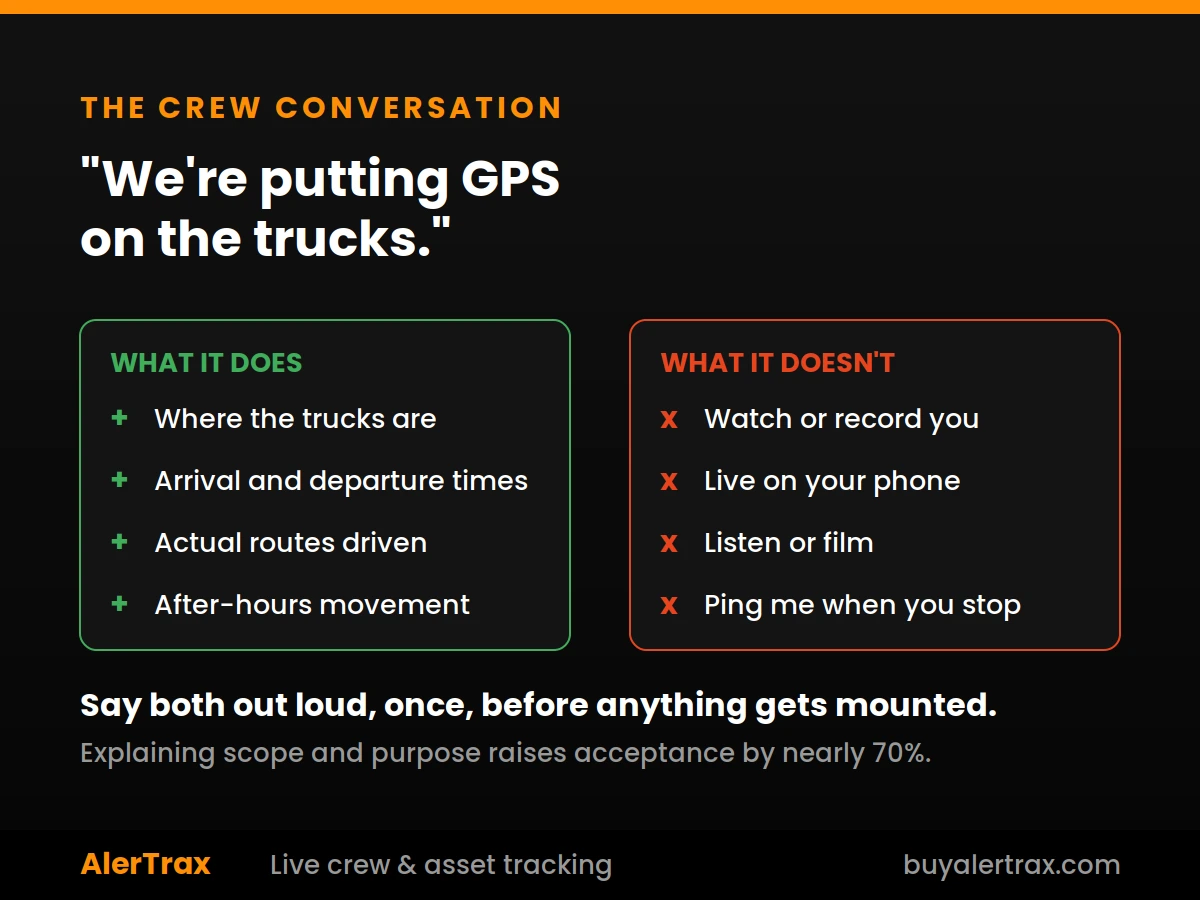
Research cited in that same paper found that explaining the scope and purpose of monitoring can raise employee acceptance of it by nearly 70 percent. Same device, same data, radically different reception, decided entirely by whether somebody explained it.
It is also worth knowing that workers are not paranoid for having a reaction. The Pew Research Center has found that majorities of American workers oppose employers using AI to track their movements. Your crew is bringing that broader context into the room whether or not it applies to what you are actually doing, and pretending they should not is how these conversations go sideways.
The pattern across all of it is consistent: people accept oversight that is transparent, limited to a clear purpose, and connected to something they recognize as legitimate. They resist oversight that is vague, open-ended, and introduced with no explanation. Your job in this conversation is to be the first kind.
Four Ways Owners Blow This
- Installing them quietly and hoping nobody notices. Somebody always notices, usually while looking for a dropped socket. Now the story is not "we track our trucks," it is "he hid something on my truck," and you have handed your crew a legitimate grievance you cannot argue your way out of.
- Announcing it right after a problem. If a customer complained on Thursday and the trackers show up Friday, everyone knows exactly what happened, and the whole crew gets to feel like suspects in somebody else's case.
- Overselling it. "This is going to make everybody's job easier" is not true and your crew knows it. The person whose job gets easier is you. Say that instead.
- Being vague about the limits. If you cannot answer "does this follow me home" and "are you watching me on the weekend" in one clear sentence each, your crew will fill in the blanks with the worst version.
Say It to the Whole Crew, Once, Before Anything Gets Mounted
Do it at a Monday morning huddle, in person, with everyone there. Not a text, not a memo taped in the shop, and not one-on-one conversations that let rumors form in the gaps. Two or three minutes is enough. Something close to this:
"Quick thing before you head out. We are putting GPS trackers on the trucks and the trailers this week. I want to tell you what they do and what they do not do, so nobody is guessing.
They tell me where the trucks are and when they got to a job and left it. I am using that for three things. One, scheduling, because I am tired of sending you across town twice in one day and I can finally see when I am doing that. Two, billing, because when a customer says nobody showed up, I want the record in front of me instead of asking you to remember a Tuesday from three weeks ago. Three, if a truck or trailer walks off overnight, I can find it before it gets stripped.
What it does not do is watch you. There is no camera and no microphone. I am not getting a text every time you stop for coffee. It is on the truck, not on your phone, so when the truck is parked at your house it just sits there and I have no reason to look at it.
This is not about anybody in this room. If I had a problem with somebody I would be talking to that person, not buying hardware. Ask me anything about it now or catch me later."
Then actually take the questions. The willingness to stand there and answer is most of the message.
The Four Questions They Will Ask
"Are you tracking me at home?" The honest answer is that the device is on the vehicle and it reports where the vehicle is, so yes, if the truck is in their driveway, the truck's location is in the system. Do not fudge that. What you commit to is the policy: you look at work hours and you do not run reports on people's evenings, and the reason after-hours alerts exist is movement, not parking. If you take home vehicles seriously, put that policy in writing so it outlives the conversation.
"Do you not trust us?" The move here is to refuse the frame without dismissing the feeling. You are not buying trust, you are buying records, and records mostly protect the person doing the work. Give the concrete version: the last time a customer claimed a crew skipped a visit, the only thing you had was a foreman's memory against a paying client's certainty. That is a bad position to put a good employee in.
"Is this about the timesheets?" Answer it straight. If your intention is to use arrival and departure times for payroll, say so now, because they will find out the first week and the surprise is what breaks trust, not the practice. Most owners find the timesheet question mostly resolves itself: the records tend to confirm what honest crews already write down.
"What happens if it says something you do not like?" This is the real question under all the others, and it deserves a real answer: you will ask before you conclude. A truck sitting somewhere for forty minutes could be a supply run, a bathroom, a customer conversation, or a hydraulic hose. The commitment worth making out loud is that the data starts conversations, it does not end them.
The First Two Weeks
How you behave right after the rollout matters more than the speech.
- Mount them openly. Same week, in daylight, no ceremony. Covert mounting is for thieves who steal the truck, not for your own crew.
- Do not micromanage the first week. The temptation to comment on every stop is enormous and it will undo everything you just said. Watch, learn what normal looks like, and stay quiet.
- Use it for their benefit first, visibly. The fastest way to change the meaning of the device is to fix a route with it and tell the crew that is why their Tuesday got shorter. Or to settle a customer dispute in the crew's favor and let them hear that you did.
- Ask before you assume, every single time, especially early. The first time you lead with an accusation, the device becomes a weapon in everyone's mind permanently.
Owners who do this consistently report the same outcome: after a week or two, nobody mentions it. It becomes as unremarkable as the fuel card.
Why AlerTrax Makes the Conversation Easier
AlerTrax tracks vehicles and equipment, not people, and the hardware itself backs up what you told the crew:
- No Camera, No Microphone, No Phone App for the Crew: There is nothing to install on anyone's personal phone. The device is on the asset, full stop, which is exactly the sentence that defuses most of the anxiety.
- Over a Year of Battery Life, No Wiring: No splicing into the truck, no OBD port, no install appointment. Magnetic mount, about a minute per vehicle.
- Automatic Time-on-Site Logging: Arrival and departure timestamps at every stop, with no check-ins for the crew to remember and nothing extra for them to do.
- Route History: Every day's actual routes on a map, which is the tool that lets you fix the schedule instead of blaming the driver.
- Live Fleet Map: Every asset in the AlerTrax Fleet Portal and the iOS and Android app, updated as often as every 2 minutes, so you check a screen instead of interrupting a working crew with a phone call.
- Works on Trailers, Mowers, and Skid Steers Too: Which quietly reinforces the point that this is about assets, since a mower does not have feelings about being tracked.
The One Benefit Your Crew Will Agree With: Theft Protection
Here is the part of the conversation that tends to turn the room, and it is worth leaning on precisely because it is not about anybody's behavior.
When a truck or a loaded trailer gets stolen overnight, your crew loses too. The tools they know and have set up the way they like are gone. The truck somebody has driven for three years is gone. And on the morning it happens, there is no work, which means there is no day's pay for a crew that had nothing to do with it. Equipment theft is one of the few things in this business where the owner's interest and the crew's interest are perfectly identical, and everyone in the room already knows it.
What AlerTrax actually does on that front:
- Geofence the yard. Draw a boundary around where trucks, trailers, and mowers sleep. If anything crosses it outside working hours, you get an alert within minutes instead of finding out at 6:30 the next morning.
- After-hours movement alerts. Your mower trailer should not be moving at 2 AM. If it moves, your phone goes off while the trailer is still close and still intact, which is the window when recovery is realistic.
- Tamper notifications. If someone interferes with the device itself, you are notified. Thieves who know to look for a tracker still have to find one that is magnetically mounted out of sight with no wires to trace.
- A shareable live link for law enforcement. When you call it in, you can send responding officers a live tracking link that opens in a browser with no app and no login. They watch the asset move on a live map rather than waiting on a callback with a stale address.
- Coverage on the things that actually walk. Because there is no wiring, the same device protects the trailer, the walk-behind, the skid steer, and the generator, not just the truck with a battery to tap.
Lead the crew conversation with scheduling and records, because that is honestly what you will use it for most days. But when someone in the room is still skeptical, theft is the argument that lands, because it is the one where you are unmistakably on the same side.
Have the Conversation, Then Get Back to Work
The trackers in the box on your desk are not the hard part. Three minutes on a Monday morning is the hard part, and the research is clear that those three minutes largely determine whether this becomes infrastructure your crew forgets about or a grievance they remember.
Tell them what it does. Tell them what it does not do. Tell them why. Then use it the way you said you would.
Visit www.buyalertrax.com, put a tracker on every truck and trailer, and have the conversation like someone with nothing to hide, because you do not.
This article is for general informational purposes only and is not legal or employment advice. Laws governing GPS tracking of employer-owned vehicles, employee notice and consent requirements, and use of location data for payroll vary by state. Consult qualified legal counsel regarding your specific obligations, and see our state-by-state GPS tracking law guide for an overview.
Sources
Brinson, N. H., Amini, B., Lemon, L. L., and Bawole, C. (2024). Electronic performance monitoring: The role of reactance, trust, and privacy concerns in predicting job satisfaction in the post-pandemic workplace. Cyberpsychology: Journal of Psychosocial Research on Cyberspace, 18(5): Employees respond more favorably when leaders communicate openly and transparently about what data will be collected, and when they trust it will be used only for the intended purpose.
Kropp (2019), as cited in Brinson et al. (2024): Explaining the scope and purpose of monitoring can increase employee acceptance of the practice by nearly 70 percent.
Pew Research Center: Majorities of U.S. workers oppose employer use of AI to track worker movements.