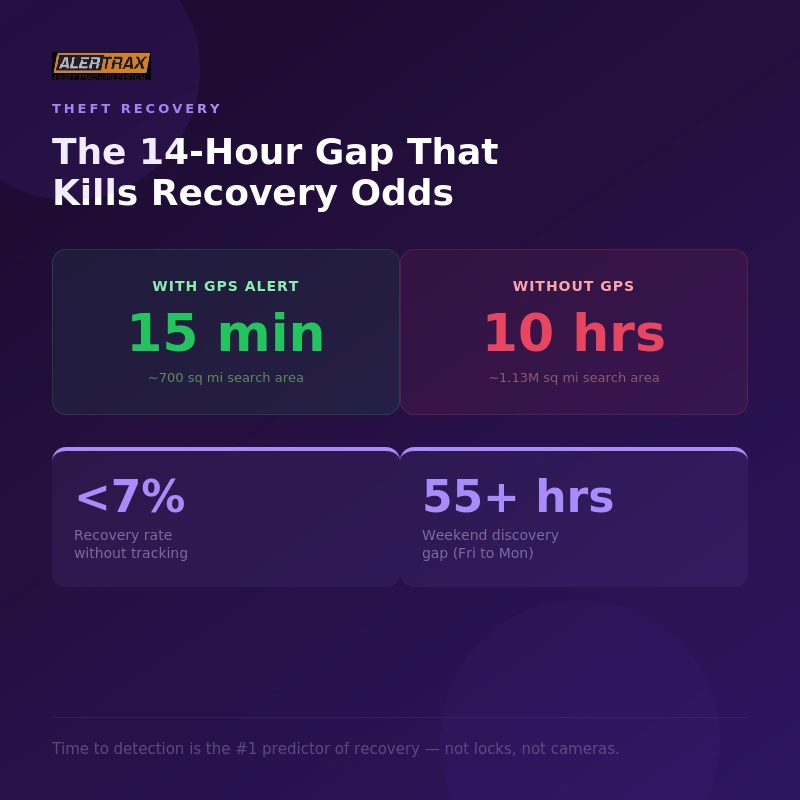
The conversation about equipment theft almost always focuses on prevention: locks, lighting, fencing, cameras. Those matter. But the data reveals an uncomfortable truth — the single most important factor in whether stolen equipment comes back isn't the barrier that failed. It's how long it takes someone to realize it's gone.
That gap between when the theft occurs and when the owner discovers it is the critical window. And for most businesses without live tracking, that window is measured in hours — hours during which the equipment is moving farther away, changing hands, and becoming functionally unrecoverable.
How the Typical Theft Timeline Unfolds
The NICB and multiple law enforcement agencies describe a consistent pattern:
- 9:00 PM – Midnight: Thief scouts the target. Job site is quiet, crew has left, no lights are on. Many thefts show evidence of prior surveillance.
- 1:00 AM – 4:00 AM: The theft occurs. A truck backs up to the trailer. Hitch locks are cut or bypassed. The average time to hook and steal a trailer: under 3 minutes.
- 4:00 AM – 6:00 AM: The equipment is moved to a staging location. By dawn, it may already be 50–100 miles from the job site.
- 6:00 AM – 8:00 AM: The crew arrives and discovers the equipment is missing. The owner is called. A police report is filed.
- 8:00 AM – 12:00 PM: The police report is processed. Officers have no leads and no location data. Meanwhile, the equipment is being repainted, re-serialized, or loaded onto a truck heading to another state.
By the time law enforcement can act, the trail is cold. The equipment has had a 6 to 10 hour head start — and in most cases, that's enough to make it disappear permanently.
Less than 7%
Recovery rate for single-item equipment thefts, according to NICB/NER data. The primary driver of this low rate: the time gap between theft and discovery.
Why Hours Matter More Than Locks
The math is stark. A stolen trailer or machine moving at highway speed covers 60 miles per hour. In a 6-hour gap between theft and discovery, that's a 360-mile radius. In a 10-hour gap, that radius expands to 600 miles.
| Discovery Delay | Potential Distance Traveled | Search Area (Radius) |
|---|
| 15 minutes (GPS alert) | 10–15 miles | ~700 sq miles |
| 1 hour | 50–60 miles | ~11,300 sq miles |
| 6 hours | 300–360 miles | ~407,000 sq miles |
| 10 hours (typical without tracking) | 500–600 miles | ~1,130,000 sq miles |
At the 15-minute mark, police can search a manageable area with a specific GPS coordinate. At the 10-hour mark, the equipment could be in a different state — and there's no coordinate to search for at all.
What Instant Detection Changes
GPS tracking with movement alerts fundamentally rewrites this timeline. Instead of discovering the theft 6 to 10 hours later, the owner gets a notification the moment the equipment begins moving during unauthorized hours.
| Without GPS Alert | With GPS Alert |
|---|
| Theft at 2 AM | Theft at 2 AM |
| Discovery at 7 AM (5 hours) | Alert received at 2:15 AM |
| Police report filed at 8 AM | Police called with live coordinates |
| Equipment is 300+ miles away | Equipment is 10–15 miles away |
| No location data for officers | Officers dispatched to exact location |
| Recovery odds: <7% | Recovery odds: dramatically higher |
The equipment is the same. The thief is the same. The locks failed in both scenarios. The only variable that changed is the time between theft and response — and it flips the outcome from near-certain loss to probable recovery.
The Weekend and Holiday Multiplier
The discovery gap doesn't stay at 6 to 10 hours. It expands dramatically on weekends and holidays — the same periods when theft rates spike.
A trailer stolen Friday night at midnight might not be noticed until Monday morning at 7 AM. That's a 55-hour gap. Over a holiday week like Christmas or Thanksgiving, the gap can stretch to 5 or 6 days. By then, recovery is essentially impossible without location data.
55+ hours
Typical discovery gap for equipment stolen on a Friday night and not noticed until Monday morning — giving thieves an entire weekend to move, hide, or sell the stolen assets.
Why the Serial Number System Fails
Unlike passenger vehicles, which have standardized VINs recorded in national databases, construction equipment relies on inconsistent serial number and PIN systems. These numbers are not uniformly recorded across states, are not checked at the point of resale in most cases, and can be ground off or replaced far more easily than a vehicle VIN.
The Identification Gap: Cars vs. Equipment
Passenger vehicles have standardized VINs, national registration databases, license plate readers, and automated law enforcement tools that can flag stolen vehicles in seconds. Heavy equipment has none of this. No national registration. No standardized numbering. No automated detection at scale. GPS tracking is the only tool that provides comparable live identification and location capability for construction equipment.
The One Metric That Predicts Recovery
Across every data source — NICB, NER, law enforcement case studies, and insurer recovery data — the single variable that most strongly predicts whether stolen equipment is recovered is time to detection. Not lock quality. Not fence height. Not camera resolution.
Equipment detected as stolen within 30 minutes has a fundamentally different recovery trajectory than equipment detected 8 hours later. The physics of the situation are simple: the faster you know, the smaller the search area, the closer the equipment, and the more likely law enforcement can act before the trail goes cold.
AlerTrax delivers that time advantage. A movement alert within 15 minutes of unauthorized motion. A live location that officers can follow. A GPS breadcrumb trail that shows where the equipment has been.
The locks still matter. The lighting still helps. But the clock is what determines outcomes — and GPS tracking is the only tool that puts you on the right side of it.
Visit www.buyalertrax.com today. Close the gap. Get alerted immediately.