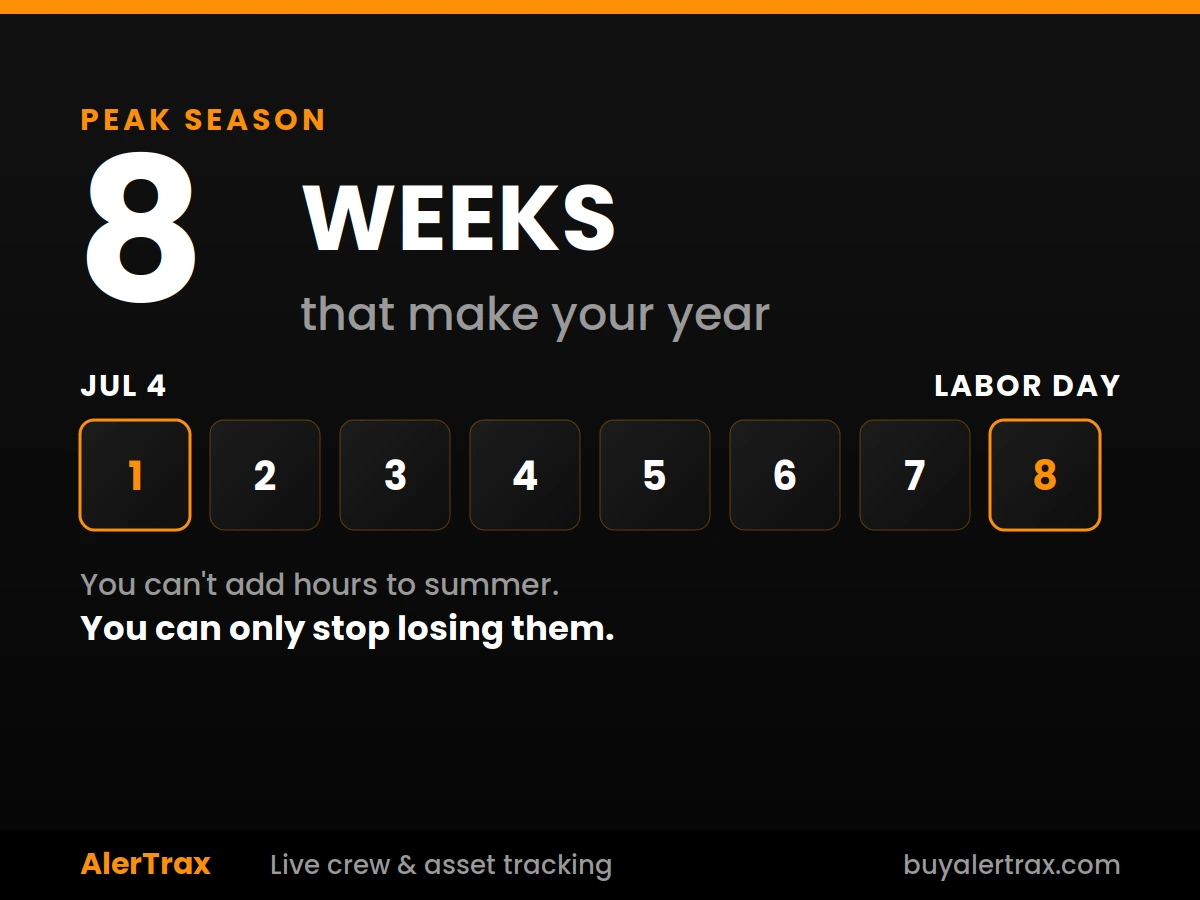
It is the Tuesday after the Fourth of July. Your phone started buzzing before 6 AM. Two crews are already running behind, one truck is somewhere between the yard and the first job and you are not entirely sure which, and the calendar in front of you is packed solid from now until Labor Day.
You do not need a spreadsheet to know what these next eight weeks mean. This is the stretch that makes your year. The window where you do the bulk of your revenue, cover your slow months, and either come out of summer ahead or spend the winter wondering where the money went.
Here is the part nobody likes to say out loud. You cannot add hours to summer. The season is exactly as long as it is. The daylight is fixed. Your crews can only be in one place at a time. Between now and Labor Day, you are not going to grow by finding more days on the calendar, because there are no more days. You are going to grow, or not, based on how much of the time you already have turns into billable, profitable work.
That is the whole game in peak season. And most owners are playing it half blind.
The Season You Cannot Get Back
Landscaping is a seasonal business, and the U.S. Bureau of Labor Statistics puts real numbers behind what every owner already feels in their bones. Grounds and landscaping crews work their longest hours in the spring, summer, and fall, when mowing, planting, and trimming demand is at its peak (U.S. Bureau of Labor Statistics). The middle of that window, the weeks right after the Fourth, is when the pressure is highest and the margin for waste is thinnest.
The trap is that peak season feels like a growth problem, so owners try to solve it the growth way: hire more people, add another crew, take on more work. But you already know how that goes right now. The workers are not out there to hire. More than half of landscaping owners name staffing as a major risk to hitting their goals, and roughly seven in ten are raising wages just to hold onto the crews they have (Aspire, 2025 Commercial Landscape Industry Report).
So if you cannot buy your way out of the summer with more labor, the only lever left is the one you already own: getting more real, billable work out of the crews and trucks already on your payroll. That is not a hiring problem. That is a visibility problem. And it is the one problem in this whole equation you can actually fix this week.
Where the Summer Hours Actually Leak
Labor is the single biggest line item you have. Across the industry it eats 30 to 50 percent of total revenue (Aspire, 2025 Commercial Landscape Industry Report). In the eight weeks where you do a huge share of your year's work, that is also the eight weeks where the leaks cost you the most. Here is where the hours quietly disappear in peak season, and every one of these is something you can act on right now:
- Late starts and long lunches. In the heat and the rush, a crew that rolls onto the first job at 7:45 instead of 7:15 does it every day, and thirty minutes a day across a full crew adds up fast.
- Routes that wander. A truck that zigzags back and forth across town between jobs is burning the exact daylight you cannot replace, plus the fuel to do it.
- Jobs that quietly run long. The property you estimated at two hours that actually takes three and a half, every single visit, all summer. Nobody catches it until you are closing the books in the fall.
- The "did your guys even show up?" call. A customer disputes a visit, and without a record, you are defending your crew's memory against theirs.
None of these are theft. None of them mean you have bad people. They are just the normal friction of running crews across a busy map, and in the slow season you can absorb them. In peak season, when every hour is doing double duty, they come straight out of your best two months.
What Live Tracking Actually Shows You
GPS crew tracking is not about spying on anybody. In peak season it is about one thing: knowing where your time is going while you still have time to do something about it. Here is what you get with an AlerTrax tracker on every truck and trailer:
- Live location of every asset on one map, updated as often as every 2 minutes. You glance at your phone instead of making a call, and you see exactly which crew is at which job right now.
- Automatic arrival and departure timestamps. Every stop is logged, so you get the real duration of every job and can hold it up against what you estimated and what you billed.
- Route history. Pull up everywhere a truck went yesterday and the zigzags jump right off the screen, so you can tighten the route for next week instead of next year.
- AddressFence alerts. Get an arrival or departure notification the moment a truck reaches a specific job address, so you know a crew landed without texting anyone.
The reason this matters so much in peak season is timing. Without it, you find out about the two-hour job that took four hours when you reconcile the numbers in October, long after the season is gone and the money with it. With it, you spot the pattern by Wednesday and reprice or re-route before you have bled it forty more times.
Run the Numbers on Your Own Fleet
You do not need an industry study to see the size of this. You can do it on the back of a work order.
Say each crew loses just 45 minutes of billable time a day to late starts and drive-time slop. On a three-person crew, that is more than two labor hours gone every day. Across a 40-day peak stretch between now and Labor Day, that is over 80 labor hours per crew that you paid for and never billed. Run that against your own billable rate, then multiply by the number of crews you are running this summer. For most operations the number lands somewhere that makes a tracker on every truck look like a rounding error.
And that is before you count the fuel from the wandering routes, or the jobs you have been underpricing all season without knowing it.
The Cash Flow Angle Nobody Talks About
Peak season is not just when you earn the most. It is when your cash is stretched the thinnest, because you are floating payroll, fuel, and materials across dozens of jobs at once. So getting paid quickly and cleanly matters more in July than at any other time of year.
The industry has a real problem here. While 76 percent of landscaping contractors bill within four days of finishing a job, only about half of them report getting paid on time (Aspire, 2025 Commercial Landscape Industry Report). A big piece of that gap is disputes and questions: when did you show up, how long were you there, did the work actually happen. When every invoice is backed by a timestamped arrival and departure log, those questions answer themselves. You send the proof with the bill, and the customer has nothing to slow-walk.
Why AlerTrax Fits the Way You Actually Work
Most GPS systems were built for over-the-road trucking fleets with constant 12-volt power and hardwired installs. Landscaping does not work that way. You have work trucks, trailers, mowers, and skid steers moving in and out of crews and job sites all day. AlerTrax was built for that reality.
- Over a Year of Battery Life, No Wiring: AlerTrax runs on its own battery for a full year or more. No splicing into your electrical system, no OBD port, no install appointment. Mount it and it works.
- Put It on Anything That Moves: Because there are no wires, it goes on trucks, trailers, mowers, skid steers, or any piece of equipment you take to a job. One platform for your whole fleet.
- Live Fleet Map: Every tracked asset on one screen in the AlerTrax Fleet Portal and the iOS and Android app, with updates as often as every 2 minutes.
- Automatic Time-on-Site Logging: Arrival and departure timestamps on every stop, for job costing, payroll, and proof of service.
- AddressFence and Geofence Alerts: Draw a boundary around a job site, a customer property, or your yard, and get notified the moment an asset arrives, departs, or moves.
- 100% Waterproof, Ruggedized Housing: Built to take rain, mud, and pressure washing, day after day.
- Covert Magnetic Mount: Sticks to any steel surface and tucks out of sight. No visible antenna, nothing to trace.
Pricing That Pays for Itself in a Single Reclaimed Job
You can put AlerTrax on your entire fleet for a low monthly rate, with no long-term contracts and no hidden fees. If a tracker helps you catch one underpriced job or reclaim a few billable hours a week, it has already paid for itself before the season is out.
(Want to own it outright? There is a $599 one-time Lifetime option for permanent, subscription-free tracking. No fees, ever.)
See the monthly plan and get set up here.
And Yes, It Watches the Yard Overnight Too
This post is about protecting your billable hours, but there is a bonus worth a mention. Peak season is exactly when your equipment is most exposed, because it is out on trailers and job sites constantly and back at the yard late. Set a geofence around your yard and AlerTrax will alert you if a truck, trailer, or mower moves after hours, along with tamper notifications if someone messes with the device. If your gear leaves at 2 AM, you know within minutes instead of the next morning. Same device, same platform, one more problem solved.
The Clock Is Already Running
The eight weeks that make your year are not coming. They are here. You cannot get more summer, but you can get more out of the summer you have, starting with knowing where every crew and truck actually is and what they are actually doing all day.
Visit www.buyalertrax.com and put a tracker on every truck, trailer, and machine before you lose another billable hour to the one thing you cannot buy back: time.
Sources
U.S. Bureau of Labor Statistics, Occupational Outlook Handbook (Grounds Maintenance Workers): Seasonal demand for landscaping and grounds work, with the longest hours in spring, summer, and fall when mowing, planting, and trimming are most frequent.
Aspire, 2025 Commercial Landscape Industry Report: 72% of owners cite labor availability and retention as their biggest barrier to growth; labor is the single largest expense at 30 to 50% of revenue; 51% cite staffing as a major risk; roughly 70% plan wage increases; 79% are focused on growing revenue; 76% bill within four days of completion while only about half report being paid on time.