A foreman gets let go in March. In June you get a letter.
Maybe it is an unemployment appeal. Maybe it is a lawyer's demand letter, or a complaint filed with the state labor department. The specifics vary. The paragraph that matters is almost always the same one: the employer tracked my client's movements without his knowledge or consent, including outside of working hours.
You know that is not what happened. You put the tracker on a truck the company owns and paid for. Every guy on the crew knew it was there. Nobody hid anything from anybody.
Then your attorney asks the only question that actually matters: show me where he acknowledged it in writing.
And you have a text message thread, a memory of a conversation in the yard in 2023, and nothing else.
That is the gap this article is about. Not whether you are allowed to track your own trucks - you almost certainly are, nearly everywhere. The gap is between doing it legally and being able to prove you did it legally, eighteen months later, to somebody who is being paid to argue otherwise.
Closing that gap takes one signed page and one written policy. Both are at the bottom of this article, free, no email required.
The Part Almost Everyone Gets Right
Let us dispose of the easy question first, because it is the one that gets asked most and it has a boring answer.
If your company owns or leases the vehicle, you can put a GPS tracker on it. That is true in every state. The state statutes that criminalize putting a tracking device on a car are written to stop stalkers and jealous exes, and they are drafted around the vehicle's owner.
Texas is the clearest example. Texas Penal Code § 16.06 makes it an offense to knowingly install a tracking device "on a motor vehicle owned or leased by another person." If the vehicle is yours, the statute does not describe your conduct at all. There is nothing to comply with, because the offense was never triggered. Virginia's law (Va. Code § 18.2-60.5) and California's (Cal. Penal Code § 637.7) are built the same way, around consent of the owner or lessee.
This is worth saying plainly because a surprising number of "GPS tracking laws by state" pages on the internet imply otherwise, listing Texas as a state where you need employee consent to install a tracker. On a truck the company owns, you do not - not under § 16.06, anyway. We maintain our own state-by-state guide and we try hard to keep this distinction straight.
So if the ownership question is settled, why does any of this generate lawsuits?
The Part That Actually Creates Liability
Because "can I install it" turns out to be a small question sitting on top of five much larger ones. And the larger ones are not answered by who holds the title.
- Does anybody track after hours? The truck goes home with the foreman. The tracker does not know the difference between 2 PM Tuesday and 9 PM Saturday. Neither does your fleet portal, unless somebody configured it to.
- Whose vehicle is it, really? The moment a crew member runs a job in his own pickup and you ask him to take a tracker, every ownership-based exception in every state statute stops protecting you.
- Who can see the data? If a dispatcher, three foremen, an office manager and your brother-in-law all have logins, "the company tracked me" starts to mean something different than you intended.
- How long do you keep it? Location history you no longer need is not an asset. In a dispute it is a discovery obligation.
- Does it feed discipline? Using location data in a termination decision is generally fine. Using it in a termination decision the employee was never told could happen is where cases start.
None of those five are about the tracker. All five are about documentation. And all five are answered, in about ten minutes, by a consent form and a written policy.
What the States Actually Require
Here is the accurate short version for the states that impose real, specific obligations on employers. This is the part most roundups get wrong, so we have cited the statute in each row and stuck to what it says.
Two federal notes, because both come up.
United States v. Jones (2012), the Supreme Court case people cite about GPS trackers, held that police attaching a tracker to a car is a Fourth Amendment search requiring a warrant. The Fourth Amendment restrains the government. It is not a private employer's problem, and it does not mean a business needs a warrant to track its own truck.
And there is no single federal statute governing employer GPS use. For a period, the National Labor Relations Board's General Counsel had issued guidance suggesting close electronic monitoring could interfere with employees' organizing rights. That guidance (GC 23-02) was rescinded in February 2025 under memorandum GC 25-05. So for most employers today, the operative rules are state statutes and whatever you agreed to in your own handbook - which puts even more weight on getting the handbook right.
What a Consent Form Has to Contain
Here is the useful shortcut: build the form to California's standard and it will clear the bar in every other state. California's notice requirements are the longest list in the country, so a form that satisfies AB 984 satisfies Connecticut and Delaware without a second version.
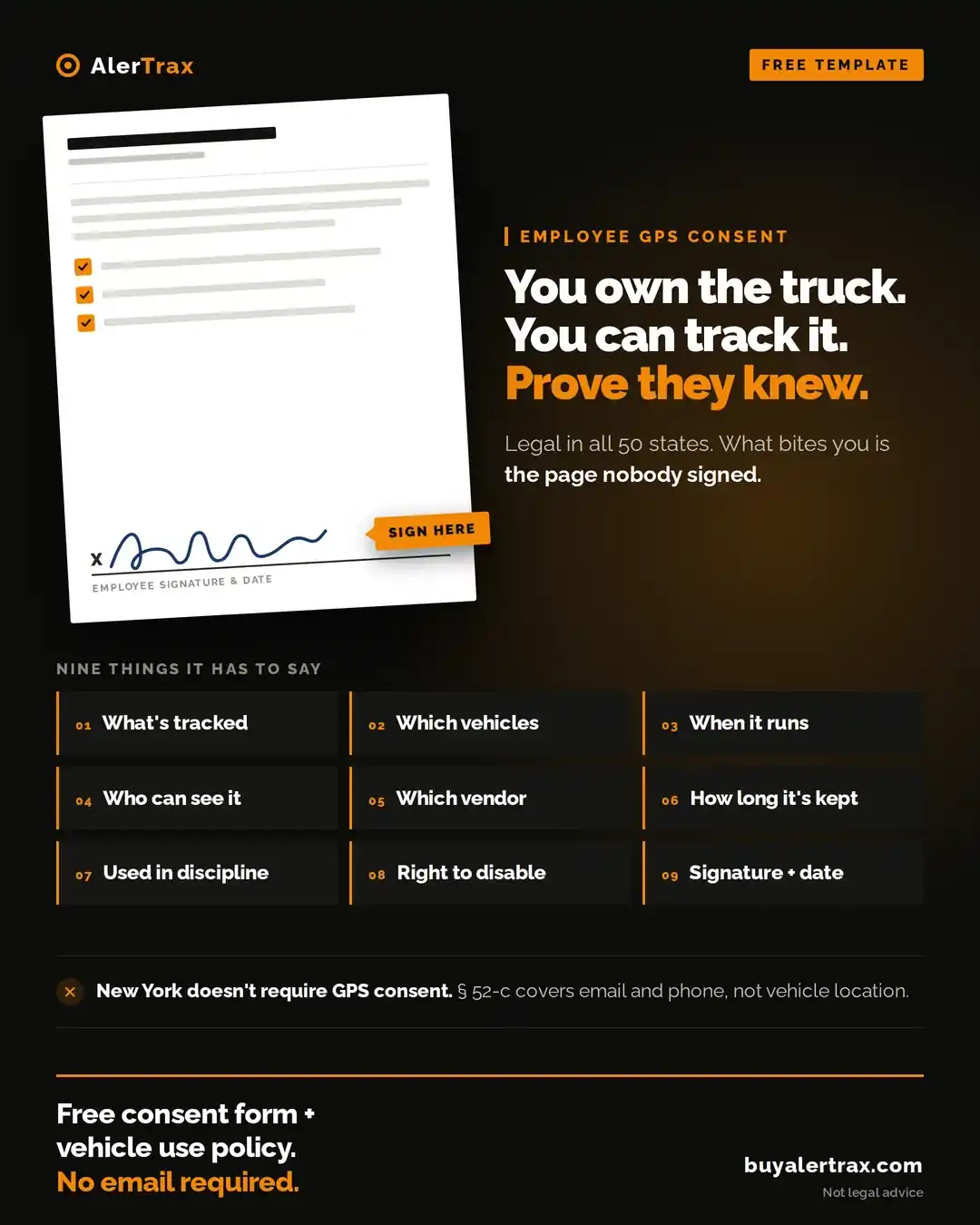
That means nine things on one page:
- What is being monitored - vehicle location, ignition status, speed, arrival and departure times. Be specific. "Company monitors vehicles" is not a description.
- Which vehicles and equipment - listed or described by class, and explicitly whether personal vehicles are ever included.
- When monitoring occurs - during scheduled work hours, or continuously, and if continuously, say so in that sentence rather than three paragraphs later.
- Who can access the data - by role, not by name, so the form survives turnover.
- Which vendors receive it - your tracking provider, named.
- How long it is retained - a number of days or months, and what happens after.
- Whether it informs employment decisions - including discipline and termination. This is the sentence that prevents the surprise later.
- The right to disable outside work hours, where applicable, and a statement that no one will be retaliated against for exercising it.
- A signature, a printed name, and a date. The signature is the entire point. Everything above it is what the signature is attesting to.
A companion vehicle use policy covers the operational half: who is authorized to drive, permitted personal use, fuel and toll cards, accident reporting, prohibited uses, and what happens to the vehicle and the tracker at separation.
Download the Free Template
An Employee GPS Consent Form and a Vehicle Use Policy, written to the California standard so they work almost anywhere. Fill-in-the-blank, editable, no email required.
Download PDF
Download Word (editable)
Please read this part. AlerTrax is a GPS tracking company, not a law firm, and nothing here is legal advice. This template is a starting point built from publicly available statutes as of September 2026. Employment law varies by state and changes; your obligations depend on where you operate, how many people you employ, whether your workforce is unionized, and what your existing handbook already says. Have an employment attorney in your state review both documents before you put them in front of an employee. That review is cheap. The letter in June is not.
Where AlerTrax Fits
A consent form makes a promise. The tracking system has to be able to keep it - and most consumer-grade trackers cannot, because they were not built with an employer's obligations in mind.
- Role-Based Portal Access: The AlerTrax Fleet Portal lets you decide who sees what, so "who can access the data" on your consent form is a statement of fact rather than an aspiration.
- Geofence and After-Hours Alerts: Set boundaries around yards, lots and job sites and get notified on movement - so you can run alert-based monitoring rather than watching a live map all evening.
- Route History with Timestamps: A complete record of arrivals and departures, which is what turns a disputed timecard or a "he never showed" claim into a settled question.
- Shareable Tracking Link: Send a customer a live link to one asset without giving anyone a login or exposing the rest of your fleet.
- Over a Year of Battery Life, No Wiring: Magnetic mount, about a minute per unit. No install appointment, no splicing, no OBD port - and nothing wired into a vehicle you may not own.
- 100% Waterproof and Ruggedized: Built for trucks, trailers, mowers, skid steers, boats and equipment, indoors or out, year round.
- iOS and Android App: The whole fleet on your phone, wherever you are.
Pricing
You can put AlerTrax on your entire fleet for a low monthly rate, with no long-term contracts and no hidden fees.
(Want to own it outright? There is a $599 Lifetime option for permanent, subscription-free tracking. No fees, ever.)
Ten Minutes Now, Or a Deposition Later
Almost every employer we talk to is already operating legally. They own the trucks. They told the crew. Nobody is hiding anything.
What they are missing is the paper that proves it - and paper is only cheap before you need it. A signed consent form costs you one conversation at hire. Reconstructing that same conversation from memory, two years later, in front of somebody with subpoena power, costs considerably more.
Download the template, have your attorney look at it, and get it into your onboarding packet this week.
Then visit www.buyalertrax.com and put a tracker on every truck, trailer and machine you own - with the paperwork already handled.
Sources
Cal. AB 984 (2022) - Vehicle identification and registration: alternative devices; employer notice requirements for vehicle location technology, limits on monitoring outside work hours, and anti-retaliation provisions
Cal. Penal Code § 637.7 - Electronic tracking devices; owner and lessee consent
Conn. Gen. Stat. § 31-48d - Employers engaged in electronic monitoring required to give prior notice to employees; exceptions; civil penalty
Del. Code tit. 19, § 705 - Notice of monitoring of telephone transmissions, electronic mail and internet usage
Tex. Penal Code § 16.06 - Unlawful installation of tracking device; affirmative defenses
Va. Code § 18.2-60.5 - Unauthorized use of electronic tracking device; penalty
N.Y. Civil Rights Law § 52-c - Notice of electronic monitoring of telephone, email and internet usage
United States v. Jones, 565 U.S. 400 (2012) - Fourth Amendment; government installation of a GPS tracking device
NLRB General Counsel Memorandum GC 25-05 (February 2025) - Rescission of certain General Counsel memoranda, including GC 23-02 on electronic monitoring and algorithmic management