It is the second week of August in Central Florida. By 9 AM it is already 88 degrees with the kind of humidity that soaks a shirt before the first trailer is unloaded. Your crews started at sunrise to beat the worst of it. By 2 PM the afternoon thunderstorm rolls in like it does almost every day this time of year, and the radar lights up over half your service area.
Here is the question that should keep a Florida owner up at night: right now, at 2:15 PM with storms on the map, where are your crews? Did crew two get the commercial property finished before the rain, or did they bail early and head back? Is crew three sheltering at a job site, or did they call it and drive home, billing you for a full afternoon? You sent the schedule this morning. After that, you are guessing.
In a lot of the country, a sloppy, low-visibility operation can limp through the busy months and recover over a slow winter. Florida does not work that way. There is no off-season here to bail you out. The grass grows twelve months a year, your crews run twelve months a year, and every leak in your operation runs twelve months a year right alongside them. That is exactly why crew visibility matters more in Florida than almost anywhere else in the country.
Florida Is the Biggest Landscaping Market in the Country, and the Most Crowded
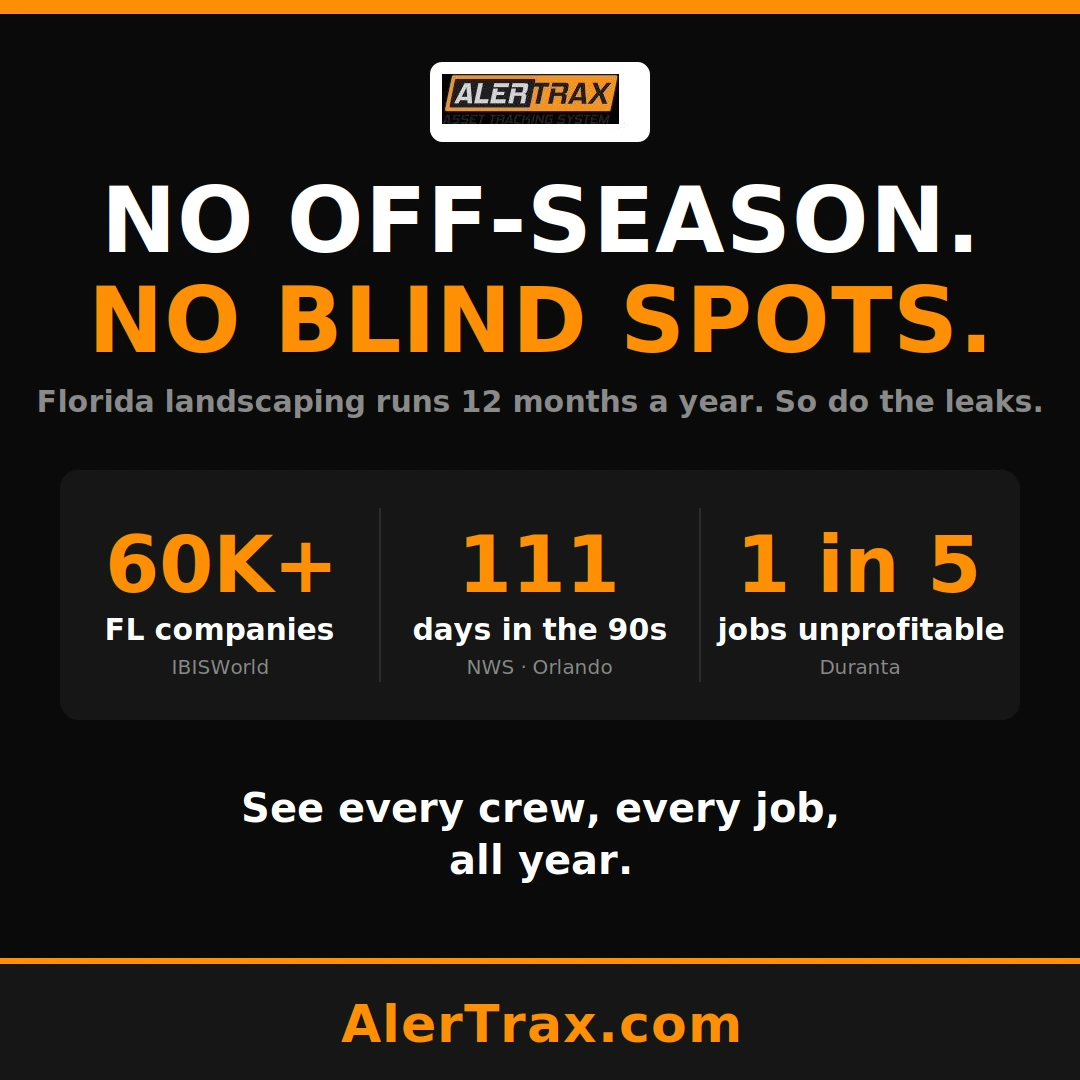
Florida is not just a big landscaping state. It is the biggest. The state is home to more than 60,000 landscaping businesses, more than any other state in the country (IBISWorld / U.S. Census), and ranks second nationwide in the number of landscaping and groundskeeping workers (U.S. Bureau of Labor Statistics). According to the Florida Department of Agriculture and Consumer Services, the landscaping services sector alone accounts for more than 73,000 jobs and $2.3 billion in wages across the state.
Industry analysts point to Florida, along with Texas and Arizona, as the fastest-growing landscaping region in the nation, driven by population growth, constant residential construction, and year-round vegetation cycles with almost no weather-related downtime (Aspire). The climate that makes the work never stop is the same climate that makes the competition never stop.
Think about what 60,000 competitors actually means on the ground. In any given Florida metro, your customer can find another crew to cut their grass or maintain their property with a single phone call. There is no shortage of companies willing to underbid you. In a market that crowded, the difference between the companies that thrive and the ones that quietly fold is almost never who works hardest. It is who runs tightest. And you cannot run tight on an operation you cannot see.
The 12-Month Season Cuts Both Ways
The year-round season is the best thing about running a landscaping company in Florida. It is also the thing that punishes a blind operation hardest.
Up north, an owner runs hard for roughly 30 to 35 weeks and then the snow shuts everything down. A mispriced contract or a crew that drifts 20 minutes late every morning still hurts, but the damage is capped at a season, and winter is a forced reset to regroup and fix things. In Florida, that same leak runs across 50-plus working weeks a year. There is no winter to stop the bleeding and no slow stretch to catch your breath and rebuild your systems. Whatever is broken in your operation in February is still broken, and still costing you, in October.
That changes the math on everything. Labor is already the largest cost in any landscaping business, running 30 to 50 percent of total revenue (Aspire), and once you add labor burden, the payroll taxes, insurance, and overhead, a crew member you pay $20 an hour actually costs $24 to $27 an hour (Service Autopilot, 2026). The American Payroll Association estimates businesses lose 5 to 10 percent of payroll to time theft through late starts, long breaks, and early departures. Northern operators bleed that for part of the year. Florida operators bleed it all twelve months. A leak that costs a seasonal company $25,000 can cost a Florida company running the same way far more, simply because the clock never stops.
The Heat Tax Nobody Puts on the Invoice
Then there is the heat, which quietly reshapes a Florida workday in ways that never show up on a timesheet. Orlando alone averages about 111 days a year when the temperature reaches into the 90s (National Weather Service), and that is before you factor in the humidity that makes 92 feel like 105.
Heat changes how the day actually runs. Crews start at dawn to get ahead of it. Productivity sags through the brutal midday hours. Water breaks get longer and more frequent, as they should, because a heat-sick crew member is a real danger, not a productivity statistic. And then, like clockwork through the summer, the afternoon storms arrive and scatter everyone. These are not signs of a lazy crew. They are the reality of doing physical work in a subtropical climate. But they mean the gap between scheduled hours and productive hours is wider in Florida than just about anywhere, and without data, you have no idea how wide.
When a storm breaks up the afternoon, the questions multiply. Did the crew wait it out and finish, or pack up early? Did they relocate to a covered job or an indoor task, or just head back to the yard? Did the property that got rained out actually get the full visit it was billed for, or half of one? On a gut feel, every one of those is a guess. With verified arrival and departure data, every one of them is a fact you can see from your phone.
At a 6% Margin in the Toughest Market, Guesswork Is Fatal
Put the pieces together. The most competitive landscaping market in the country, a season that never stops to let you recover, and a climate that widens the gap between paid hours and productive hours every single day. Now layer on the margins this industry actually runs on.
The average landscaping company earns a 6.2 percent profit margin (Wifitalents). Well-run companies target 10 to 14 percent (Fieldcamp). At 6.2 percent, you have to generate roughly $16 in revenue to keep a single dollar of profit. There is no cushion in that number for guesswork, and industry analysis from Duranta finds that 1 in 5 landscaping jobs is unprofitable, usually because actual labor hours quietly outran the estimate and nobody caught it. In a market with 60,000 competitors and no off-season, you do not get to be the owner who finds out in December which jobs lost money all year. By then you have lost the year, not the season.
This is the whole case for crew visibility in Florida. It is not about catching people. It is about being able to see, live and in the data, where your single biggest cost is actually going, on every job, every day, all year.
What Crew Visibility Shows a Florida Operator
Crew visibility is not a dot on a map. It is a set of automatic, verified data streams that close the gap between what you scheduled and what actually happened.
- A live fleet map. Every truck, trailer, and piece of equipment on one screen, live. When the 2 PM storms hit, you can see at a glance which crews are still on site, which are moving, and which are headed home, without making a single call.
- Automatic time-on-site logging. Arrival and departure timestamps at every stop, recorded with no crew input. These are the real hours behind every job, the numbers that tell you whether a storm-shortened afternoon was billed accurately and which year-round contracts are quietly losing money.
- Complete route history. A full breadcrumb trail of where each truck went and when. In a sprawling metro where crews cross town between jobs, this is where you find the wasted drive time and the routes that need tightening.
- Exportable trip reports. Address, arrival, departure, duration, and mileage for every vehicle, every day. Proof of service when a customer asks whether your crew really came, and the raw data for repricing contracts before the next renewal.
None of this asks anything of your crews. There is no app to open and no clock to punch in the heat. The device on the truck logs it automatically, and the data is waiting for you on the fleet map and the trip report.
Your Crews Won't Fight It, Especially in the Heat
Every owner worries the crews will feel watched. The research says the opposite. Surveys from TSheets and HR C-Suite found 95 percent of employees rate GPS tracking positive or neutral, 75 percent say it helps track their time accurately, and 50 percent say it actually builds trust with their employer.
In a Florida summer, that protection runs both ways and the crew feels it. When a customer complains the lawn was not touched because nobody was standing there in the rain at 3 PM, the data shows your crew was on that property grinding through 95-degree heat at 7 AM. When a foreman makes the right call to pull his guys off a property as lightning moves in, the record backs up the decision instead of leaving it open to second-guessing. Verified data defends the people doing hard work in hard conditions. The only ones it makes uncomfortable are the ones counting on you not knowing.
Introduce it honestly from day one as a tool for routing, billing accuracy, and crew safety, and resistance drops to nearly zero.
Why Alertrax Is Built for Florida Conditions
Most GPS systems were designed for long-haul logistics: hardwired installs, constant vehicle power, dedicated drivers. That is not how a Florida landscaping fleet runs, and frankly, a lot of that hardware was never built for daily downpours and subtropical humidity either.
Alertrax was engineered for exactly these conditions.
- 100% Waterproof, IP67 Rated: Built to shrug off afternoon thunderstorms, daily humidity, mud, and pressure washing. Florida weather is the test it was designed to pass.
- One-Year Battery Life, No Wiring Required: Runs over a year on two AA batteries. No splicing, no OBD-II port, no install appointment, and no power drain to worry about in the heat. Mount it and it works.
- Track Anything That Moves: Trucks, trailers, mowers, skid steers, and equipment, one platform for the whole fleet across every job in your service area.
- Automatic Time-on-Site Logging: Arrival and departure timestamps at every stop, for billing accuracy, job costing, and proof of service on year-round contracts.
- Live Fleet Map: Every asset on one live map from the Fleet Portal or the iOS and Android app, so a storm-afternoon check takes five seconds.
- Complete Trip Reports: Address, time, duration, and mileage for every vehicle, every day, exportable to PDF or CSV.
- Geofence and After-Hours Alerts: Set boundaries around the yard, job sites, and customer properties, and get notified on arrivals, departures, and movement that should not be happening.
Pricing for a Business That Runs All Year
You can equip your entire fleet for a low monthly rate, with no long-term contracts and no hidden fees.
(Want to own it outright? We offer a $599 Lifetime option for permanent, subscription-free tracking.)
Because your season never stops, the payback never stops either. A recovered 20 minutes per crew per morning, a single repriced money-losing contract, a storm afternoon billed accurately instead of guessed at, every one of those adds up across 52 weeks, not 30. In a year-round market, a tool that recovers wasted labor and sharpens your billing does not pay for itself once. It pays for itself again every month the grass keeps growing, which in Florida is all of them.
And Yes, It Protects Your Equipment Too
The same device tracking your crews is watching your equipment around the clock. Equipment theft costs the industry an estimated $400 million annually, and 40 percent of stolen landscaping equipment is never recovered (AMAROK / NER), with a single truck out of service costing up to $4,000 a day in lost revenue (AMAROK). With after-hours movement alerts, you know within minutes if a trailer leaves the yard overnight, and you have a live location to hand to law enforcement. It is not the reason to put GPS on your fleet. It is the bonus that comes with it.
In a Year-Round Market, Visibility Is the Edge
Florida hands landscaping owners the best gift in the industry: a season that never ends. But that gift comes with a catch. The same calendar that lets you earn all year lets a blind, leaky operation bleed all year, in the most competitive landscaping market in the country, while the heat and the storms quietly widen the gap between the hours you pay for and the work you actually get.
The owners who win in Florida are not the ones grinding the hardest in the heat. They are the ones who can see exactly where their crews are, how long every job really takes, and which work makes money, twelve months a year. That visibility does not require new habits from your crews or new software for anyone to learn. It takes one device per asset, mounted in under a minute, and a glance at a map.
Visit www.buyalertrax.com today and stop running blind in a market that never slows down.
Sources
IBISWorld / U.S. Census Bureau, "Florida has more than 60,000 landscaping businesses, the most of any state"
U.S. Bureau of Labor Statistics, "Florida ranks second nationwide in landscaping and groundskeeping workers (May 2023)"
Florida Department of Agriculture and Consumer Services, "Landscaping services sector: more than 73,000 jobs and $2.3 billion in wages statewide"
National Weather Service, "Orlando averages about 111 days a year reaching the 90s°F"
Aspire, "Florida, Texas, and Arizona are the fastest-growing landscaping region; year-round vegetation cycles and minimal weather downtime; labor = 30-50% of total revenue"
Service Autopilot (2026), "Labor burden adds 20-35% on top of base wages; a $20/hr employee costs $24-$27/hr"
American Payroll Association, "Businesses lose 5-10% of payroll to time theft annually"
Wifitalents, "6.2% average profit margin"
Fieldcamp, "Well-run companies target 10-14% net profit"
Duranta, "1 in 5 landscaping jobs is unprofitable"
TSheets / HR C-Suite, "95% of employees rate GPS tracking positive or neutral; 75% say it tracks time accurately; 50% say it builds trust"
AMAROK / NER, "$400M annual equipment theft losses; 40% never recovered; up to $4,000/day lost revenue per truck"