There are roughly 700,000 landscaping businesses in the United States (NALP, 2025). The average one employs two people (IBIS World, 2025). Most will never grow beyond a handful of trucks.
This isn't because demand is lacking — the U.S. landscaping services market reached $188.8 billion in 2025 and has grown at 6.5% annually over the past five years (NALP, 2025). It's not because the opportunity isn't there. It's because scaling a landscaping company is fundamentally different from starting one, and the systems that get you to three crews will break down completely at six.
Nationally, 20.4% of all businesses fail in their first year (Bureau of Labor Statistics, 2024). By year five, 48.4% have closed. By year ten, 65.1% are gone (LendingTree / BLS, 2024). New service businesses fare even worse, with a 40% failure rate often tied to poor service delivery processes (World Metrics, 2026). The landscaping companies that survive and scale are the ones that build operational infrastructure before they need it — and GPS tracking has become one of the most critical pieces of that infrastructure.
The Scaling Wall: Why Most Landscaping Companies Get Stuck
Most landscaping businesses start the same way: one owner, one truck, a handful of accounts. The owner does everything — sales, scheduling, quality control, billing. That approach works fine at 20 properties. Try it at 200 and you'll discover why so many companies stall at a certain size (Grow Group, 2025).
The 2026 Commercial Landscape Industry Report reveals the tension clearly: 79% of contractors are focused on growing revenue, but only 41% are optimizing processes to support that growth sustainably (Aspire, 2026). That gap between ambition and operational readiness is where scaling fails.
The problems compound quickly as crews are added. Labor is already the largest expense, consuming 30% to 50% of total revenue (Aspire, 2025). The full labor burden adds 20% to 35% on top of base wages, meaning a $20-per-hour employee actually costs $24 to $27 per hour (Service Autopilot, 2026). Each new crew multiplies that cost — and multiplies the management complexity. At three crews, you can run the operation from memory. At six, you need systems. At ten, you need data.
The 2026 Industry Report confirms this: 54% of contractors identify recruiting and retaining staff as a top business risk (Aspire, 2026). Seventy percent of contractors plan to raise wages in 2026, with 44% planning increases of 4% or more. Meanwhile, 48% cite material costs as a top concern, and 37% anticipate those costs rising 10% or more. When both labor and materials are getting more expensive, operational efficiency isn't optional — it's the only lever you can pull.
The Owner as Bottleneck
The first scaling wall every landscaping company hits isn't labor or equipment. It's the owner.
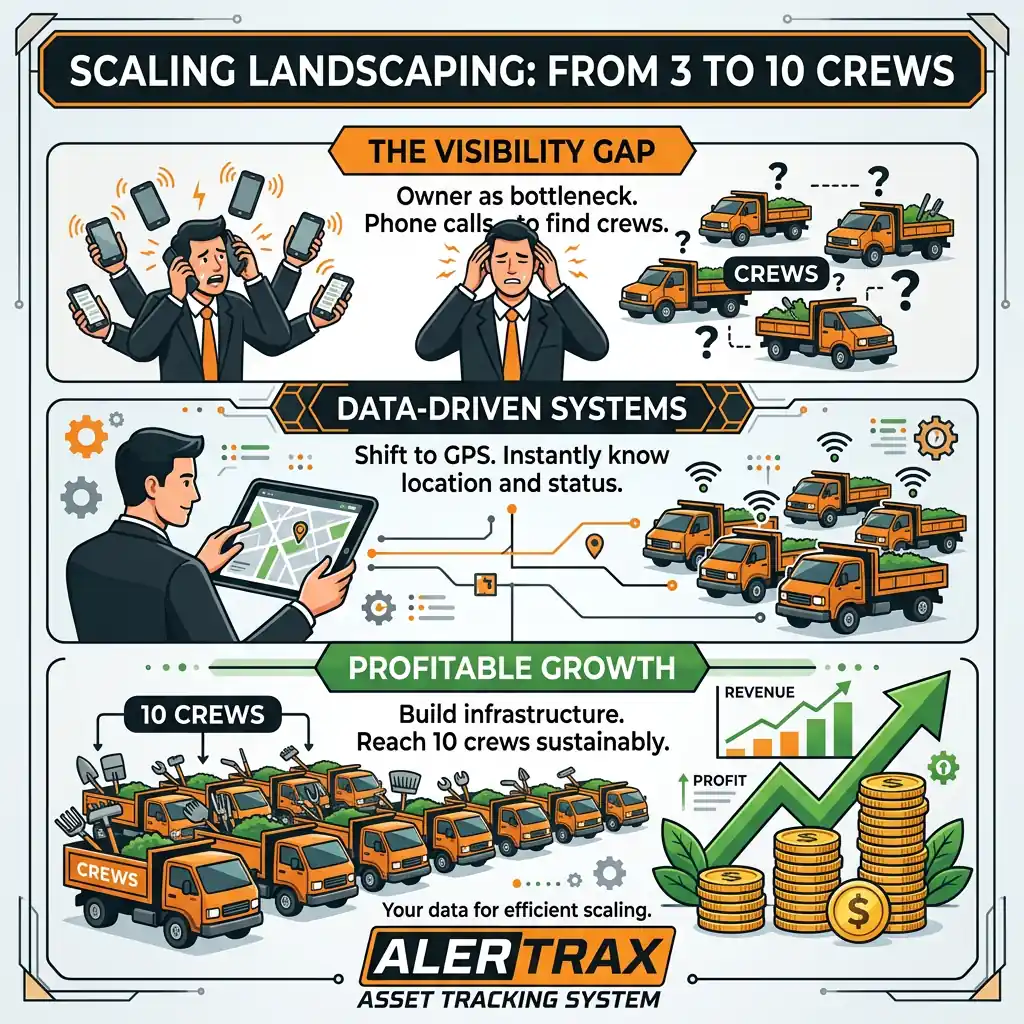
At three crews, the owner is the central nervous system of the operation. They know where every truck is, which properties are scheduled, and whether crews are running on time — because they were just at two of those job sites themselves. But as the company grows, the owner physically cannot be everywhere. The phone becomes a lifeline. Calls to crew leads. Texts that don't get answered. Driving between job sites to check on progress.
This is the bottleneck. A business cannot grow if the owner is still the single point of visibility into operations (LMC Landscape Partners, 2025). Every hour the owner spends chasing down crew locations is an hour not spent selling work, building client relationships, managing finances, or developing the leadership team the company needs to reach the next level.
GPS tracking eliminates this bottleneck instantly. One screen shows every vehicle in the fleet — who's on site, who's in transit, who's running behind, and who hasn't left the shop yet. The owner gets back hours of productive time per week, and the information is more accurate than what any phone call would provide. Companies using GPS fleet management report productivity increases of 20% to 25% through streamlined operations and reduced coordination overhead (US Fleet Tracking).
Scaling Profitably: The Math That Matters
Growing revenue is easy. Growing profit is hard. And in a low-margin industry, the difference between the two determines whether scaling builds enterprise value or just creates a bigger, more stressful version of the same struggling business.
Industry benchmarks put a well-run landscaping company at 10% to 14% net profit, with a target gross margin of 45% to 50% on each job (Fieldcamp, 2025). The industry average sits around 6.2% (Wifitalents, 2023). The gap between 6% and 14% isn't usually about pricing power. It's about operational efficiency — how much of every labor dollar turns into billable revenue versus how much is consumed by waste.
GPS tracking attacks waste across every dimension that matters when scaling:
Time theft and productivity loss. Studies estimate businesses lose 5% to 10% of payroll costs annually to time theft — extended breaks, early clock-outs, inflated hours (ShadowGPS / Workpuls). For a growing company with $600,000 in annual payroll, that's $30,000 to $60,000 per year in invisible losses. GPS fleet data consistently shows 30 to 60 minutes of unproductive time per vehicle per day before tracking is implemented (Spytec GPS, 2026). At a loaded labor cost of $35 to $50 per hour, recovering even 30 minutes per truck per day saves $350 to $500 per month per vehicle. For a ten-truck fleet, that's $42,000 to $60,000 per year recovered.
Fuel waste. Fleets typically cut fuel spending by 15% to 25% after implementing GPS tracking (Spytec GPS, 2026). For a ten-truck operation spending $6,000 to $8,000 per month on fuel, that's $10,800 to $24,000 per year in savings. A typical service truck burns half a gallon to a full gallon of fuel per hour of idle time (GPS Insight). Reducing idle time alone can save $562 per vehicle per year from a single behavioral change.
Billing disputes. GPS-equipped operations report eliminating 2 to 5 disputed invoices per month through timestamped records (Spytec GPS, 2026). At an average service ticket of $150 to $300, that's $300 to $600 per month in protected revenue. Service fleet operators report GPS proof of service eliminates up to 95% of service verification disputes (FleetRabbit, 2026).
Maintenance costs. Fleet tracking systems that monitor driving behavior help companies reduce maintenance expenses by 15% to 20% (US Fleet Tracking). GPS fleet management can also lower insurance premiums by 10% to 25% through demonstrated safety improvements. For a company scaling from five trucks to ten, these savings compound significantly.
The combined ROI is substantial. Fleet tracking systems typically deliver 200% to 400% annual ROI, with most companies seeing measurable savings within 30 to 90 days (Traxelio / Spytec GPS). Seventy percent of fleets using GPS tracking report significant operational benefits, and 41% achieve positive ROI in under 12 months (Heavy Duty Journal, 2026).
Route Density: The Scaling Multiplier
One of the most underappreciated factors in scaling profitability is route density. A company serving 50 properties clustered within a few neighborhoods will be far more profitable than one serving the same number scattered across 30 miles (Grow Group, 2025). Dense service areas reduce drive time, lower fuel costs, and allow crews to complete more jobs per day.
As companies scale, maintaining route density becomes both more important and more difficult. New accounts get added wherever the sales come in, and without visibility into actual drive patterns, routes become progressively more inefficient. Some contractors deal with this by dividing their market into geographic zones and assigning specific days to each zone (Green Industry Pros), but you can't optimize what you can't measure.
GPS route history gives you the data to make smart geographic decisions. You can see exactly how much drive time each crew is logging between stops, identify routes that have become scattered, and reorganize schedules to maximize time on property. For a four-crew operation losing just 45 minutes per day to inefficient routing, the wasted hours add up to hundreds over the course of a season (Service Autopilot, 2026). At a fully burdened labor rate of $25 per hour, that lost productivity becomes a meaningful drag on profit even before fuel and vehicle costs are added.
Consistency at Scale: Managing What You Can't See
At three crews, quality is personal. The owner sees the work. At ten crews, quality becomes a system — and systems need data.
One of the most common reasons landscaping companies lose clients during growth phases is inconsistent service. A crew that was excellent on a property gets reassigned; the new crew doesn't know the client's preferences; the property gets missed or quality drops. The owner doesn't find out until the client cancels.
GPS tracking provides the operational visibility to maintain consistency as you scale. You can verify that every property on the schedule was visited. You can see how long each crew spent on each site and compare it to the estimate. You can identify when a crew is consistently rushing through a property or spending significantly more time than expected.
The data also helps you build accountability into your crew leadership structure. As you scale past five or six crews, you need crew leads and supervisors who can manage independently. GPS data gives those leaders — and you — a shared set of facts that shifts conversations from interrogation to coaching.
Ninety-five percent of employees who've used GPS tracking at work describe the experience as positive or neutral (TSheets / HR C-Suite). Three out of four say it helps them accurately track time, ensure paycheck accuracy, and stay safer on the job. For a scaling company fighting 42% annual industry turnover (Wifitalents, 2023), a system that builds trust rather than eroding it is a critical advantage.
Protecting More Assets as You Accumulate Them
Every truck, trailer, mower, and piece of equipment you add to the fleet is another asset at risk. The landscaping industry loses an estimated $400 million annually to equipment theft, and 40% of stolen equipment is never recovered (AMAROK). A single stolen truck can cost up to $4,000 per day in lost revenue while it's out of service.
When you're running three trucks, you can park them all in your driveway. When you're running ten, they're spread across a yard, a shop, and sometimes overnight at job sites. The attack surface grows with every piece of equipment you add. GPS tracking scales your security right alongside your fleet. Geofence alerts notify you if any asset moves outside its designated boundary during off-hours. Live location data lets you guide law enforcement directly to a stolen vehicle or trailer.
For a growing company, the theft of even one truck with a full equipment trailer isn't just a financial loss — it's a scheduling catastrophe that ripples through the entire week's operations. GPS tracking provides the protection that ensures growth doesn't increase vulnerability.
The Alertrax Advantage for Growing Fleets
This is exactly why we built Alertrax.
Alertrax gives scaling landscaping companies the fleet visibility, operational data, and asset protection they need to grow from three crews to ten — and beyond — without losing control.
- Live Fleet Map: See every truck, trailer, and piece of equipment on a single screen. Know which crews are on site, which are in transit, and which are running behind — without a single phone call.
- Automatic Time-on-Site Logging: Every arrival and departure is timestamped and location-verified. Use the data for job costing, billing verification, crew accountability, and estimate calibration.
- Complete Route History: Review exactly where each vehicle went throughout the day. Identify route inefficiencies, measure drive time, and optimize schedules with data instead of assumptions.
- Ruggedized for the Field: 100% waterproof housing built to survive rain, mud, dust, vibration, and high-pressure washdowns. Designed for work trucks and trailers, not consumer cars.
- One-Year Battery, No Wiring: A massive self-contained battery lasts a full year on a single charge. Mount it on any asset — truck, trailer, mower, skid steer — without touching a wire.
- Geofence and After-Hours Alerts: Draw a boundary around your shop, yard, or any location. If an asset moves outside that boundary during off-hours, you get an instant alert.
An Investment That Scales With You
You can equip your entire fleet today for a low monthly rate — no long-term contracts, no hidden fees.
(Prefer to own it outright? We also offer a one-and-done $599 Lifetime option for permanent, subscription-free tracking.)
The math scales with you: at $350 to $500 per truck per month in recovered productivity, a single Alertrax device pays for the fleet's entire tracking cost. Every additional truck you add amplifies the return.
The Bottom Line
Scaling a landscaping company isn't about adding trucks and crews and hoping the numbers work out. It's about building the operational infrastructure that lets you grow revenue faster than costs — and GPS tracking is one of the highest-ROI investments in that infrastructure.
In an industry of 700,000 competitors where labor costs are rising, margins are thin, and 79% of contractors want to grow but only 41% are building the systems to do it sustainably (Aspire, 2026), the companies with the best data will win. Not because they work more hours, but because they make more of every hour they're already paying for.
The difference between a landscaping company that's busy and one that's building enterprise value comes down to visibility, accountability, and data. GPS tracking provides all three.
Stop scaling blind. Start scaling smart.
Visit www.buyalertrax.com today to give your growing landscaping operation the fleet visibility it needs to scale profitably.
Sources: NALP (2025), IBIS World (2025), Bureau of Labor Statistics (2024), LendingTree / BLS (2024), World Metrics (2026), Aspire 2025 & 2026 Commercial Landscape Industry Reports, Service Autopilot (2026), Grow Group (2025), LMC Landscape Partners (2025), Fieldcamp (2025), Wifitalents (2023), ShadowGPS, Workpuls, Spytec GPS (2026), GPS Insight, US Fleet Tracking, FleetRabbit (2026), Traxelio, Heavy Duty Journal (2026), TSheets / HR C-Suite Independent Survey, Green Industry Pros, AMAROK.