Fleet Fuel Waste From Idle Time

Fuel is the single largest controllable operating cost for most fleet-dependent businesses. The Bureau of Transportation Statistics puts fuel at 28% to 38% of total fleet operating costs. For a contractor running five work trucks, that's tens of thousands of dollars per year — and a meaningful percentage of it is being wasted on vehicles that are running but not moving.

The culprit is idle time. Not intentional idling for PTO equipment or climate control, but the habitual, unnoticed kind: trucks left running at job sites, engines idling in driveways before the crew gets rolling, vehicles sitting with the key turned while the driver runs into a supply house.

How Much Fuel Idling Actually Burns

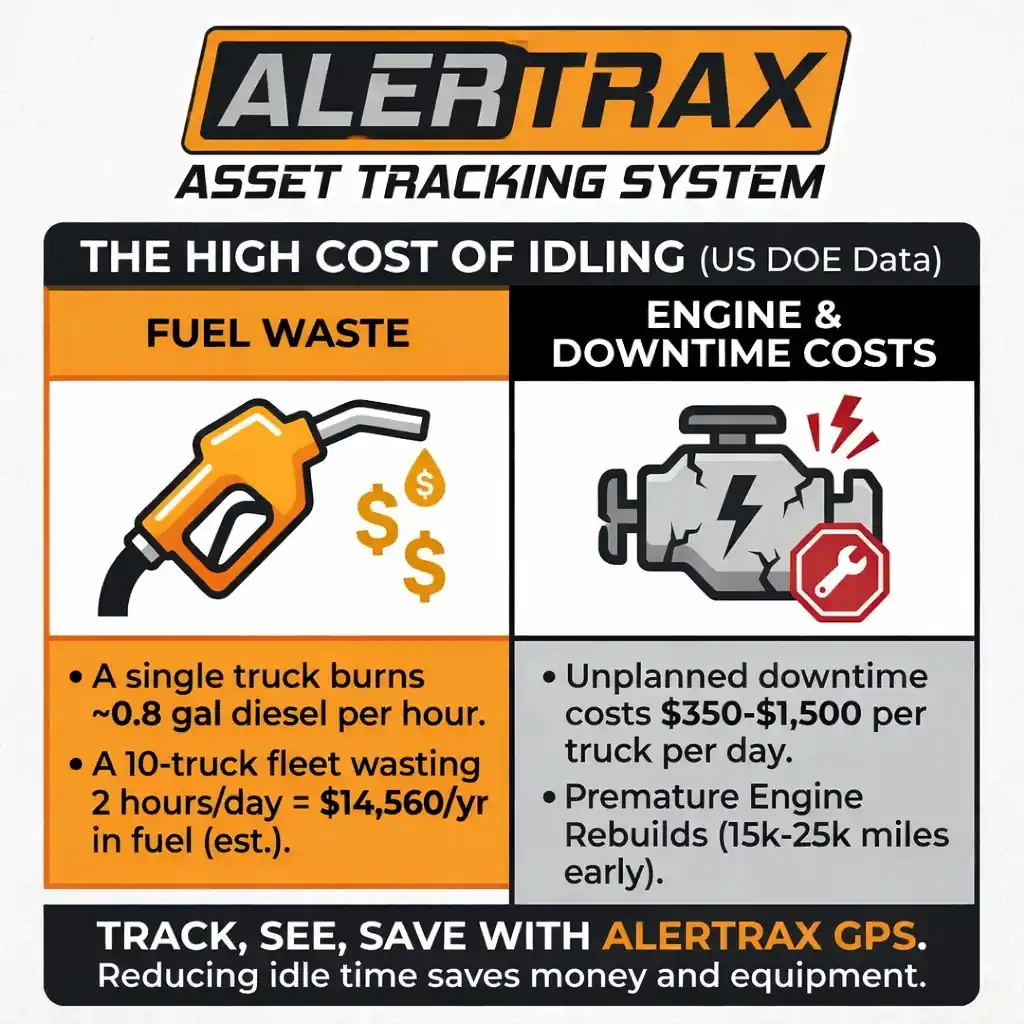
According to the U.S. Department of Energy, a heavy-duty truck can consume up to 0.8 gallons of fuel per hour while idling. Even a standard pickup burns roughly 0.5 gallons per hour when stationary with the engine running.

For a single work truck that idles two hours per day across 260 working days:

MetricPer Vehicle (Annual)
Daily idle time2 hours
Fuel burned per hour (idle)0.8 gallons
Annual gallons wasted416 gallons
At $3.50/gallon diesel$1,456/year
At $4.50/gallon diesel$1,872/year

That's per truck. Scale it to a small fleet and the numbers become significant fast.

$100,000+/yr Estimated annual fuel waste for a 25-vehicle fleet with unmanaged idle time, according to fleet management industry calculations at 2025 fuel prices.

Scaling the Problem: What Idle Time Costs a Fleet

Fleet SizeDaily Idle/VehicleAnnual Gallons WastedAnnual Cost ($3.50/gal)
5 trucks2 hours2,080 gallons$7,280
10 trucks2 hours4,160 gallons$14,560
15 trucks2 hours6,240 gallons$21,840
25 trucks2 hours10,400 gallons$36,400

And two hours is a conservative estimate. Some fleets have recorded idle time reaching 35% of total engine-on time. For a truck running 8 hours a day, that's nearly 3 hours of daily idling.

Fuel Is Only Half the Cost

What most business owners don't realize is that idling doesn't just burn fuel — it damages the engine. Idle conditions create incomplete fuel combustion, which accelerates carbon buildup, overloads exhaust systems, and degrades oil quality.

Mechanical Costs of Excessive Idling
  • More frequent oil changes due to fuel dilution and soot contamination
  • Accelerated DPF (diesel particulate filter) clogging — replacements cost $2,000 to $5,000 each
  • Premature turbocharger wear from insufficient exhaust flow at idle
  • Shortened engine life, with idle-heavy engines reaching rebuild stages 15,000 to 25,000 miles earlier
  • Increased downtime for unplanned repairs, costing $350 to $1,500 per truck per day

The 30% Factor: Driver Behavior and Fuel Efficiency

Fleet management research consistently shows that up to 30% of a vehicle's fuel efficiency is determined by driver behavior. Idling is the largest contributor, but it's compounded by aggressive acceleration, unnecessary speeding, and inefficient routing.

The challenge for small fleet operators is visibility. Without tracking data, you can't identify which drivers are idling excessively, which routes waste time, or which job sites create the most dead time.

Up to 30% Percentage of fleet fuel efficiency impacted by driver behavior — with unnecessary idling being the single largest controllable factor.

What GPS Movement Data Reveals About Fuel Waste

GPS tracking produces movement data that reveals idle patterns clearly. When a vehicle reports the same GPS coordinates for extended periods during work hours, it's either productively parked or wastefully idling.

Over time, this data answers critical questions: Which vehicles spend the most time stationary during working hours? Which job sites create the most dead time between tasks? Are vehicles making efficient routes between sites? How early do vehicles arrive at job sites versus when work actually starts?

Telematics provider Linxup reported that their customers reduced idling by 373,000 hours in a single 12-month period — eliminating roughly 186,000 gallons of fuel consumption and over 1,650 metric tons of carbon dioxide emissions.

What Reducing Idle Time by One Hour Per Day Saves

Fleet SizeAnnual Fuel SavingsEst. Maintenance SavingsTotal Annual Savings
5 trucks$3,640$2,500$6,140
10 trucks$7,280$5,000$12,280
15 trucks$10,920$7,500$18,420

For context, the annual cost of tracking 15 vehicles with AlerTrax is a fraction of these savings. The ROI isn't theoretical — it's visible in the fuel receipts within the first quarter.

Visit www.buyalertrax.com today to see where your fleet actually spends its time — and where the money goes.