There's a category of equipment in almost every small construction, landscaping, and contracting business that doesn't show up on any report. It doesn't appear in theft statistics. It doesn't trigger insurance claims. It just sits there — depreciating, costing money in insurance and maintenance, and contributing nothing to revenue.
The industry calls them ghost assets. They are the trailers parked in the yard that haven't moved in weeks. The skid steer that was bought for a project eighteen months ago and has been "available" ever since. The mower that sits at one crew's location while another crew rents an identical machine because nobody knew it was there.
The Utilization Problem by the Numbers
Asset utilization — the percentage of available time that a piece of equipment is actively being used — is one of the most important metrics in equipment-dependent businesses. It's also one of the least tracked.
Most manufacturers and construction firms operate equipment at 60% to 70% overall effectiveness, according to OEE (Overall Equipment Effectiveness) benchmarks. But those numbers come from companies that actually measure. For the small contractor with 5 to 15 pieces of equipment scattered across job sites, the real number is often worse.
Below 50%
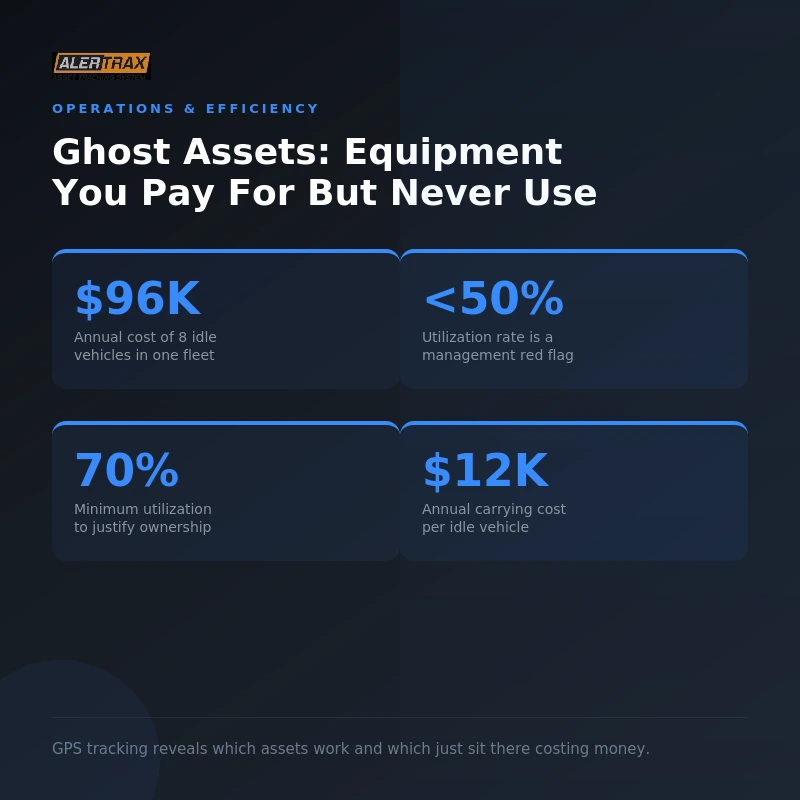
Equipment utilization rates under 50% indicate resource management problems. Many small fleet operators don't track utilization at all, meaning they can't identify what's being underused.
A field services company that tracked its 35 vehicles using GPS data discovered that 8 of them — nearly one-quarter of the fleet — were consistently underutilized. Each of those vehicles was costing $12,000 per year in insurance, parking, depreciation, and maintenance. That's $96,000 per year in carrying costs for assets that were barely earning revenue.
What Ghost Assets Actually Cost
Every piece of equipment your business owns carries a fixed annual cost regardless of whether it moves or not:
| Asset Type | Estimated Annual Carrying Cost (Idle) |
|---|
| Enclosed work trailer | $2,400–$4,800 |
| Skid steer | $5,000–$9,000 |
| Mini-excavator | $6,000–$11,000 |
| Work truck | $8,000–$14,000 |
| Commercial mower (ZTR) | $1,800–$3,500 |
These figures include insurance premiums, registration, depreciation, scheduled maintenance, and storage or yard space. None of them require the equipment to turn a single hour of productive work.
A contractor with two underutilized trailers, one idle skid steer, and a truck that's only deployed twice a month could be carrying $20,000 to $35,000 per year in dead weight — and never know it.
$96,000/yr
Carrying cost identified by one field services company for 8 underutilized vehicles — discovered only after GPS tracking revealed actual usage patterns.
Why This Happens: The Visibility Gap
Ghost assets don't appear because business owners are careless. They appear because growing businesses lose visibility. When you go from 3 pieces of equipment to 12, from 1 job site to 5, from 2 crew members to 8, the mental inventory system that used to work stops working.
Ask a contractor with 10 trailers where each one is right now, and you'll get a confident answer. Ask them which ones moved in the last 14 days, and the confidence disappears. Ask them which ones generated billable hours this month, and you're in territory that almost nobody tracks.
The Rental Paradox
One of the clearest signs of ghost assets is when a business is simultaneously renting equipment while owning idle units of the same type. Crew A needs a skid steer for a two-week job and rents one for $2,500. Meanwhile, Crew B's skid steer — which the business owns outright — sits in a yard 11 miles away because no one knew it was available. This happens constantly in operations without centralized asset visibility. The rental cost is obvious. The opportunity cost of the idle machine is invisible.
How GPS Data Exposes Ghost Assets
GPS tracking was designed for theft recovery. But the operational data it produces is often more valuable than the security function. When every trailer, truck, and machine reports its location on a regular interval, usage patterns become visible for the first time.
What GPS Utilization Data Shows
- Which assets haven't moved in 7, 14, or 30+ days
- Which job sites have equipment sitting idle between project phases
- Which crews are using equipment daily versus which have machines parked at a home base
- Where duplicate assets exist across locations — creating rental-avoidance opportunities
- Seasonal patterns that indicate when equipment should be sold, stored, or redeployed
None of this requires expensive fleet management software or complex analytics. A simple GPS report showing when and where each asset last moved is enough to start identifying waste.
The Decision Framework: Keep, Sell, or Redeploy
Once you can see actual utilization data, the decisions become straightforward:
| Utilization Pattern | Action | Financial Impact |
|---|
| Not moved in 30+ days, no upcoming need | Sell or list for rental | Recover capital + eliminate carrying cost |
| Used less than 25% of available time | Redeploy to higher-need crew or site | Avoid duplicate rental; improve crew output |
| Used seasonally (e.g., 4 months/year) | Rent out off-season or reduce insurance | Generate income or cut 6+ months of costs |
| Used 70%+ of available time | Keep and maintain | Full return on investment |
Industry benchmarks suggest that equipment utilization below 70% is a red flag. Below 50%, it's likely the asset isn't justifying its cost of ownership. And below 25%, the business is almost certainly better off selling the equipment and renting when needed.
The Bigger Picture: Utilization Is Margin
Contractors tend to measure margin at the job level. But equipment carrying costs don't live at the job level. They spread across the entire business, diluting margin on every project whether the equipment was used or not.
In an industry where theft adds an estimated 1% to 5% to overall project costs, underutilization can add equal or greater cost — and unlike theft, it happens silently and continuously.
GPS tracking gives you the data to measure this. AlerTrax gives you that data without the complexity of enterprise fleet management systems. Every asset reports its position. You see what moves and what doesn't. And you start making decisions based on evidence instead of assumptions.
Visit www.buyalertrax.com today to find your ghost assets and stop paying to own equipment that isn't earning its keep.