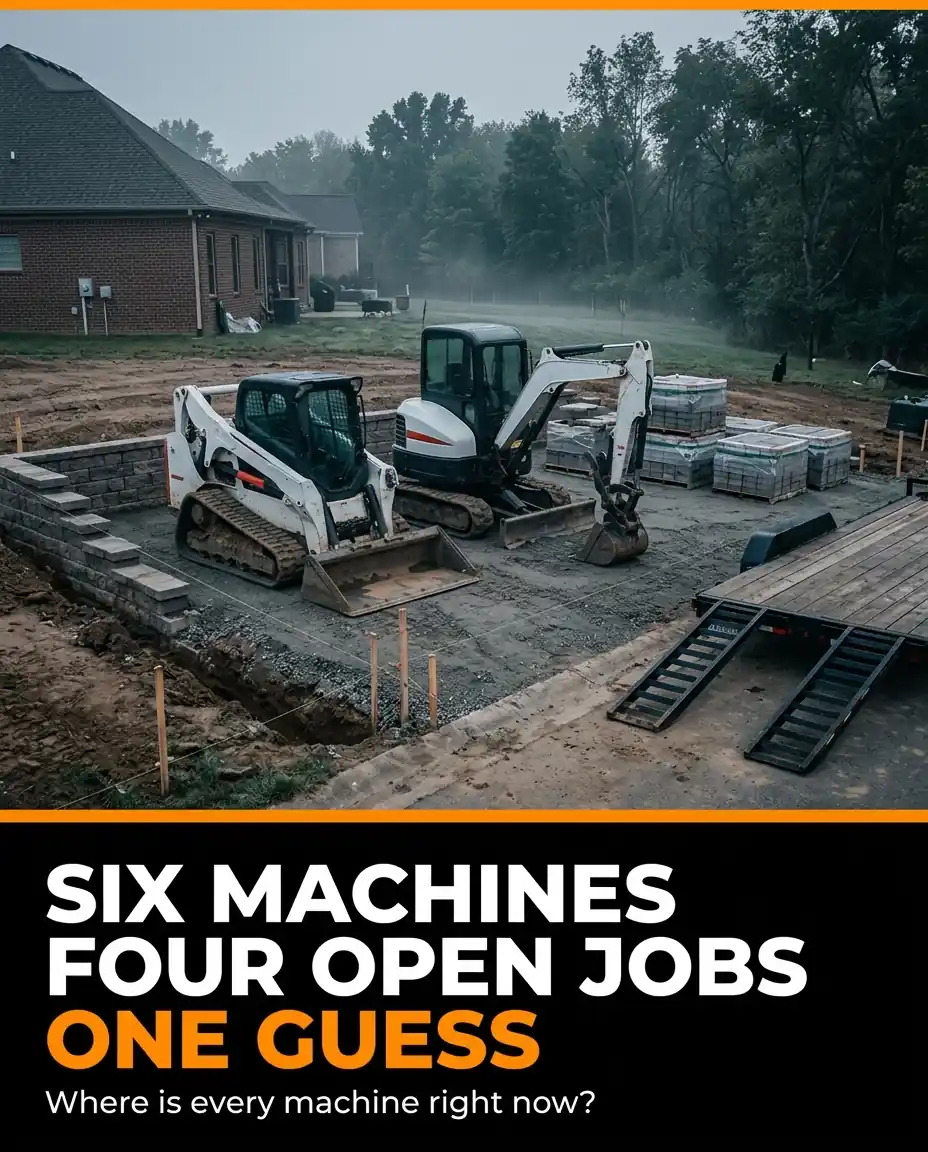
It is 6:50 on a Wednesday morning and your install crew is standing in the yard waiting to be told something.
They need the mini excavator. You have four jobs open right now: a paver patio in its fourth day, a retaining wall that started Monday and needs footings dug today, a driveway you are prepping for Thursday's pour, and a walkway job that was supposed to wrap Tuesday and did not.
The excavator is at one of those four sites. Nobody in the yard knows which one.
So the foreman calls the other foreman, who does not pick up because he is driving. He calls the guy who ran the walkway job, who thinks it went to the driveway on Monday, but he is not certain because he left at three. Somebody hooks up the trailer and drives twenty-two minutes to the driveway site. It is not there.
By the time the machine is located, loaded, strapped, and moving, it is 8:20. Three guys got paid to stand in a gravel lot for ninety minutes, a truck and trailer burned a round trip for nothing, and Thursday's pour just got tighter.
Nobody did anything wrong. That is what makes this so expensive. Every person in that story acted reasonably, and the morning still evaporated, because the information nobody had was where six machines were sitting at seven in the morning.
Heavy Equipment Does Not Come Home at Night
If you run maintenance routes, your equipment problem is mostly solved by physics. Trucks leave the yard loaded in the morning, they come back at night, and the yard is an accurate picture of what you own every single evening.
Heavy equipment breaks that model completely, and it breaks it for a reason that has nothing to do with discipline: moving a machine is itself a job.
A mower goes in the truck bed. A skid steer, a compact track loader, or a mini excavator needs a trailer, a truck rated to pull it, a licensed driver, straps and chains, and thirty to sixty minutes on both ends. So it does not come home. A retaining wall runs two weeks and the excavator stays for two weeks, because hauling it back and forth nightly would cost more than leaving it exposed.
Then the machine moves directly from job two to job four without ever passing through the yard, because that is the efficient thing to do. Nobody logs it. The transfer exists only in the memory of whoever made the call.
So the yard stops being the source of truth. The last person to touch each machine becomes the source of truth, and that person is on a job site with a saw running and a phone in his truck.
This will not be fixed by telling people to communicate better. It is a structural feature of how equipment-heavy work happens.
Which Machines Are Actually Worth Tracking
Not everything in your yard justifies a tracker, and it is worth being honest about where the line sits.
Hand tools and small equipment are not the problem. A $600 compactor that walks off is annoying, but it does not strand a crew, and putting a tracking device on every small tool you own is a project you will abandon by August.
The machines worth tracking share three traits: they are expensive, they are the bottleneck when missing, and they are made of steel. That last one matters practically, because it is what lets a magnetic mount work.
- Skid steers and compact track loaders. Usually $45,000 to $90,000, and the single most fought-over machine in most hardscape fleets.
- Mini excavators. Often $50,000 to $100,000. When one is missing, footings do not get dug and the whole schedule shifts right.
- Trenchers, ride-on rollers, and tracked dumpers. Lower use frequency, which is exactly why nobody can remember where they went.
- Telehandlers and larger loaders. The highest-value assets you own outside the trucks.
- The trailers themselves. Frequently overlooked and worth tracking on their own, because a trailer sitting at the wrong site strands a machine just as effectively as a missing machine does.
- Attachments. Augers, breakers, grapples, and buckets travel separately from the machine they belong to and go missing constantly. An attachment that costs $4,000 and holds up a $70,000 machine is worth a device.
A useful rule: if losing track of it for a morning costs you a crew, track it. That is usually somewhere between eight and fifteen assets for a hardscape company running four crews, not fifty.
The Demand Is Holding. The Margin Is Where It Gets Decided.
The market side of this is not the problem, which is exactly why the operational side matters so much.
The National Association of Home Builders reported a Remodeling Market Index of 61 in the second quarter of 2026, down a single point from the previous quarter and steady in the low 60s across the past year. Any reading above 50 means more remodelers rate conditions as good than poor, and the RMI has now stayed above that break-even line for 24 consecutive quarters (NAHB, 2026).
NAHB projects residential remodeling activity to rise 3 percent in 2026 and another 2 percent in 2027 in inflation-adjusted terms, supported by an aging housing stock and record homeowner equity. And the appetite for outdoor work specifically is not subtle: a NAHB survey found 86 percent of homebuyers want a patio and 81 percent want a back porch.
Here is the part that should get your attention. NAHB's own remodelers identify rising costs as a leading headwind, with larger projects getting delayed as material prices climb. Demand is steady and costs are rising, which means the difference between a good year and a mediocre one will not come from winning more work. It will come from how cleanly you execute the work you already sold.
Ninety minutes of a crew standing in a gravel lot is exactly the kind of leak that decides which side of that line you land on.
What a Morning of Looking Actually Costs
Put a number on the scenario at the top of this post.
The Bureau of Labor Statistics reports that construction and extraction occupations had an annual mean wage of $65,360 as of May 2025, across 6.4 million workers, with construction laborers the single largest occupation in the group at 1.1 million (BLS, May 2025 OEWS). At 2,080 hours a year, that annual mean works out to roughly $31.42 an hour.
A three-person crew at that rate costs $94.26 an hour in base wages, before burden, before the truck, before the fuel.
Ninety minutes of that crew waiting on a machine is $141.39. Add the wasted trailer trip and you are meaningfully past $150 before anything productive has happened.
Now assume it happens twice a week across a thirty-week season. That is 60 occurrences, and 60 times $141.39 is about $8,483 a year in base wages alone, for one crew, spent on nothing but locating equipment. Two crews doubles it.
And notice that heavy equipment makes every one of these delays longer than it would be with small tools. You cannot throw a mini excavator in a truck bed when you find it. Locating it is only the first half; hooking up, loading, strapping, and hauling is the second half, and that half is not optional.
None of it appears anywhere in your books. There is no line item called "waiting." It shows up as jobs that ran slightly over on labor, month after month, for reasons that never get diagnosed.
Three Jobs Works. Four Is Where It Breaks.
Ask most hardscape owners how they track equipment and the honest answer is that they hold it in their head. For a long time that works fine.
With two open jobs and four machines, your mental model is accurate almost all the time. You were at both sites this week. You remember what got moved.
Somewhere around the fourth concurrent job it stops working, and it stops working suddenly rather than gradually. You are no longer at every site every week. Foremen start making equipment decisions without you. A machine moves from job two to job four on a Friday afternoon and the only person who knows is a guy who is now on vacation.
The tell is not that you get it wrong. The tell is that you start hedging. You stop saying "the excavator is at the Whitfield job" and start saying "the excavator should be at Whitfield." That word is the sound of your mental model failing, and most owners say it for two full seasons before they do anything about it.
What makes this particularly costly is that four concurrent jobs is not a problem. It is growth. It is exactly what you have been working toward. The system that got you here just quietly stopped scaling, and the failure looks like slightly worse mornings rather than an obvious breakdown.
Geofence the Job Sites, Not Just the Yard
Most companies that adopt tracking draw one geofence around the yard and call it done. For equipment-heavy work that is backwards, because the yard is the one place your machines are not.
The higher-value move is to geofence every active job site. Load the addresses when you sell the job, and from that point on every arrival and departure logs itself. Nobody radios in. Nobody updates a spreadsheet. When the track loader moves from the walkway job to the retaining wall on a Friday afternoon, the record writes itself whether anyone remembers or not.
That changes your Wednesday morning from three phone calls and a wasted trailer trip into one glance at a map before anyone hooks up.
It also gives you something you have never had, which is the actual staging history of a job. When you look back at why the retaining wall ran two days long, you can see that the excavator did not arrive until day three. That is not a blame exercise. It is the difference between guessing at what went wrong and knowing.
The Handoff Problem
The most common way heavy equipment goes missing is not theft. It is a handoff that never got recorded.
Crew A finishes early on Thursday. Rather than haul the skid steer back to the yard, the foreman drops it at Crew B's site because they will need it Monday and it saves two trailer trips. This is good judgment. It is the right call operationally, and with heavy equipment the savings are real, because every avoided haul is an hour of truck and driver time. And it is invisible to everyone who was not standing there.
Multiply that by a season and your equipment ends up distributed across your job sites according to a set of sensible decisions that nobody wrote down. The machines are all working. Nothing is lost. But no single person can produce an accurate list of what is where, which means every morning starts with a small investigation.
Automatic arrival and departure logging does not change the decision, and it should not. Dropping the skid steer at Crew B's site is still the right move. It just means the decision gets recorded the moment it happens, so the good judgment your foreman exercised on Thursday is still visible to you on Monday.
Why AlerTrax Fits Heavy Equipment
Most tracking hardware was designed for vehicles: constant 12-volt power, a permanent install, a technician appointment. That is a poor match for machines that sit for weeks between uses, run on their own batteries, and get pressure washed at the end of a job.
AlerTrax was built for this.
- Two AA batteries, no wiring: Nothing to splice into a machine's electrical system, and no parasitic drain on a battery that has to start a diesel after sitting idle for three weeks. Over a year of life on equipment that moves occasionally, roughly 4 to 6 months on a machine working five days a week. A battery swap takes about a minute.
- 8 lb magnetic mount: Heavy equipment is the ideal surface for this. Steel frames, counterweights, boom arms, and trailer tongues everywhere. It mounts in seconds with no drilling, and it comes off just as fast when you sell the machine. Screws and zip ties are included for anywhere a magnet will not hold.
- IP67 waterproof and ruggedized: Rated for dust and water immersion including salt water exposure. It survives mud, rain, and the pressure washing that actually kills tracking hardware on job sites.
- Small enough to hide: 3.2 x 1.8 x 1.6 inches, 5.3 ounces. It disappears inside a frame rail, behind a counterweight, or under a cowling, which matters on a machine parked behind a house all weekend.
- Live fleet map: Every machine, attachment, trailer, and truck on one screen, with location updates as often as every 2 minutes. This is the 6:50 AM answer.
- AddressFence: Load your job site addresses and get automatic arrival and departure alerts as equipment reaches each property, with no crew input required.
- Automatic time-on-site logging: Every arrival and departure timestamped, which builds the staging history of every job without anyone maintaining it.
- After-hours movement and tamper alerts: Get notified when a machine moves outside expected hours or when a device is disturbed.
- One platform for the whole fleet: Skid steers, track loaders, mini excavators, trenchers, rollers, attachments, trailers, and trucks, all on the same map.
What It Costs
AlerTrax is $49.99 per month over 12 payments, with no long-term contract and no hidden fees.
(Prefer to own it outright? There is a $599 Lifetime option for permanent, subscription-free tracking.)
The math on heavy equipment is not close. A $599 Lifetime device on a $60,000 mini excavator is one percent of the machine's value, one time, for the life of the machine. Set that against about $8,483 a year in crew standing time from the example above, and the decision stops being a budget question.
It is also worth noting what you are not paying. There is no installation appointment, no wiring labor, and no downtime for a machine that needs to be earning.
And Yes, Open Job Sites Are Where Machines Disappear
Everything above is about knowing where your equipment is during business hours. The same data covers the other sixteen.
Industry reporting puts the volume at nearly 1,000 pieces of equipment reported stolen to the National Crime Information Center every month, and treats that as a low estimate because a meaningful share of thefts are never reported. The National Insurance Crime Bureau estimates annual losses between $300 million and $1 billion (CONEXPO-CON/AGG, 2023).
The same reporting notes that thieves specifically favor the stretches when a site sits unattended, and that recovery odds improve the sooner an owner knows something moved.
That describes a hardscape job site precisely. A residential retaining wall job leaves a skid steer and a mini excavator sitting behind a house from Friday afternoon until Monday morning, on a property you do not own, with no fence and no lights. That is well over $100,000 of equipment parked in a stranger's backyard for sixty hours, and heavy equipment is stolen by people who arrive with a trailer and know exactly what they are taking.
An after-hours movement alert turns that sixty-hour blind spot into a notification. Useful. Still not the reason to buy. The reason is the 6:50 AM problem.
Answer the Question Before Anyone Hooks Up a Trailer
Four open jobs is a good problem. It means you sold the work, the crews are producing, and the business is doing what you built it to do.
But the way you kept track of six machines when you had two jobs is not going to carry you through six jobs, and the failure will not announce itself. It will show up as mornings that start late, jobs that run a day over, and a season that felt harder than the revenue suggests it should have been.
You should be able to answer one question at 6:45, on your phone, in the truck, before a single trailer gets hooked up: where is every machine right now?
Visit www.buyalertrax.com and put a tracker on every machine you stage on a job site.
Sources
National Association of Home Builders : NAHB/Westlake Royal Remodeling Market Index, second quarter 2026 reading of 61, down one point from the previous quarter and above the break-even level of 50 for 24 consecutive quarters; rising material costs and delays on larger projects cited as leading headwinds.
National Association of Home Builders : Remodeling forecast of 3 percent growth in 2026 and 2 percent in 2027 in inflation-adjusted terms, supported by aging housing stock and homeowner equity; NAHB buyer preference survey finding 86 percent of homebuyers want a patio and 81 percent want a back porch.
U.S. Bureau of Labor Statistics : Occupational Employment and Wage Statistics, May 2025 (released May 15, 2026). Construction and extraction occupations at 6.4 million employed with an annual mean wage of $65,360; construction laborers the largest occupation in the group at 1.1 million.
CONEXPO-CON/AGG (2023) : Equipment theft volume reported to the National Crime Information Center, NICB annual loss estimates of $300 million to $1 billion, and the relationship between unattended sites, speed of discovery, and recovery odds.
Note on figures: The hourly rate of $31.42 is derived from the BLS annual mean wage divided by 2,080 hours. The three-person crew, 90-minute delay, twice-weekly frequency, 30-week season, and quoted machine values are illustrative inputs, not survey data. Substitute your own crew size and rates to run the same calculation.