When equipment disappears, most business owners reach for the phone and call their insurer. The logic feels airtight: that's what insurance is for. But the moment a claim is filed, something else starts — a compounding cost cycle that can outlast the theft itself by years.
Insurance is not free money. It is a risk-transfer arrangement, and every claim recalibrates how your insurer views your business. Understanding the math behind that recalibration is essential for any contractor, landscaper, or fleet operator who thinks a policy alone is enough protection.
The Premium Escalation: Claim by Claim
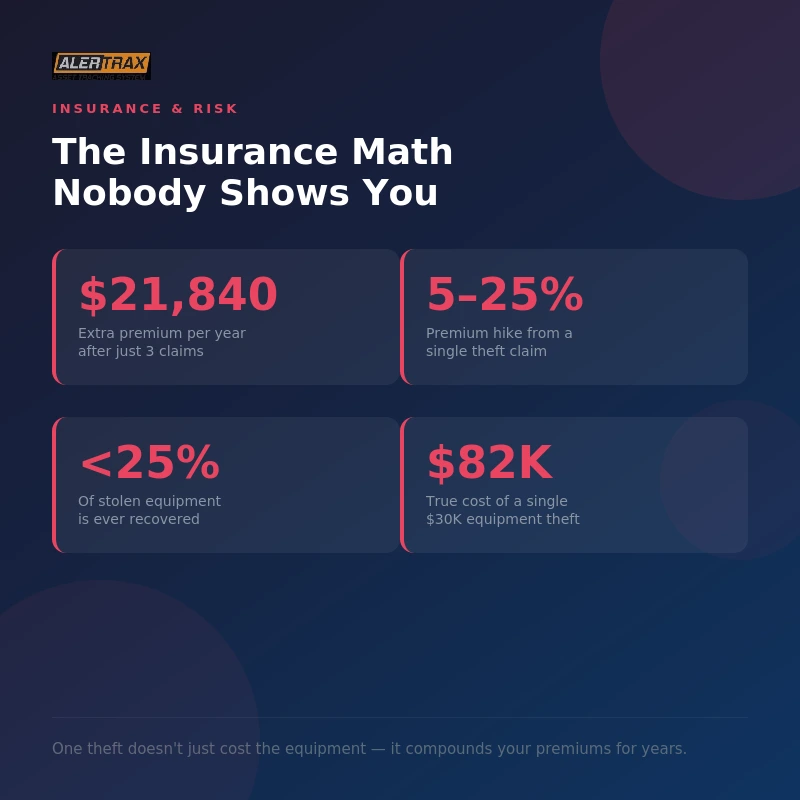
According to industry data, businesses typically see a 5% to 25% premium increase after filing a single theft claim. That's not a one-time bump — it resets your baseline for every future year. And it compounds.
Here's what that actually looks like for a contractor paying $30,000 per year for commercial property coverage:
| Event | Annual Premium | Increase from Baseline |
|---|
| Starting premium | $30,000 | — |
| After 1st claim (20% increase) | $36,000 | +$6,000/yr |
| After 2nd claim (20% increase) | $43,200 | +$13,200/yr |
| After 3rd claim (20% increase) | $51,840 | +$21,840/yr |
Three theft incidents — which is not unusual for a company running multiple trailers, trucks, and machines across multiple job sites — and the annual premium has nearly doubled. That $21,840 per year increase doesn't go away when the stolen equipment is replaced. It stays on the books.
$21,840/yr
Additional premium cost after three claims — that's $65,520 in extra insurance costs over just three years, on top of what you were already paying.
The Deductible Trap Most Owners Miss
Here's a detail that catches many business owners off guard: insurance deductibles often apply per unit, not per incident. If thieves hit your parking lot and steal catalytic converters from five trucks in one night, you don't pay one $1,000 deductible. You pay five.
That's $5,000 out of pocket before the insurer writes a check for anything — and every one of those claims contributes to the premium escalation described above.
For smaller operators, this math gets painful fast. A landscaping company with a $2,500 deductible that loses a trailer and a skid steer in a single theft is looking at $5,000 in deductibles, weeks of waiting for claim processing, and a premium increase that will follow them for the next three to five years.
The Claims That Get Denied
Premium increases assume the claim actually pays out. But denial is more common than most owners expect. Insurance companies can reject theft claims for reasons including:
Common Theft Claim Denial Triggers
- Insufficient documentation of ownership or proof the items existed
- No evidence of forced entry (an unlocked gate or door can void coverage)
- Failure to file a police report within the required window
- Equipment stored at a location not listed on the policy
- Missing or inaccurate valuations of stolen property
- Insufficient preventive security measures as required by the policy terms
That last point is increasingly relevant. Many insurers now require documented security measures — locks, cameras, alarms, or GPS tracking — as a condition of coverage. Without them, the claim can be reduced or denied entirely.
What a $30,000 Theft Actually Costs
The National Equipment Register estimates the average construction equipment theft costs around $30,000 in direct losses. But the real cost extends well beyond that.
| Cost Category | Estimated Range |
|---|
| Direct loss (equipment value) | $30,000 |
| Insurance deductible | $1,000–$5,000 |
| Premium increase (3-year impact) | $4,500–$22,500 |
| Lost productivity / project delays | $3,000–$15,000 |
| Rental equipment during replacement | $2,000–$8,000 |
| Administrative time (claims, police, etc.) | $500–$2,000 |
| True total cost | $41,000–$82,500 |
That $30,000 theft can cost the business anywhere from $41,000 to over $80,000 when all downstream costs are included. Insurance covers a portion — but the rest comes straight from operating margin.
The Tracking Discount Most Insurers Now Offer
There's a meaningful flip side to this equation. The same insurers who penalize claims also reward prevention. The Hartford, for example, has publicly stated that they waive the theft deductible for scheduled equipment that is fitted with a GPS tracking device at the time of theft.
Other carriers are offering premium discounts of 5% to 15% for businesses that demonstrate active asset tracking and monitoring. In an industry where over 11,000 pieces of equipment are stolen every year and fewer than 25% are ever recovered, anything that improves recovery odds reduces insurer risk — and they're willing to share that savings.
<25%
Recovery rate for stolen construction equipment without GPS tracking — the primary reason insurers charge high premiums for equipment coverage.
Prevention Costs Less Than One Deductible
An AlerTrax GPS tracker costs less than a single insurance deductible. It runs on standard AA batteries, reports location every 15 minutes, and sends instant alerts the moment equipment moves when it shouldn't.
Compare that to a single year of compounded premium increases after a claim. The math isn't close.
The goal isn't to avoid carrying insurance. It's to avoid using it. Every claim you don't file is a claim that doesn't compound against your premiums. GPS tracking is the tool that sits between you and that first phone call to your insurer.
Visit www.buyalertrax.com today to stop paying for theft twice — once for the loss, and again for the premium increase.