You are bidding a commercial maintenance contract on a Thursday night. The property takes a three-person crew about two and a half hours per visit. You multiply the hours by what you pay your guys, add materials, add a margin you are comfortable with, and send it.
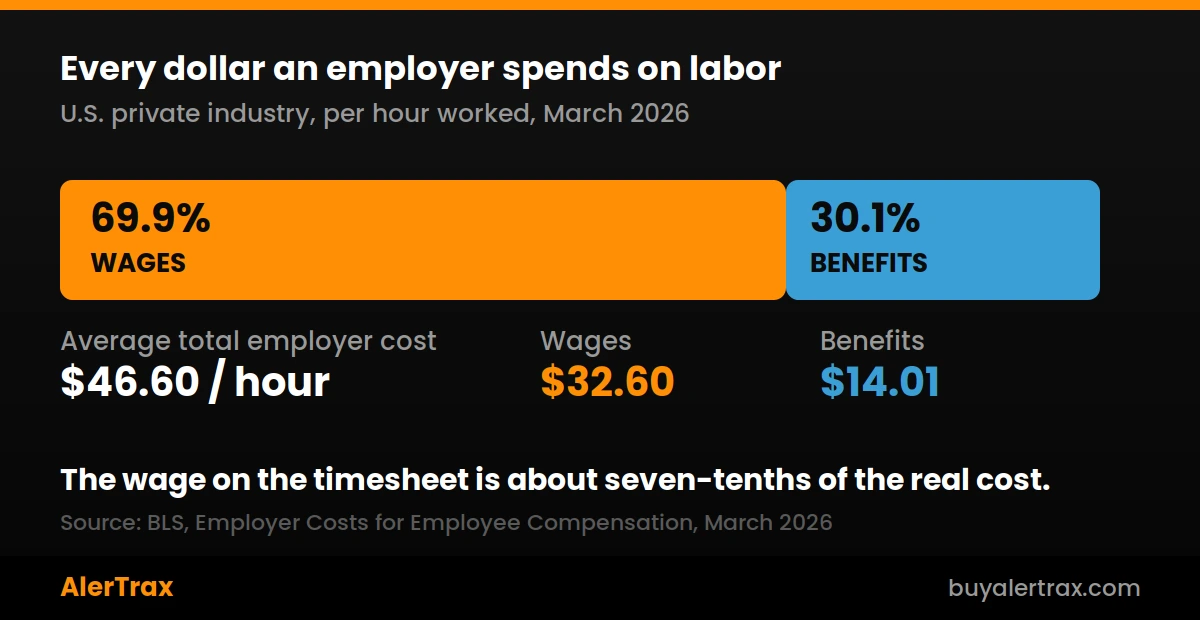
The number you used for labor was the wage. It is the number on the timesheet, the number in the offer letter, and the number in your head when you think about what a crew costs. It is also, according to the federal government's own measurement of what employers pay for labor, about seven-tenths of the truth.
This post is about the other three-tenths, where it goes, and what it does to every other number in your business once you account for it.
Want your own number instead of the industry average?
Calculate Your Burdened Labor Rate
The Ratio That Changes Everything
The Bureau of Labor Statistics runs a survey called Employer Costs for Employee Compensation, which measures what employers actually spend per hour worked, wages and benefits separately. It is the most authoritative answer available to the question "what does an employee really cost," and the March 2026 numbers were released in June.
- $46.60 per hour. Average total employer compensation cost for U.S. private industry workers (BLS, Employer Costs for Employee Compensation, March 2026).
- $32.60 of that is wages, which is 69.9 percent of the total (BLS).
- $14.01 is benefits, the remaining 30.1 percent (BLS).
Wages, in other words, are roughly seven-tenths of what employers actually spend on labor. Flip that ratio around and it becomes a multiplier you can use. If wages are 69.9 percent of the true cost, then the true cost is the wage divided by 0.699, which is roughly 1.43 times the wage.
Now apply it to this industry. The median grounds maintenance worker earns $18.50 an hour (BLS, Occupational Outlook Handbook). Run that through the benchmark ratio and the same employee costs you about $26.47 per hour, of which roughly $7.97 never appears on a paycheck. That is 43 percent more than the number most owners bid with.
Where the Other 30 Percent Goes
The benefits figure is not one line item. BLS breaks it into five categories covering eighteen distinct benefits, and most of them are obligations you cannot opt out of even if you offer no voluntary benefits at all. Five categories, eighteen benefits, and not one of them visible on a timesheet.
- Paid leave. Vacation, holiday, sick, and personal time.
- Supplemental pay. Overtime and premium pay, shift differentials, bonuses.
- Insurance. Health, life, short-term and long-term disability.
- Retirement and savings. Defined benefit and defined contribution plans.
- Legally required benefits. Social Security, Medicare, unemployment insurance, workers' compensation.
The one that matters most for landscaping is the legally required bucket: Social Security, Medicare, unemployment insurance, and workers' compensation. Those are not optional, they scale directly with payroll, and workers' compensation in particular is expensive in this trade because the work is classified as high risk. An owner who provides no health plan and no retirement match still carries that entire category.
An Honest Caveat About This Number
Being straight about what the 30.1 percent is and is not: it is the average across all U.S. private industry, not a landscaping-specific measurement. Applied to a landscaping wage it gives you a benchmark, not an audit, and your own number will land differently for two reasons that push in opposite directions.
Smaller field-service companies typically offer less on the voluntary side, fewer health plans, thinner retirement contributions, less paid leave, which pulls the ratio down. But landscaping carries higher workers' compensation rates than the private-industry average because of the injury profile, which pushes it back up. Depending on your state, your claims history, and what you offer, your real multiplier might be 1.25 or it might be 1.5.
The honest takeaway is not "your labor costs exactly 43 percent more than you think." It is that the gap is large, it is real, and if you have never calculated your own version of it, you are bidding with a number you know is wrong in a direction that costs you money. Your accountant can give you the exact figure in about fifteen minutes from last year's payroll returns.
What the Burden Does to Every Other Number
Once you carry the multiplier through, a lot of familiar figures get worse. Each of the three below is the same activity priced two ways, and in each case only the second number is the one leaving your bank account.
A crew-hour. Three people at $18.50 looks like $55.50 an hour of labor. Fully burdened it is closer to $79.40. Every hour that crew spends on something you cannot bill costs you nearly $24 more than the wage math suggests.
A season of small losses. Forty-five minutes a day of slop, late starts, drive-time zigzags, a supply run that ran long, across the roughly 40 working days between the Fourth of July and Labor Day, is 30 crew-hours. At wage that reads as about $1,665. Fully burdened it is about $2,382 per crew. Run three crews and you are near $7,150 for the summer, from a leak that never shows up as a line item anywhere.
A year of one employee. At 2,080 hours, $18.50 an hour is $38,480 of wages. The same person fully burdened is roughly $55,050. The difference, about $16,570, is what most owners never put in the model.
None of this means your prices are wrong by 43 percent. Most owners are unknowingly absorbing some of the burden inside their margin, which is exactly why the margin never feels as good as the spreadsheet promised. Labor already consumes 30 to 50 percent of revenue at a typical landscaping company (Aspire, 2025 Commercial Landscape Industry Report), and that share is measured in real dollars spent, not in wages quoted.
Why This Makes Unbilled Time So Expensive
Here is the practical consequence. Every conversation about lost hours in this business gets priced at the wage, and every one of those conversations is understating the damage by more than forty percent.
The American Payroll Association reports that 75 percent of companies experience some form of time theft, at a cost of up to 7 percent of total payroll. Seven percent of a $400,000 wage bill is $28,000, but the actual cost to the business is the burdened figure, closer to $40,000 in real money out the door. The same correction applies to the job you underpriced, the route that wanders, and the two-hour property that has quietly taken three hours since May.
Which is the argument for measuring where crew hours actually go, and measuring it with records rather than recollections. You cannot reprice a job whose real duration you never captured, and at $79 an hour for a burdened crew, a two-hour estimation error you repeat weekly is not a rounding difference.
Where AlerTrax Fits
AlerTrax does not lower your labor burden. Nothing does; it is mostly statutory. What it does is show you where the burdened hours actually go, so you can price and schedule against real numbers:
- Automatic Time-on-Site Logging: Arrival and departure timestamps at every stop, so each property has a true duration history to check against the hours you bid.
- Route History: Every day's actual routes on a map, which is where the between-jobs hours hide.
- Live Fleet Map: Every asset in the AlerTrax Fleet Portal and the iOS and Android app, updated as often as every 2 minutes.
- AddressFence Alerts: Arrival and departure notifications tied to the customer addresses you care about, with nothing for the crew to remember to do.
- Exportable Reports: Pull the numbers into a spreadsheet and set them beside your estimates, which is the entire job-costing exercise.
- Over a Year of Battery Life, No Wiring: No splicing, no OBD port, no install appointment. Magnetic mount, about a minute per vehicle, on trucks, trailers, mowers, and skid steers alike.
Pricing, Against a Burdened Crew-Hour
You can put AlerTrax on your entire fleet for a low monthly rate, with no long-term contracts and no hidden fees. Set it against a single burdened crew-hour of about $79: recovering one hour a week across the fleet pays for the tracking many times over, and the job-costing data keeps working every week after that.
(Want to own it outright? There is a $599 one-time Lifetime option for permanent, subscription-free tracking. No fees, ever.)
See the monthly plan and get set up here.
And the Same Trackers Watch the Yard
A note worth adding, since the theme here is costs that do not show up until you look for them. Geofence your yard and AlerTrax alerts you within minutes if a truck, trailer, or mower moves after hours, with tamper notifications on the device and a live tracking link you can hand to law enforcement. Not the reason to buy. Just the same hardware doing a second job overnight.
Run Your Own Multiplier This Week
Ask your accountant for your true burdened hourly cost per crew member. Then go back to three contracts you priced this spring and rerun them with the real number. If they still look good, you have earned some confidence. If they do not, you have found the reason a busy season keeps ending with a disappointing bank balance.
Visit www.buyalertrax.com and start measuring where your burdened hours actually go, so the next bid uses a number that is true.
This article is for general informational purposes only and is not accounting, tax, or legal advice. Labor burden varies substantially by state, company size, claims history, and benefits offered. The figures here apply a national private-industry benchmark ratio to an industry median wage and are illustrative, not a calculation of any specific company's costs. Consult a qualified accountant to determine your actual burdened labor rate.
Sources
U.S. Bureau of Labor Statistics, Employer Costs for Employee Compensation, March 2026 (released June 12, 2026): Total employer compensation costs for private industry workers averaged $46.60 per hour worked; wages and salaries averaged $32.60 and accounted for 69.9 percent of employer costs; benefit costs averaged $14.01 and accounted for the remaining 30.1 percent. Benefits comprise five major categories and eighteen benefits: paid leave, supplemental pay, insurance, retirement and savings, and legally required benefits.
U.S. Bureau of Labor Statistics, Occupational Outlook Handbook (Grounds Maintenance Workers): Median wage of $18.50 per hour, May 2024.
Aspire, 2025 Commercial Landscape Industry Report: Labor consumes 30 to 50 percent of total revenue at a typical landscaping company.
American Payroll Association: 75 percent of companies experience some form of time theft, which can cost up to 7 percent of total payroll.