Your Crews Are Already at the 40 Hour Line
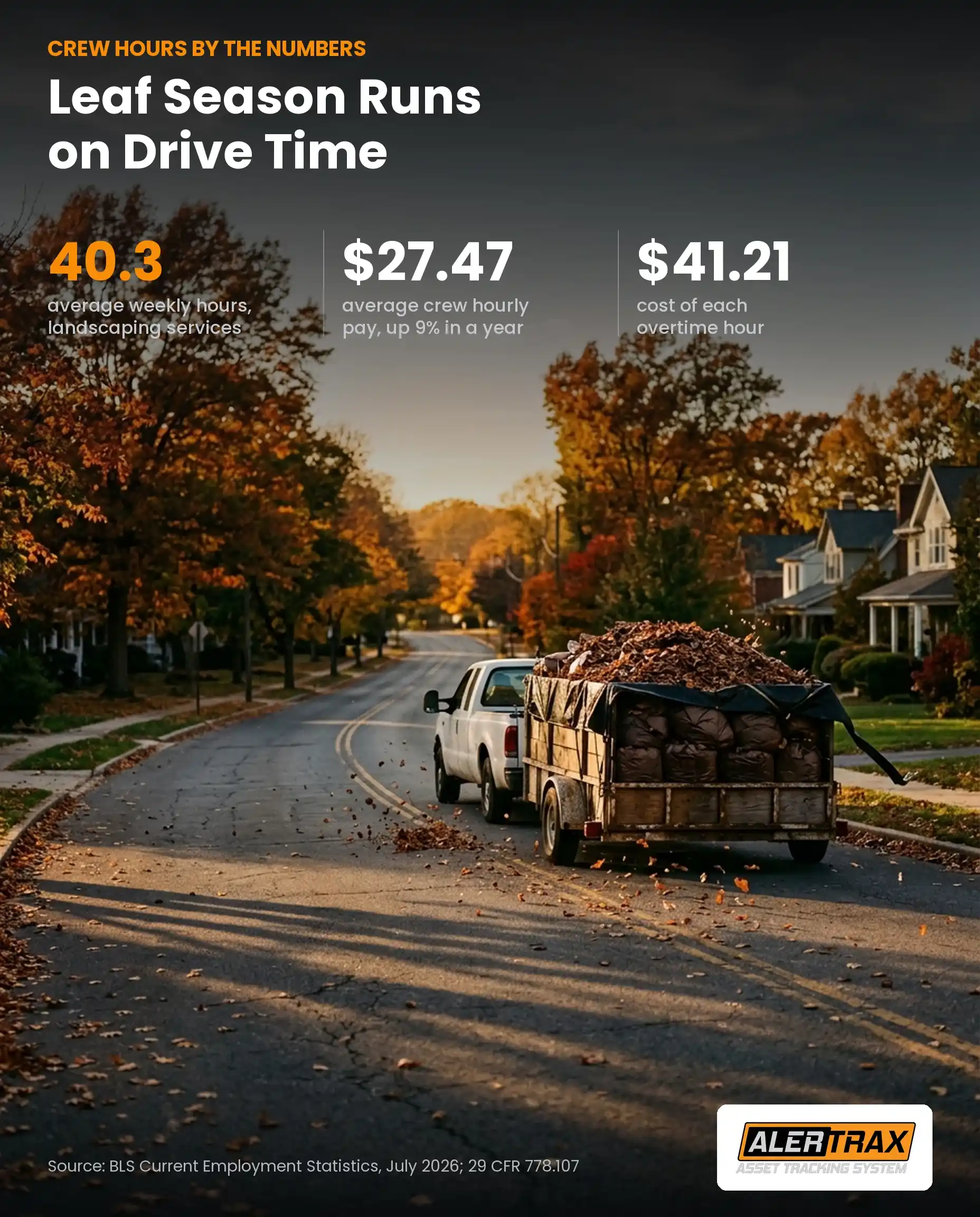
The Bureau of Labor Statistics tracks hours and pay in the landscaping services industry every month through its Current Employment Statistics survey. In July 2026, the most recent month published, employees in landscaping services averaged 40.3 hours a week. Production and nonsupervisory employees, the people on the crews, averaged 39.4 hours (BLS Current Employment Statistics, July 2026, not seasonally adjusted).
Those are averages across the whole industry, so plenty of crews run well above them and some run below. But the point is hard to miss. For a typical crew member, there is almost no room left in the week before overtime starts.
Fall does not lighten the load right away, either. Last year, the same survey had landscaping employees averaging 40.2 hours in September 2025 and 39.4 hours in October 2025, before hours fell off in November and December (BLS CES, 2025).
An Hour of Crew Time Costs More Than It Did Last Year
Production and nonsupervisory employees in landscaping services earned an average of $27.47 an hour in July 2026, up from $25.19 in July 2025, an increase of about 9 percent in a single year (BLS CES, July 2026).
Federal overtime rules require pay of at least one and one-half times an employee's regular rate for hours over 40 in a workweek (29 CFR 778.107). At the July 2026 industry average, that works out to about $41.21 for every overtime hour, per person.
Overtime is not a problem when it is planned and priced into the work. It becomes a problem when it is made of hours nobody saw coming, like dump runs, detours, and drive time that never made it into the bid.
What the Federal Rule Says About Drive Time
The Fair Labor Standards Act regulations are direct about travel during the workday. Under 29 CFR 785.38, "travel from job site to job site during the workday, must be counted as hours worked."
The same section covers the way most landscaping companies start the day. Where an employee is required to report to a meeting place "to receive instructions or to perform other work there, or to pick up and to carry tools," the travel from that place to the work site "is part of the day's work, and must be counted as hours worked regardless of contract, custom, or practice." For a crew that meets at the yard and loads the trailer, the drive to the first property is generally work time.
Ordinary travel from home to work is a different matter. 29 CFR 785.35 says normal home to work travel "is not worktime," whether the employee works at a fixed location or at different job sites. That line matters, and it is exactly why knowing where the day actually started is so useful.
The recordkeeping side is just as plain. 29 CFR 516.2 requires employers to keep records of "hours worked each workday and total hours worked each workweek" for employees covered by the overtime rules. A dump run is part of those hours whether or not anyone wrote it down.
State wage laws can be stricter than the federal rules, and some workers may be exempt. Treat this section as a summary of the federal regulations, not as a ruling on your specific crews.
Leaf Season Is a Driving Season
Spring and summer work is mostly time on the property. Fall cleanup adds a different kind of time: hauling. Leaves, brush, and debris have to go somewhere, and every trip to the compost site, transfer station, or back to the yard is time with the crew in the truck and the mowers on the trailer.
Here is an example, not survey data. Say a three person crew picks up four dump runs a week during leaf season, and each one takes 45 minutes. That is 3 extra hours per person per week. If those crew members were already at 40 hours, all 3 are overtime.
At the July 2026 industry average of $41.21 an overtime hour, that is about $124 per person per week, or roughly $371 a week for the crew. Over an eight week leaf season, the example adds up to almost $3,000 for one crew, all of it for time spent driving, none of it for time spent on a lawn.
Your numbers will be different. The point of the example is that you can only plan for this time if you can see it.
The Season Ends Fast
The same BLS survey shows how quickly the season turns. Landscaping services employment stood at about 1,014,200 in July 2025, fell to 965,400 in October, and dropped to 848,200 by December, a decline of roughly 166,000 jobs in five months. It bottomed out at 776,400 in February 2026 before climbing back to 1,018,500 in July 2026 (BLS CES, not seasonally adjusted).
That means the fall cleanup push happens with the crews you have, on a short clock. Every hour lost to an unplanned route or a long haul is an hour you do not get back before the work dries up.
What to Do Before the Leaves Peak
1. Count the in-between time. For two weeks, compare each crew's yard departure, every stop, and yard return against what got billed. The gap between first stop and last stop that was not on a property is your drive and haul time.
2. Put the dump site on the route, not after it. If a crew always fills up by the third stop, plan the run between the third and fourth stops and choose the order of properties so the compost site sits on the way.
3. Price the haul into fall cleanup. If a cleanup takes two hours on site and 40 minutes to haul away, the bid should know about the 40 minutes.
4. Watch the weekly total by Wednesday. Overtime is decided by the workweek. A crew at 30 hours by Wednesday afternoon in a five day week is heading for 50, and Wednesday is still early enough to move a stop.
5. Keep the timesheet and the route record side by side. The federal rule asks for hours worked each workday. A record of when the truck left the yard and when it came back makes the timesheet easier to trust and easier to defend.
6. Tell your crews what you are doing and why. Visibility into drive time protects their pay as much as your margin. Crews that know hauls are counted have less reason to rush them.
Where Alertrax Fits
You cannot plan drive time you cannot see. Alertrax gives you a record of where every truck and trailer went, when it got there, and how long it stayed, without asking the crew to do anything.
- Automatic Time-on-Site Logging: Every arrival and departure is timestamped automatically, so the time on each property and the time between properties come out of the data, not out of memory.
- Complete Route History: A full breadcrumb trail of every stop, including the compost site, the supply house, and the run back to the yard.
- Trip Reports You Can Export: Pull a date range by vehicle or across the fleet, with start time, stop time, addresses visited, duration, and distance, in a table you can put beside a timesheet.
- AddressFence: Address-based arrival and departure alerts, so you know when a crew reaches a property and when it leaves.
- Live Fleet Map: Every tracked truck and trailer on one map in the Alertrax Fleet Portal, with location updates every 2 minutes, so you can move a stop before it turns into overtime.
- One-Year Battery, No Wiring Required: Alertrax runs on two AA cells. Put it on the truck, the leaf trailer, or the dump trailer, with nothing to wire in and nothing to charge.
- 100% Waterproof, Covert Magnetic Mounting: Mounts to a steel frame in seconds and keeps working through rain, mud, and wet leaves.
- iOS and Android App: Check the map, the alerts, and the day's history from your phone.
And when the season winds down and the trailers sit in the yard for the winter, the same device sends an after-hours movement alert if one of them moves when it should not.
Pricing
You can equip your fleet with Alertrax for a low monthly rate, no long-term contracts, no hidden fees.
(Want to own it outright? We offer a $599 Lifetime option for permanent, subscription-free tracking.)
Set that against the example above, where one crew's leaf season dump runs added up to almost $3,000 in overtime.
Sources
U.S. Bureau of Labor Statistics (BLS), Current Employment Statistics, Landscaping Services (NAICS 56173), not seasonally adjusted, series CEU6056173001, CEU6056173002, CEU6056173007, and CEU6056173008, retrieved October 2026: average weekly hours of all employees of 40.3 in July 2026, 40.2 in September 2025, and 39.4 in October 2025; average weekly hours of production and nonsupervisory employees of 39.4 in July 2026; average hourly earnings of production and nonsupervisory employees of $27.47 in July 2026 and $25.19 in July 2025; employment of 1,014,200 in July 2025, 965,400 in October 2025, 848,200 in December 2025, 776,400 in February 2026, and 1,018,500 in July 2026. July 2026 was the most recent month available at the time of writing, and recent months are subject to revision
Electronic Code of Federal Regulations (eCFR), 29 CFR 785.38, "Travel that is all in the day's work," retrieved October 2026: travel from job site to job site during the workday must be counted as hours worked; travel from a required meeting place, or after picking up and carrying tools, to the work place is part of the day's work
eCFR, 29 CFR 785.35, "Home to work; ordinary situation," retrieved October 2026: normal travel from home to work is not worktime
eCFR, 29 CFR 778.107, "General standard for overtime pay," retrieved October 2026: overtime must be paid at not less than one and one-half times the regular rate
eCFR, 29 CFR 516.2(a)(7), retrieved October 2026: employers must keep records of hours worked each workday and total hours worked each workweek
This article is provided for general informational purposes and is not legal, payroll, or financial advice. It summarizes federal regulations only; state and local wage laws may impose different or stricter requirements, and some employees may be exempt from overtime. Talk to an employment attorney or payroll professional about your own crews. BLS figures are industry averages and may not reflect your company. The dump run and overtime figures above are an illustration, not survey data.
See the Hours Between the Lawns
The leaves will come down on their own schedule. How many of your crew's hours go to driving them away is something you can measure, plan, and price, starting this week.
Visit www.buyalertrax.com today and see where every crew's day actually goes.