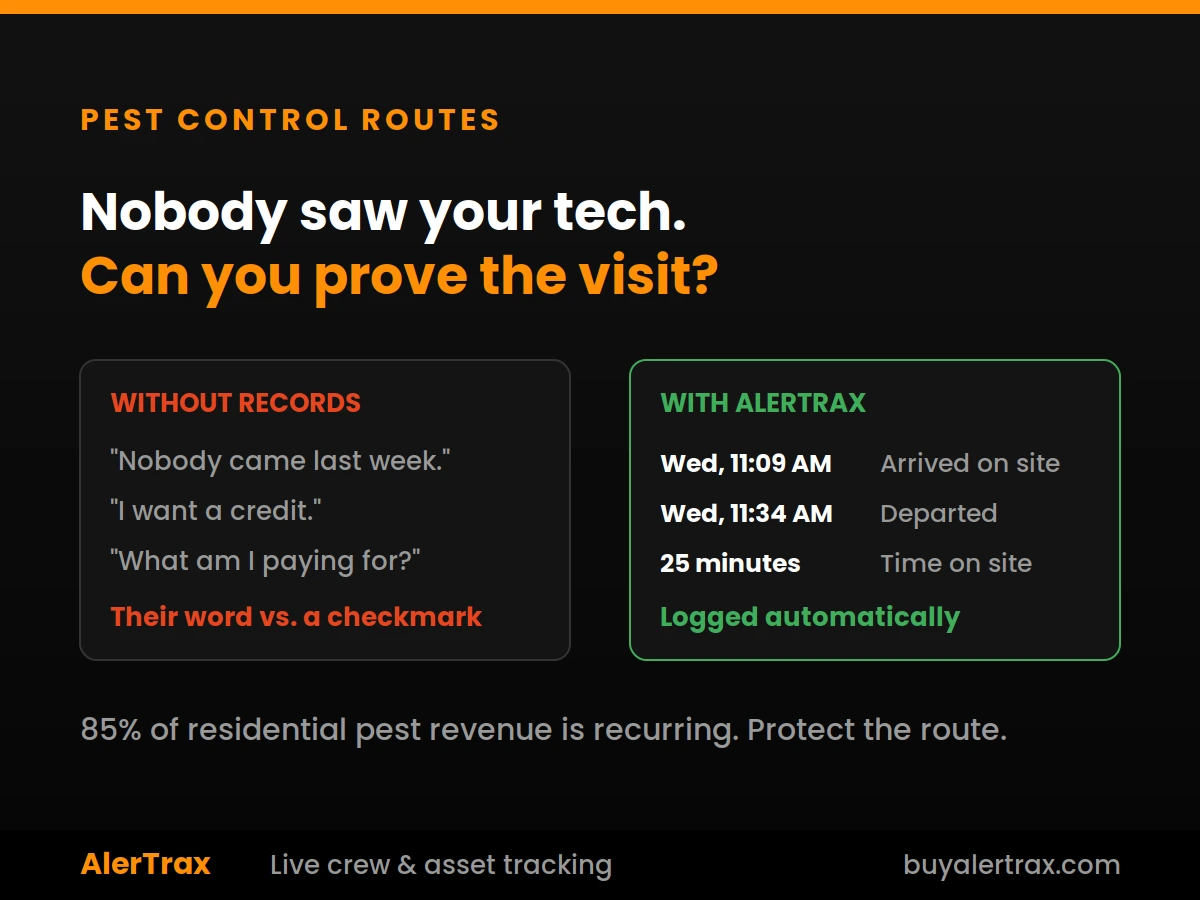
Monday morning, first call of the day. A quarterly customer, three years on the books, never a complaint. "Nobody came last week. I was home Thursday and Friday and I never saw a truck. I want a credit, and honestly I'm wondering what I've been paying for."
You pull the route sheet. It says serviced, Wednesday, 11:15 AM. Your tech remembers the stop, or thinks he does, it was a full route. The customer was at work Wednesday. He treated the exterior, like he does every quarter, and left the door hanger, which apparently blew off or never made it. And now it is your paperwork against her doorbell camera memory, and you already know how this ends: you issue the credit, she stays a little less convinced, and the next "did anyone come?" call gets you one step closer to a cancellation.
Every recurring-service business has this problem. Pest control has it worse than almost anyone, for one simple reason: your customers almost never see the work. The treatment happens on the exterior, midday, while they are at the office. The whole relationship runs on trust that an invisible service actually happened. And in this industry, that trust is not a soft thing. It is the revenue.
In Pest Control, the Route Is the Business
The numbers say it plainly. The U.S. pest control industry is a $29.7 billion market in 2026 (IBISWorld), and the residential side of it runs overwhelmingly on subscriptions: recurring revenue accounts for 85.4 percent of residential service revenue (NPMA, Strategic Analysis of the U.S. Structural Pest Control Industry, 2025). You are not selling one-time jobs. You are selling a standing promise, billed monthly or quarterly, that your company will quietly keep a property protected.
That structure is what makes pest control such a durable business, and it is also what makes churn the one number that can quietly kill you. A canceled quarterly account does not cost you a job. It costs you every visit that account would have generated for years. And cancellations in this business rarely come from a failed treatment. They come from doubt: the accumulating suspicion that the service is not really happening.
Meanwhile, the usual answer to growth, adding techs and routes, is jammed. More than a third of pest control companies, 36.8 percent, say their growth is constrained by not having enough technicians on staff (NPMA, 2025). If you cannot reliably add routes, the routes you already run have to hold. Retention is not one metric among many right now. It is the plan.
The Invisible-Service Problem
Think about what your customer actually experiences in a normal quarter. A charge on their card. Maybe a door hanger. That is often the entire visible footprint of your company. The treatment itself, the perimeter spray, the granular application, the bait station checks, happens while nobody is watching.
When the service is invisible, three expensive things grow in the dark:
- The "did anyone come?" calls. Each one costs office time, usually ends in a goodwill credit, and chips at the account's confidence whether or not the visit happened exactly as scheduled.
- The slow-fade cancellation. The customer who never calls to complain, just calls to cancel, because "we never see anyone and the ants came back." You lose the account without ever getting to defend it.
- The question you cannot comfortably ask. Every owner running paper or app-based route sheets eventually wonders: are all these stops actually being made, at full length, every time? A self-reported checkmark cannot answer that, and for your best techs, the ones doing it right every day, a checkmark cannot vindicate them either.
Proof of Service, Generated Automatically
Put an AlerTrax tracker on every truck and the invisible service develops a paper trail that nobody has to remember to create:
- AddressFence at every customer address. Tie an alert to each property you service and the system logs the truck's arrival and departure automatically. No tech input, no check-in app, no forgotten scans. The visit writes its own record.
- Timestamped answers to "did anyone come?" The Monday-morning call changes completely. "Yes ma'am, our truck was at your property Wednesday from 11:09 to 11:34." Dated, specific, checkable. Most disputes end right there, with the account's confidence higher than before the call.
- Time-on-site you can stand behind. The record does not just show the stop was made. It shows how long the truck was there, which is the difference between "we serviced it" and proof the service had time to actually happen.
- Route verification without confrontation. You do not have to ask anyone whether the route ran as written. The day's record either matches the route sheet or it does not, and your reliable techs get the credit their work has been earning all along.
For commercial accounts, restaurants, food facilities, property managers, the same records slot straight into the service documentation those customers already require, without your techs filling out anything extra.
The Other Half: Route Density
Pest control margins are a density game. The cost of a stop is mostly the drive to reach it, so the difference between a profitable route and a mediocre one is how tightly the stops cluster and how little windshield time sits between them. That is exactly what route history makes visible.
Pull up last Tuesday's route on the map and the problems are not subtle: the two stops on opposite sides of town serviced back to back, the route that crosses itself before lunch, the one far-flung account that eats forty minutes of driving for a twenty-minute service. Reshuffle the schedule so geography drives the order, move the outlier to the day you are already out that way, and the same truck, the same tech, and the same gas produce more completed stops per day. With a third of the industry unable to hire its way to growth, density is where the growth actually is.
Why AlerTrax Fits a Route Fleet
Most GPS platforms were built for long-haul logistics fleets, with hardwired installs and per-vehicle contracts to match. A route business does not have time for that. AlerTrax was built to be zero-friction.
- No Wiring, No Install Appointment: AlerTrax runs on its own battery for over a year. No splicing into the truck's electrical, no OBD port, no downtime. Magnetic mount, one minute per vehicle.
- Covert Mounting: Tucks out of sight on any steel surface. Nothing visible, nothing to unplug.
- Live Fleet Map: Every truck in the AlerTrax Fleet Portal and the iOS and Android app, with updates as often as every 2 minutes.
- AddressFence and Geofence Alerts: Arrival and departure logging tied to every customer address on your routes, plus your shop and supply stops.
- Automatic Time-on-Site Logging: Timestamps at every stop, your proof of service, payroll record, and route audit in one.
- Route History: Every day's actual route on a map, ready to compare against the plan.
- Waterproof and Ruggedized: Built for trucks that work outside every day, and for anything else you tow or store, from spray rigs to trailers.
Pricing That One Saved Account Covers
You can put AlerTrax on your entire fleet for a low monthly rate, with no long-term contracts and no hidden fees. Run it against the lifetime value of a single quarterly account: if timestamped proof of service saves you one cancellation, the tracking has paid for itself, and it is protecting every other account on the route at the same time.
(Want to own it outright? There is a $599 one-time Lifetime option for permanent, subscription-free tracking. No fees, ever.)
See the monthly plan and get set up here.
And Yes, It Watches the Trucks at Night Too
A pest control truck parked overnight carries sprayers, backpack rigs, termite equipment, and a stocked chemical inventory that is expensive to replace and worse to explain. Set a geofence around your shop and AlerTrax alerts you the moment a truck moves after hours, with tamper notifications if someone messes with the device. If a truck rolls at 2 AM, you know in minutes, and a live tracking link goes straight to law enforcement for recovery. One device, both jobs.
Make the Invisible Service Visible
Your business runs on work your customers never see. The companies that thrive in this industry are the ones that close that gap, not with more door hangers, but with records a customer cannot argue with and routes that get tighter every month.
Visit www.buyalertrax.com and put a tracker on every truck, so every visit on every route proves itself.
Sources
IBISWorld: U.S. pest control industry market size of $29.7 billion in 2026, with a 3.4% compound annual growth rate from 2021 to 2026.
NPMA (National Pest Management Association), A Strategic Analysis of the U.S. Structural Pest Control Industry, 2025: Recurring revenue accounts for 85.4% of residential pest control service revenue; 36.8% of companies report growth constrained by an insufficient number of technicians; 16,565 pest control firms operate in the U.S., 81.4% of them with one or two locations.