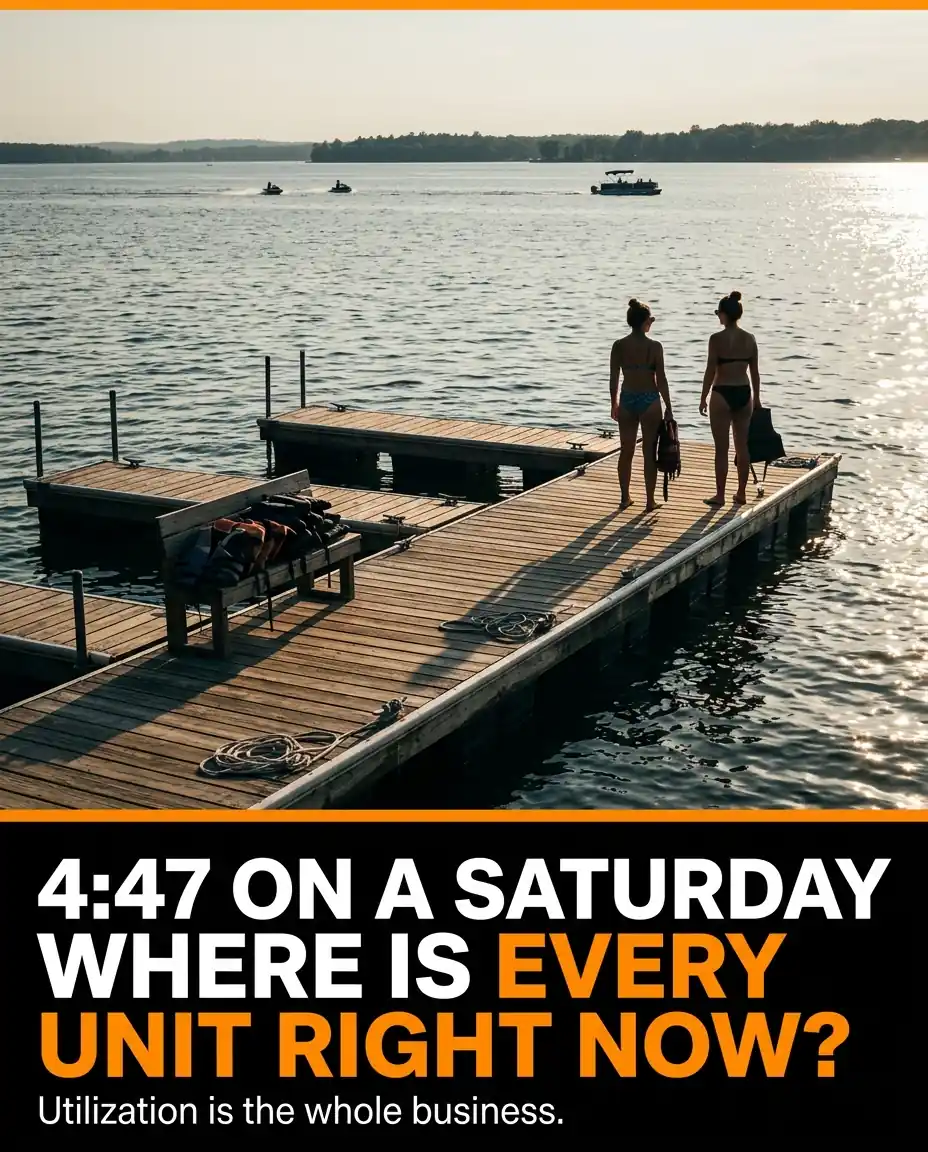
It is 4:47 on a Saturday afternoon in July. Two customers are standing at your dock with a 5:00 reservation, sunscreen on, phones out, ready to go.
Three of your units are still out on the water.
Your dock kid thinks one of them is the pontoon that went out at 2:00, but he is not sure, because the couple that took it asked to swap to the tritoon at the last minute and nobody wrote it down. He thinks the two skis are somewhere off the north end. He does not know if they are on their way back or just getting started on a second lap.
So you stand there and you wait, and you tell the 5:00 customers it will be just a few minutes, which is what you also told them nine minutes ago.
Here is the part that stings. You are not short on demand. You have a line of people who want to give you money. You are short on the one thing your entire business actually sells, which is a unit that is available at the moment someone wants it.
That is not a fleet size problem. It is a visibility problem, and it is costing you more per season than most operators would guess.
You Do Not Sell Boats. You Sell Unit-Hours.
It is worth being blunt about what a rental operation actually is. You own depreciating assets and you sell access to them by the hour. Every hour a hull sits on the trailer or floats empty at the dock during operating hours is inventory that expired unsold. You cannot get it back.
The broader rental economy has been making this point for years. The American Rental Association reports that the combined U.S. construction and industrial equipment and general tool rental industry finished 2025 at $80.6 billion and is projected to grow 3.6 percent in 2026 to $83.5 billion, with rental equipment penetration hitting a record in 2025 (ARA, May 2026).
ARA's stated reasons that customers keep shifting from owning to renting are worth reading as an operator, because they are the same reasons your customers walk onto your dock: financial flexibility, uncertainty about how much they will actually use the thing, and the high cost of owning it outright.
That is the tailwind. Your customer does not want to own a $38,000 tritoon that gets used nine days a year. They want Saturday afternoon. Your job is to have Saturday afternoon in stock.
Which means utilization is not a metric you check at the end of the season. It is the business.
The Late Return Cascade
Most operators think of a late return as a customer service annoyance. It is actually a revenue event, and it compounds.
Run it out. A ski goes out at 3:00 on a one-hour rental. It comes back at 4:12. Your 4:00 customer has been standing on the dock for twelve minutes, so now they push to 4:15, which pushes your 5:15 booking, and by 6:00 you have either shortened somebody's ride or canceled the last turn of the day.
Say that costs you exactly one booking. At a $110 hourly rate, that is $110 gone on a single unit on a single day.
Now assume it happens on three units, both weekend days, across a fourteen-week season. Three units, two days, fourteen weeks is 84 lost bookings. At $110 each, that is $9,240 in a season that never showed up in your books because it never got billed in the first place.
You will not find that number in your accounting. There is no line item for a rental that did not happen. It just shows up as a season that felt busier than it was profitable.
And notice what fixes it. Not more boats. Knowing at 4:05 that the ski is eight minutes out, so you can tell the waiting customer a real number and start the swap before the hull touches the dock.
Booked Hours Versus Actual Hours
Every rental operation has two sets of numbers, and almost nobody compares them.
The first set is what your reservation system says: this unit was booked for four hours today. The second set is what actually happened: it left the dock at 10:14, came back at 11:31, sat empty until 1:40, went out again until 3:55.
Your reservation system knows what you sold. It has no idea what you delivered.
GPS logging closes that gap without anyone writing anything down. Departure and return are timestamped automatically, so at the end of the week you can put booked hours and actual on-water hours side by side for every hull in the fleet.
That comparison answers questions you are currently guessing at. Are your two-hour rentals actually running two hours and forty minutes? Then you are underpricing every one of them. Is the 11:00 slot on Thursdays consistently going out late? Then the problem is staffing, not demand. Is one unit averaging half the water time of an identical unit next to it? Then something about how it is being assigned needs to change.
Which Units Are Actually Earning
Ask an operator with a twelve-unit fleet which three units carry the season and most can name them by instinct. Ask which three are dead weight and the answers get vaguer, because the units that sit are the ones you think about least.
Run the arithmetic on your own fleet. Twelve units, a ten-hour operating day, is 120 available unit-hours in a day. If your logs show 74 hours actually on the water, you ran at about 62 percent utilization on a day you probably remember as slammed.
That gap is where the decisions live. Before you finance unit thirteen, it is worth knowing whether units four through twelve are running at 90 percent or 40 percent. A fleet that averages 62 percent on peak Saturdays does not have a capacity problem. It has a routing and turnaround problem, and buying another hull makes the average worse, not better.
Per-unit utilization data also tells you which hulls to sell at the end of the season, which is a decision most operators make on age and hours rather than on what each unit actually produced.
Where Your Units Go Is a Safety Question Before It Is a Revenue One
Every rental operator has a version of the same rule: stay inside the bay, stay off the far side of the island, do not take it into the channel, be back by dark.
And every rental operator knows that some renters treat that rule as a suggestion, because they are on vacation and nobody is watching.
Geofencing turns that rule into something you can actually enforce. Draw a boundary around your permitted operating area and you get an alert the moment a unit crosses it. Not a lecture at the dock afterward, when the risk has already been taken. A notification while it is happening, so you can make a phone call.
This matters for reasons beyond the boat. Renters who go outside the operating area are usually going somewhere they do not know: unfamiliar water, unmarked hazards, thinner cell coverage, longer response time if something goes wrong. The boundary exists because of what is on the other side of it.
It also matters for your paperwork. When an incident happens outside your permitted area, having a timestamped record of where the unit actually was is the difference between a defensible position and your word against a renter's.
Service the Fleet on Real Hours, Not the Calendar
Most small rental operations schedule maintenance on a rough calendar and a rougher memory. Mid-season service, end-of-season service, and whatever gets flagged when something sounds wrong.
The problem is that units in the same fleet do not accumulate hours at the same rate. The two skis nearest the dock get grabbed first every single day. The pontoon at the end of the line goes out when everything else is gone. Servicing both on the same schedule means you are over-maintaining one and under-maintaining the other.
Automatic departure and return logging gives you actual usage per hull. That turns your service schedule into something driven by data instead of by the calendar, and it means the unit that is about to fail is the one you look at first, in the shop, on a Tuesday, rather than at 2:00 on a Saturday with a family sitting on it.
What the Dock Actually Needs
Strip it down and a rental operation needs three things it usually does not have.
1. One screen with every unit on it. Not a clipboard, not a whiteboard, not your dock kid's best guess. A live map showing where each hull is right now, on your phone, while you are standing on the dock with a waiting customer.
2. Automatic departure and return timestamps. Nobody at a rental counter in July has time to log anything by hand, and anything that depends on staff remembering will not survive a Saturday. The record has to build itself.
3. Something to show the waiting customer. When the 5:00 party is getting restless, sending them a link that opens a live map in their browser converts an argument into a wait they can see the end of. No app, no login, nothing for them to download while standing on a dock.
Why AlerTrax Holds Up on the Water
Most GPS tracking hardware was designed for trucks: hardwired to 12-volt power, installed once, never rained on. A rental hull is a different animal. It gets swamped, sun-baked, pressure washed, trailered, and handed to a stranger every ninety minutes.
AlerTrax was built by a company that started in marine tracking, and the spec sheet reflects it.
- IP67 rated and salt water protected: Sealed against dust and water immersion, and rated for salt water exposure rather than just rain.
- Two AA batteries, no wiring: Nothing to splice, no drain on a battery that already has to start an outboard. Expect over a year of life on units that move occasionally, and roughly 4 to 6 months on a hull that runs hard every day in season. Swapping two AA batteries takes about a minute.
- 8 lb magnetic mount, or screws, or zip ties: The magnet holds to any steel surface, and for aluminum or fiberglass you can screw it down or strap it inside a console, under a seat, or in a dry storage compartment.
- Small and light: 3.2 x 1.8 x 1.6 inches, 5.3 ounces. It disappears inside a console.
- Live fleet map: Every hull, ski, trailer, and tow vehicle on one screen, with location updates as often as every 2 minutes. Coverage on the water works the way your phone does, over LTE CAT-M1 on AT&T and T-Mobile: strong on lakes, rivers, and near-shore coastal water, thinner the farther offshore you go.
- Geofence alerts: Draw your permitted operating area, your dock, and your storage lot. Get notified on entry, exit, or after-hours movement.
- Automatic time-on-site logging: Departure and return timestamped on every trip, with nothing for your dock staff to remember.
- Shareable tracking link: Send a live map to a waiting customer by text. No app, no login, no account for them to create.
- Works on everything, not just hulls: Skis, pontoons, trailers, tow trucks, and the equipment in your yard, all on one platform.
What It Costs
AlerTrax is $49.99 per month over 12 payments, with no long-term contract and no hidden fees.
(Prefer to own it outright? There is a $599 Lifetime option for permanent, subscription-free tracking.)
Put that against the late return math. One booking recovered per unit per weekend day, at a $110 hourly rate, is $110. Do that twice in a season on one unit and the tracker on that unit has paid for a good chunk of its year. The $9,240 figure from earlier assumed only three units and one lost booking each; most operators who actually measure it find the real number is larger.
And Yes, It Matters If Something Walks Off the Trailer
The theft case for a rental fleet writes itself, but it is worth putting numbers on it, because a report came out yesterday.
The National Insurance Crime Bureau reported on August 3, 2026 that 58,957 recreational vehicles, including watercraft, ATVs, snowmobiles, and motorcycles, were reported stolen in 2025. That was a 20 percent decline from 2024, which is good news. The rest of the report is less encouraging: roughly 63 percent of them were never recovered. ATVs came in worst, with only 23 percent of the 11,050 reported stolen ever making it back to an owner (NICB, August 2026).
The line in that report that matters most for a rental operator is about timing. NICB notes that recovery odds for watercraft and other recreational vehicles improve based on how quickly a theft is discovered and reported, and that more than half of recoveries happen within two weeks of the report being filed.
Which is exactly the problem with a rental yard. A hull that goes missing off a trailer at 1 AM on a Tuesday in October may not be noticed until someone walks the lot on Thursday. That is not a security failure. It is a discovery-time failure, and an after-hours movement alert fixes it in minutes rather than days.
Still, that is the bonus, not the reason. You are buying this to have Saturday afternoon in stock.
Know Where Every Unit Is at 4:47
The rental operators who grow are not the ones with the most hulls. They are the ones who squeeze the most billable hours out of the hulls they already own, and who never make a paying customer stand on a dock wondering whether anybody knows what is going on.
That comes down to one question you should be able to answer instantly, on your phone, in the middle of your busiest afternoon: where is every unit right now, and when is the next one free?
Visit www.buyalertrax.com and put a tracker on every hull, ski, and trailer in your fleet before the back half of the season.
Sources
American Rental Association : North American equipment and event economic forecast, released May 19, 2026. Combined U.S. construction and industrial equipment and general tool rental industry at $80.6 billion in 2025, projected 3.6 percent growth to $83.5 billion in 2026, record rental equipment penetration in 2025, and stated rental tailwinds including financial flexibility, project uncertainty, and the high cost of owning.
National Insurance Crime Bureau : Recreational Vehicle Thefts Declined in 2025, but Most Remain Unrecovered, released August 3, 2026. 58,957 recreational vehicles including watercraft, ATVs, snowmobiles, and motorcycles reported stolen in 2025, a 20 percent decrease from 2024; approximately 63 percent unrecovered; 11,050 ATVs stolen with a 23 percent recovery rate; recovery odds tied to how quickly a theft is discovered and reported, with more than half of recoveries occurring within two weeks.
AlerTrax product specifications : IP67 rating and salt water protection, two AA battery operation, battery life ranges by movement profile, 8 lb magnet strength, device dimensions and weight, LTE CAT-M1 cellular on AT&T and T-Mobile.
Note on figures: The $110 hourly rate, 84 lost bookings, $9,240 seasonal total, and 62 percent utilization example are illustrative arithmetic using placeholder operator inputs, not survey data. Substitute your own rates and fleet size to run the same calculation.