Line up 100 brand-new service companies, landscaping crews, HVAC shops, pest control routes, small construction outfits, all of them opening their doors this year with a truck, a plan, and an owner who is sure they will be the exception.
The government has been quietly counting what happens next for thirty years. The Bureau of Labor Statistics tracks every new business establishment in the country from the day it opens, cohort by cohort, year after year. The curve barely moves between generations, and it does not care how good anyone's intentions were.
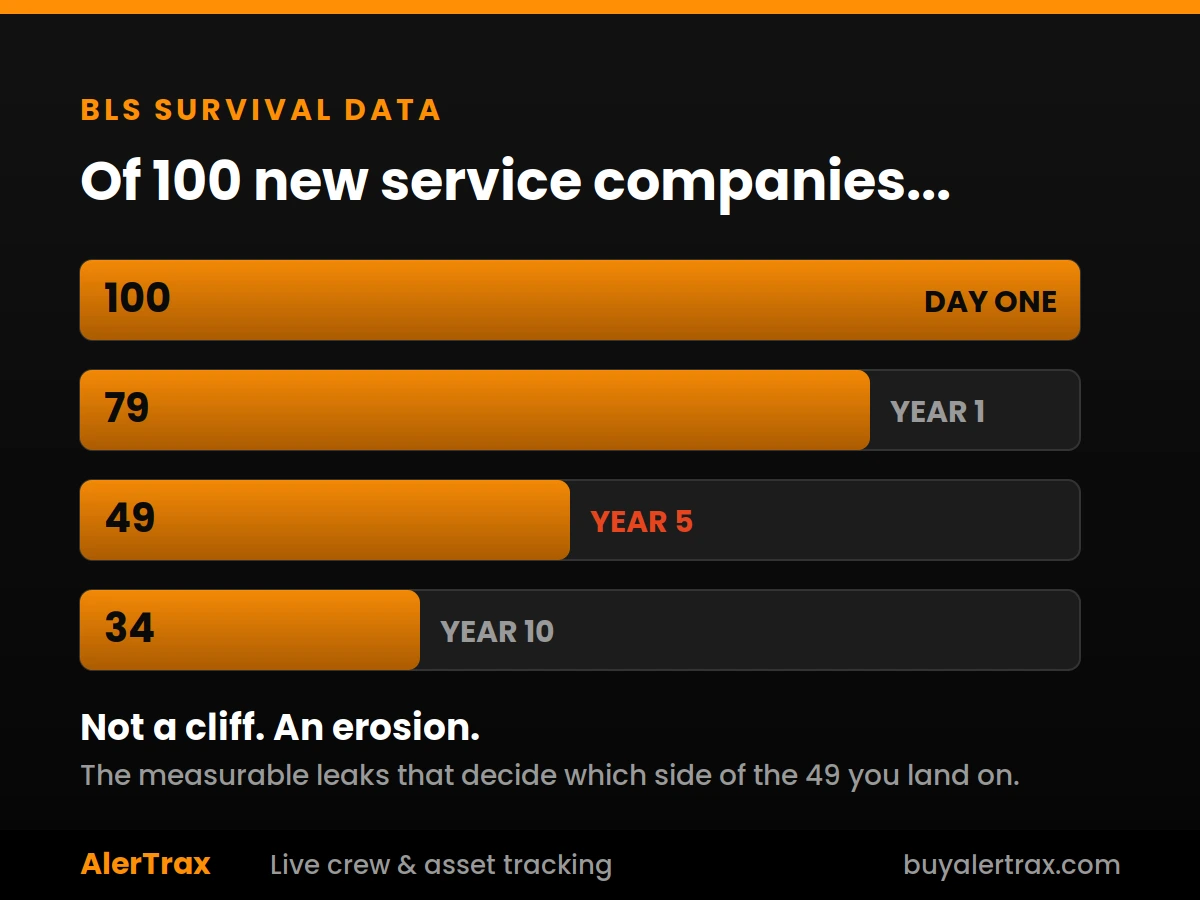
Roughly 79 of those 100 companies will still be operating after one year. About 49 will reach year five. About 34 will see year ten (U.S. Bureau of Labor Statistics, Business Employment Dynamics).
Half gone by year five. Two-thirds gone by year ten. This post is about the numbers behind that curve, and the specific, measurable leaks that separate the 49 from the 51.
The Curve Itself
- 79 of 100 new private-sector establishments survive their first year (BLS, Business Employment Dynamics).
- 49 of 100 are still operating at year five (BLS, Business Employment Dynamics).
- 34 of 100 make it to year ten (BLS, Business Employment Dynamics).
- 48.3 percent. The five-year survival rate for new construction-sector establishments specifically, averaged across three decades of BLS cohorts, essentially matching the economy-wide half (BLS, Business Employment Dynamics).
Notice what the curve is not. It is not a first-year cliff. The folklore that "90 percent of businesses fail in year one" appears nowhere in the federal data; four out of five new companies get through year one just fine. The real story is a long, steady erosion, a few points every year, for a decade. Companies do not usually explode. They bleed.
That distinction matters, because a cliff would suggest failure comes from bad luck or bad timing at launch. An erosion says something different: failure is operational, cumulative, and slow enough that the owner usually cannot see it happening from inside the truck.
What the Erosion Is Made Of
Service businesses almost never die from lack of demand. The lawns keep growing, the compressors keep failing, the ants keep coming. They die from the gap between the revenue they book and the margin they keep, and that gap has been measured from several directions by sources that have no product to sell you.
The labor leak. Labor is the largest cost in every field-service trade, consuming 30 to 50 percent of revenue at a typical landscaping company (Aspire, 2025 Commercial Landscape Industry Report). And it leaks: the American Payroll Association reports that 75 percent of companies experience some form of time theft, at a cost of up to 7 percent of total payroll (American Payroll Association). Seven percent of your biggest expense, gone, with nothing to show for it, is exactly the kind of few-points-a-year erosion the survival curve is drawing.
The cash gap. Among landscaping contractors, 76 percent send their invoice within four days of finishing the work, but only about half report being paid on time (Aspire, 2025). A company can be profitable on paper and still die of cash starvation while its receivables age through a season. Disputed hours and unverifiable visits are a meaningful share of why invoices stall.
The measurement gap. In the same survey, 79 percent of contractors said they are focused on growing revenue, while only 51 percent named improving operational efficiency as a key goal (Aspire, 2025). Nearly everyone is pushing the top line. Barely half are examining what each job actually costs to deliver. Growth without job-level cost data does not dilute the erosion. It scales it.
The replacement treadmill. The labor that leaks is also getting harder to replace. BLS projects about 171,600 annual openings for grounds maintenance workers through 2034, and roughly 40,100 a year for HVAC technicians, most of them replacing people who leave (BLS, Occupational Outlook Handbook). Every hour a scarce worker is paid but not productive is an hour you cannot simply hire around anymore.
The Composite Company the Data Describes
Put the numbers together and you can watch a hypothetical company walk the curve. Say it books $500,000 in revenue with $200,000 of labor. The APA's top-end leak takes up to $14,000 of that payroll in paid-but-unworked time. A handful of underpriced recurring jobs, the kind that run an unmeasured hour over estimate every visit, quietly consume another five figures across a season. A slice of receivables ages past 60 days because the invoices behind them cannot prove when crews arrived or how long they stayed. No single line item is fatal. No single line item is even visible without records. Together they are the few points a year that, compounded over five years, decide which side of the 49 the company lands on.
The erosion is not dramatic, and that is precisely the problem. The owner experiences it as "we are busy but the money is tight," which is perhaps the most commonly spoken sentence in field service.
What the Surviving Half Does Differently
The through-line in the data is that every major cause of the erosion is a measurement failure before it is anything else. You cannot fix a labor leak you cannot see, reprice a job whose real hours you never captured, or collect confidently on an invoice you cannot back up. Which means the difference between the halves of the curve is less about hustle and more about instrumentation:
- Knowing actual time-on-site, automatically, for every job, so estimates get corrected while the contract can still be repriced.
- Knowing real routes, so drive-time waste shows up on a map instead of vanishing into the week.
- Having timestamps behind every invoice, so "when did your crew even get here?" is a lookup, not an argument, and receivables stop aging on doubt.
- Knowing where every truck and crew is right now, so the day is managed on facts instead of callbacks.
Where AlerTrax Fits
That instrumentation layer is what AlerTrax provides, without an IT project attached:
- Over a Year of Battery Life, No Wiring: Runs on its own battery. No splicing, no OBD port, no install appointment. Mount it in a minute, on trucks, vans, trailers, mowers, and skid steers alike.
- Automatic Time-on-Site Logging: Arrival and departure timestamps at every stop. The raw material for job costing, defensible invoices, and honest payroll.
- Live Fleet Map: Every asset in the AlerTrax Fleet Portal and the iOS and Android app, updated as often as every 2 minutes.
- AddressFence and Geofence Alerts: Automatic notifications when assets arrive at or leave any customer address or boundary you define.
- Route History: Every day's actual routes on a map, so the waste has nowhere to hide.
- 100% Waterproof, Ruggedized, Covert Mount: Built for equipment that works outside for a living.
The Pricing Number
You can instrument your entire fleet for a low monthly rate, with no long-term contracts and no hidden fees. Weigh that against the erosion it exists to catch: the up-to-7-percent payroll leak, the underpriced jobs, the aging receivables. On the survival curve, it is the cheapest position you can take on the right side of the 49.
(Want to own it outright? There is a $599 one-time Lifetime option for permanent, subscription-free tracking. No fees, ever.)
See the monthly plan and get set up here.
And One Failure Mode the Curve Does Not Show
The survival data measures slow erosion, but some companies take sudden damage too: a stolen truck, an emptied trailer, a mower that walks off a job site. The same trackers watching your margin watch your equipment. Geofence the yard and AlerTrax alerts you within minutes of after-hours movement, with tamper notifications on the device itself, and a live tracking link you can hand to law enforcement. Not the reason to buy. A good reason to sleep.
The Curve Is Not a Prophecy
Half of new service companies do not see year five, but the halves are not chosen by lottery. The data says the difference is made of small, specific, measurable leaks, which means it is made of things you can find and fix, this season, if you can see them.
Visit www.buyalertrax.com and put real numbers on your fleet, your jobs, and your hours, before the erosion picks a side for you.
Sources
U.S. Bureau of Labor Statistics, Business Employment Dynamics (Establishment Age and Survival): Across cohorts tracked since 1994, roughly 79 of 100 new private-sector establishments survive one year, about 49 of 100 reach year five, and about 34 of 100 reach year ten; new construction-sector establishments average 48.3% survival at year five.
U.S. Bureau of Labor Statistics, Occupational Outlook Handbook: About 171,600 projected annual openings for grounds maintenance workers through 2034; about 40,100 projected annual openings for HVAC mechanics and installers.
Aspire, 2025 Commercial Landscape Industry Report: Labor consumes 30 to 50% of revenue; 79% of contractors are focused on growing revenue while 51% name operational efficiency as a key goal; 76% bill within four days of completion while only about half report on-time payment.
American Payroll Association: 75% of companies experience some form of time theft, which can cost up to 7% of total payroll.