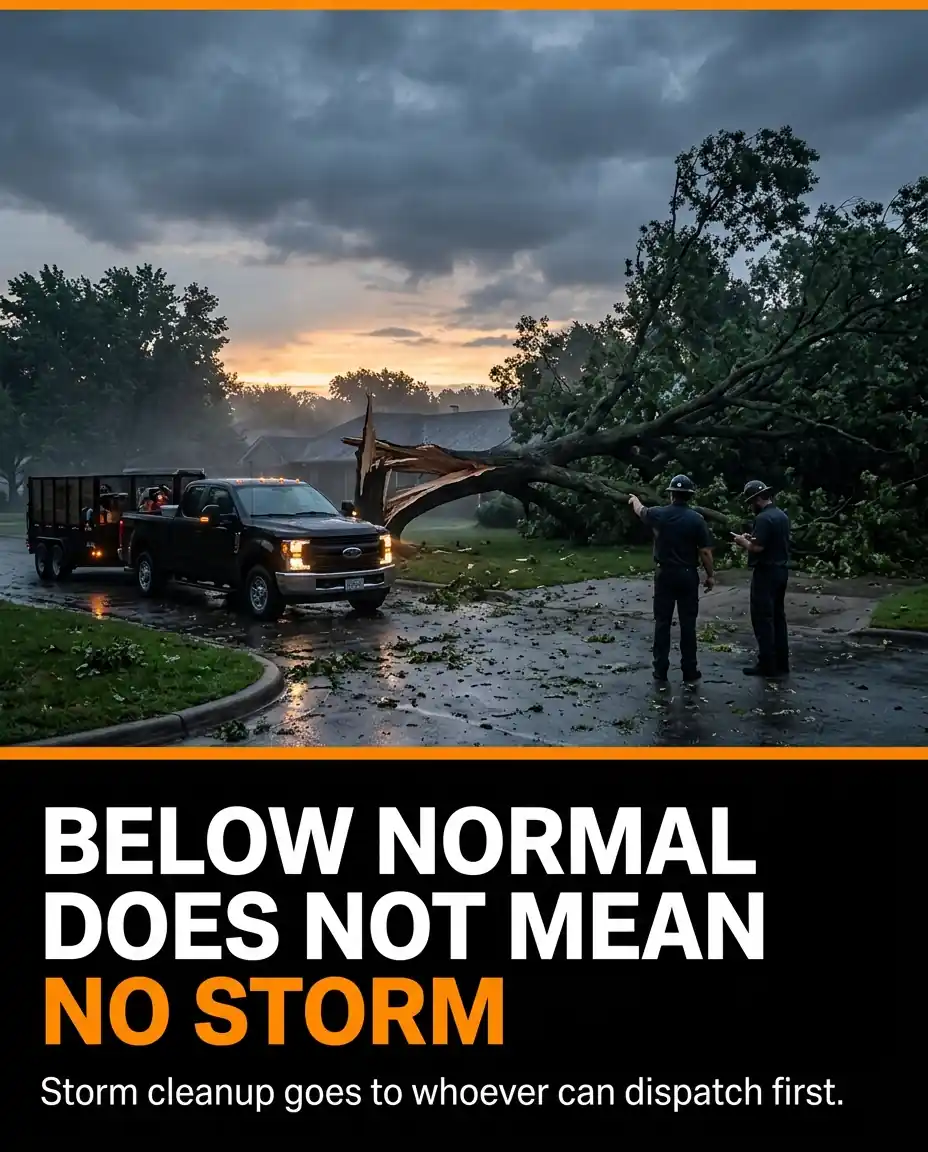
It is 5:40 on a Thursday morning. The storm cleared your service area sometime around two. You are standing in the kitchen with a cup of coffee and your phone is already going.
Nineteen voicemails. A property manager with four retail centers. The HOA board president who has been threatening to bid the contract out since March. Two commercial accounts you have had for six years. A homeowner you did a paver patio for last spring whose neighbor's oak is now lying across her driveway.
Every one of them wants the same thing, and it is not a quote. It is a time.
Here is what decides who gets that work. The company that calls back at 6:15 and says "I have a crew forty minutes out, they will be on your property by 9:15" gets the job. The company that says "let me find out where my guys are and I will call you back" gets thanked politely and never called again. Same trucks, same crews, same equipment. Different answer.
Storm work is not won on price and it is not won on capability. It is won on dispatch speed. And dispatch speed is a visibility problem, not a manpower problem.
What NOAA Actually Said, and What Gets Revised This Week
On May 21, 2026, NOAA issued its Atlantic hurricane season outlook. The headline was calm. The outlook calls for a 55 percent chance of a below-normal season, a 35 percent chance of a near-normal season, and only a 10 percent chance of an above-normal season (NOAA Climate Prediction Center, 2026).
The predicted ranges, each with 70 percent probability:
- 8 to 14 named storms
- 3 to 6 hurricanes
- 1 to 3 major hurricanes
Those ranges sit below the 1991 to 2020 seasonal averages of 14 named storms, 7 hurricanes, and 3 major hurricanes. The reason is El Niño. NOAA's forecast puts a 98 percent chance of El Niño conditions during August, September, and October, and El Niño generally suppresses Atlantic hurricane development.
Two things about that forecast matter to you specifically.
First, NOAA states plainly that most of the predicted activity is likely to occur during August, September, and October. That is right now. Second, the outlook is updated in early August to coincide with the onset of those peak months. If you have been repeating the May number to your customers and your crew leads, it is about to change, in one direction or the other.
A Quiet Forecast Is Not a Safe Forecast
It is easy to read "below normal" and mentally file storm season under things that are not going to happen this year. NOAA's own discussion argues against that reading, and the historical record does too.
Since the current Atlantic high-activity era began in 1995, 22 of the last 31 seasons have been above normal. Only four have been below normal. If 2026 finishes below normal, it would be only the second season in the last decade without above-normal activity (NOAA Climate Prediction Center, 2026).
NOAA also flags the ways the forecast could tilt. If El Niño develops later or weaker than expected, the season could land at the upper end of the ranges instead of the lower end. And the agency's preparedness language is not hedged at all: hurricane-related disasters can occur during any season, even years with low overall activity, because it only takes one storm. NOAA points at 2015, a quiet year that still produced Hurricane Joaquin.
For an owner, the translation is simple. You cannot staff to a seasonal forecast. Nobody hires four extra crews on a probability. What you can do is make sure that when one storm does come through, you are not spending the first morning after it playing phone tag with your own trucks.
NOAA Does Not Forecast Landfall, and That Is the Whole Point
This is the part most people miss. NOAA is explicit that the seasonal outlook is not a landfall forecast and does not predict activity for any particular location. Landfall depends on weather patterns that are only predictable when a storm is within a few days of the coast.
So the seasonal number tells you almost nothing about your county. A below-normal season with one storm that parks over your service area is, for your business, an above-normal season. A record year that stays offshore is a normal August.
Which means the useful question is not "how bad will the season be." It is "how fast can I move when it is my turn." That question has an answer you control.
Storm Cleanup Is the Highest Value Labor You Will Sell All Year
Look at what the labor is actually worth. According to the Bureau of Labor Statistics Occupational Employment and Wage Statistics release for May 2025, tree trimmers and pruners earn a national mean of $26.91 per hour, against a mean of $20.33 per hour for landscaping and groundskeeping workers (BLS, May 2025 OEWS). Storm cleanup pulls from both pools, and it bills at the top of your rate card because the customer needs it done now.
It is also thin. BLS counts 55,160 tree trimmers and pruners employed nationwide. Spread evenly across fifty states, that is roughly 1,100 per state. A single storm can put half a dozen counties in line for the same crews at the same time.
Now run the cost of standing still. A three-person tree crew at that BLS mean is $80.73 an hour in base wages, before burden. If that crew sits ninety minutes on a cleanup morning waiting for someone to tell them where to go, you just spent about $121 in base wages to produce nothing, on the one day of the year when every hour is spoken for.
Five crews, three days of cleanup, ninety idle minutes each morning: roughly $1,816 in base wages, plus every job you did not get to because the day started late.
The First 72 Hours Decide Who Keeps the Account
After a storm, your commercial customers do not call one vendor. They call every vendor in their phone, in order, until somebody gives them a straight answer.
Property managers are not being difficult. They have tenants who cannot get into the parking lot and a boss asking for a status update by nine. What they need from you is a specific time, and what they remember six months later at renewal is whether you gave them one.
Notice that specific beats fast. "I will get somebody out there as soon as I can" is a fast answer and a useless one. "My crew is finishing on Ridgeway, they will be at your property between 9:00 and 9:30" is the answer that ends the call and holds the account. You can only give the second answer if you know where the crew is and when they arrived at the job they are on now.
Three Things You Need to Dispatch Fast
Strip the problem down and storm dispatch needs exactly three inputs. Most companies have none of them.
1. One screen with every truck, trailer, and machine on it. Not a group text. Not a whiteboard from Tuesday. A live map you can open on your phone at 5:40 in the morning and see, in one glance, where every asset sits right now. That is the difference between assigning the closest crew and assigning the crew whose foreman happened to answer.
2. Arrival and departure timestamps. Knowing where a crew is only gets you halfway. You also need to know when they got there, which tells you roughly when they will free up. A crew that arrived at 6:50 on a four-hour job is a crew you can promise to somebody at eleven.
3. A way to answer the customer without another phone call. During cleanup week your dispatcher cannot field the same question forty times. Sending a live tracking link the customer can open in a browser ends that conversation in one text.
Set This Up in August, Not in the Parking Lot at 6 AM
Nothing above works if you install it the week the storm hits. Here is the short version of what to have in place before the peak months do what NOAA expects them to do.
- Upload your commercial account addresses now. AddressFence turns every one of those properties into an automatic arrival and departure record during cleanup week, with no crew input required. Loading fifty addresses in August takes twenty minutes. Loading them during a cleanup does not happen.
- Put a tracker on the equipment, not just the trucks. The chipper, the dump trailer, the stump grinder, the mini skid. Storm work scatters equipment across sites and it does not come home every night the way it does in July.
- Draw a geofence around the yard and any staging lot. During cleanup you will stage material and machines in places you normally do not.
- Test the shareable link on one friendly customer. Send it to a property manager you like this week and watch them open it. Find out now that it works, not while nineteen people are waiting on you.
- Check your battery status. AlerTrax runs over a year on two AA batteries, but the season peak is the wrong time to discover a device you mounted fourteen months ago is due.
Why AlerTrax Holds Up in Storm Work
Most fleet tracking was built for long-haul trucking. Constant 12-volt power, hardwired installs, one dedicated driver per vehicle. Storm response does not look like that. Equipment gets moved between crews, rented on short notice, staged in mud, and left on site for days.
AlerTrax was built for that reality.
- Two AA batteries, over a year of life, no wiring: No splicing, no OBD-II port, no installation appointment. You can mount a device on a rented chipper the morning you pick it up.
- Covert magnetic mount: Attaches to any steel surface in seconds. Under a bumper, inside a frame rail, on a trailer tongue.
- IP67 waterproof, ruggedized housing: Rated for salt water exposure and built to survive mud, sustained rain, and pressure washing.
- Live fleet map: Every tracked truck, trailer, and machine on one screen, with location updates as often as every 2 minutes.
- AddressFence: Upload your customer addresses and get automatic arrival and departure alerts as crews reach each property.
- Time-on-site reports: Every arrival and departure timestamped, with no check-in app for the crew to remember during a chaotic week.
- Shareable tracking link: Send a live map to a customer by text or email. No app, no login, no account for them to create.
- After-hours movement and tamper alerts: Get notified when an asset moves outside expected hours or when a device is disturbed.
- Works on anything that moves: Trucks, trailers, chippers, stump grinders, mowers, skid steers, generators.
- iOS and Android app plus the fleet portal: Dispatch from your truck, pull reports from the office.
What It Costs
AlerTrax is $49.99 per month over 12 payments, with no long-term contract and no hidden fees.
(Prefer to own it outright? There is a $599 Lifetime option for permanent, subscription-free tracking.)
Put that next to the number from earlier. One storm event where five crews each lose ninety minutes to a slow start costs roughly $1,816 in base wages alone. That is not the annual figure. That is one event, and it does not count the jobs that went to the company that called back first.
And Yes, It Watches the Yard While Everyone Is Out
Cleanup week is the one stretch of the year when your equipment is spread across half a dozen sites, your yard is empty, and nobody is doing a nightly count. That combination is exactly what equipment thieves look for.
Nearly 1,000 pieces of equipment are reported stolen to the National Crime Information Center every month, and because many thefts go unreported, industry sources treat that as a low estimate. The National Insurance Crime Bureau puts annual losses somewhere between $300 million and $1 billion (CONEXPO-CON/AGG, 2023).
The same reporting notes that thieves specifically target stretches when crews are away and nobody will notice for days, and that the sooner an owner knows something moved, the better the odds of getting it back. That is the entire argument for an after-hours movement alert. You are not buying a tracker for theft. You are buying it for dispatch. But when a trailer rolls out of a staging lot at 2:40 in the morning, you find out in minutes instead of Monday.
The Forecast Is Not Your Plan
NOAA gave you a number in May and will revise it this month. Either way, the number describes the ocean, not your calendar. It does not know where your crews are, how fast you can reassign them, or what you will tell the property manager who calls at 5:40 in the morning.
The companies that come out of a storm week with new contracts are not the ones with better weather information. They are the ones who could look at a screen and answer a question in fifteen seconds.
Visit www.buyalertrax.com and get a tracker on every truck, trailer, and machine before the peak months do what they usually do.
Sources
NOAA Climate Prediction Center : 2026 North Atlantic Hurricane Season Outlook, issued May 21, 2026. Seasonal probabilities (55% below-normal, 35% near-normal, 10% above-normal), predicted ranges of 8-14 named storms, 3-6 hurricanes and 1-3 major hurricanes, 1991-2020 seasonal averages, ENSO probabilities, historical season classifications since 1995, and August update schedule.
NOAA / National Weather Service : Preparedness guidance on low-activity seasons and the absence of seasonal landfall prediction.
U.S. Bureau of Labor Statistics : Occupational Employment and Wage Statistics, May 2025 (released May 15, 2026). Mean hourly wage and national employment for tree trimmers and pruners (37-3013) and landscaping and groundskeeping workers (37-3011).
CONEXPO-CON/AGG (2023) : Equipment theft volume reported to the National Crime Information Center, NICB annual loss estimates, and timing patterns for equipment theft when job sites are unattended.