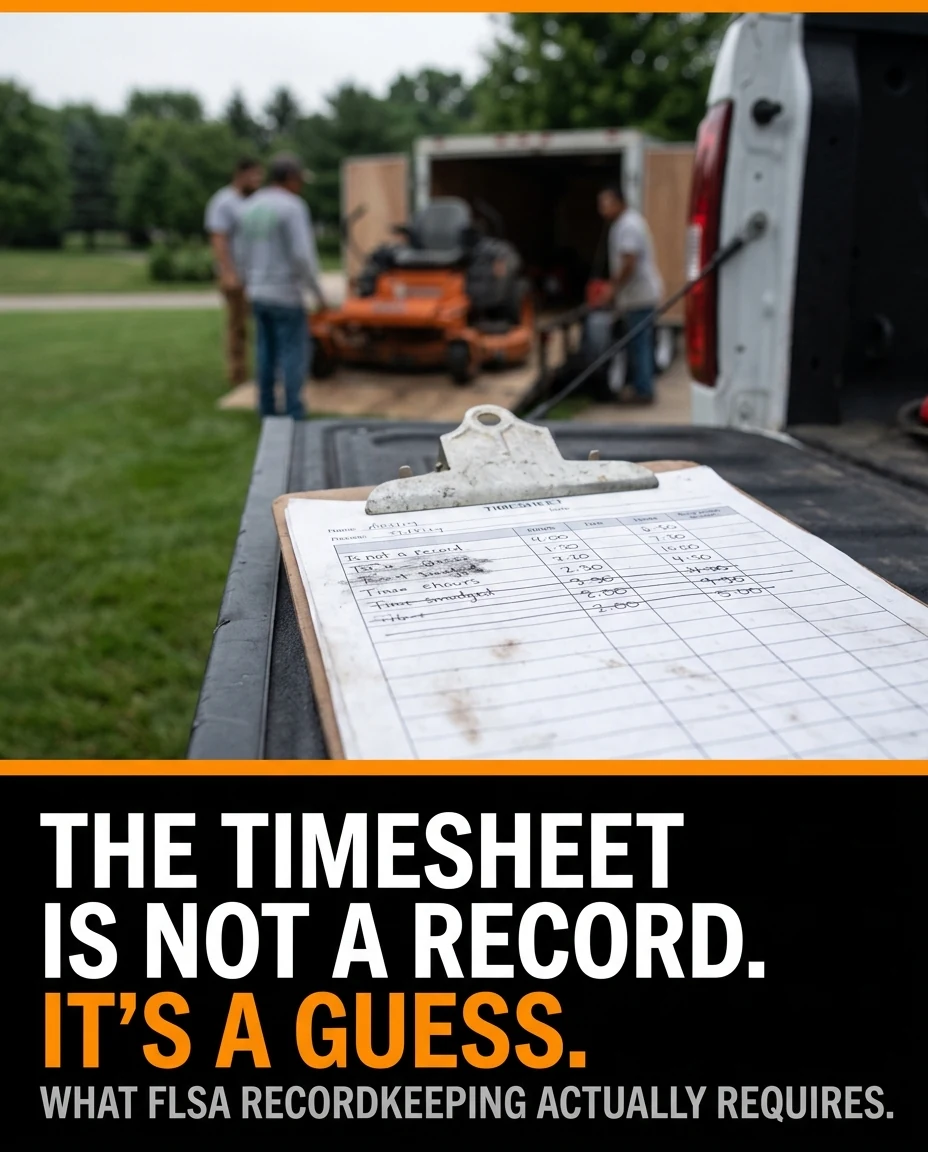
It is 4:40 on a Friday afternoon. Your foreman walks into the office with a stack of paper timesheets and drops them on the desk. He filled most of them out about twenty minutes ago, in the truck, from memory, for a crew of six across a week of work.
Monday says 7:00 to 3:30 for everybody. So does Tuesday. So does Wednesday. Thursday says 7:00 to 4:00 for four guys and 7:00 to 3:30 for two, and there is a scratched-out line on Friday that got written over.
You sign it. Payroll runs. Nobody thinks about it again.
Here is the part most owners have never had explained to them: that stack of paper is not a record of what happened. It is a recollection of what happened, written down after the fact by someone who was not watching a clock. And under federal law, the difference between those two things is the entire ballgame.
Because if a former employee ever walks into a Department of Labor office and says he worked more hours than he was paid for, the first thing that gets asked for is your records. And if what you hand over is a recollection, the law has a very specific answer for what happens next. It is not the answer most owners expect.
What the Law Actually Asks You to Keep
Start with what is required, because it is narrower and more specific than most people assume.
Under the Fair Labor Standards Act, the recordkeeping rules live in 29 CFR Part 516. For every non-exempt employee, section 516.2(a) requires an employer to keep a defined list of items. Most of them are administrative: full name, occupation, the time of day and day of the week the workweek begins, the basis on which wages are paid, total wages paid each pay period.
Then there is item seven, and item seven is the one that matters:
Hours worked each workday, and total hours worked each workweek.
Not hours per pay period. Not a schedule. Not a weekly total. Each workday. Every day, for every non-exempt employee, is a required federal record.
The good news, and it is genuinely good news, is that the rules are not fussy about how you capture it. 29 CFR 516.1 requires no particular form for these records. 29 CFR 785.48 is even more explicit: employers may use any timekeeping method they choose. A time clock, a timekeeper, or having workers write their own hours on a sheet are all acceptable methods.
There is exactly one condition attached, and the entire article turns on it. Any timekeeping plan is acceptable as long as it is complete and accurate.
A sophisticated system that misses worked time is not compliant. A simple paper timesheet that accurately captures every hour is completely compliant. The federal government does not care what your method is. It cares whether the numbers are true.
So the real question is not "do I have timesheets." Every company has timesheets. The question is whether yours could survive somebody sitting down and testing them against what actually happened.
The 1946 Case That Decides Who Wins
Here is the mechanism almost nobody outside of employment law knows about, and it is the single most important thing in this article.
In 1946, the Supreme Court decided Anderson v. Mt. Clemens Pottery Co. The case was about factory workers who spent unpaid time walking to their stations and doing prep work before their shifts officially began. But the lasting legacy of the decision has nothing to do with pottery or walking time. It is about who has to prove what when the employer's records are bad.
The Court's reasoning was straightforward. If an employee cannot prove the precise number of unpaid hours he worked, and the reason he cannot prove it is that his employer failed to keep proper records, then denying him recovery would reward the employer for breaking the recordkeeping rule. That would place a premium on failing to keep records, and let the employer keep the benefit of the work without paying for it.
So the Court built a burden-shifting framework that still governs federal wage cases eighty years later. When the employer's records are inaccurate or inadequate, the employee meets his burden by showing that he performed work he was not properly paid for, and by producing enough evidence to establish the amount of that work as a matter of just and reasonable inference.
At that point the burden flips. It becomes the employer's job to come forward with evidence of the precise amount of work performed, or with evidence that negates the reasonableness of the employee's estimate. And if the employer cannot produce that evidence, the court may award damages anyway, even though the award is only approximate.
Read that one more time, because it is the whole point of this article. When your records are inadequate, the employee's reasonable estimate becomes the operative number, and you are the one who has to disprove it.
The federal courts still apply this framework routinely. In 2021, the Fifth Circuit upheld a judgment against a fire protection contractor on exactly these grounds, describing the Mt. Clemens test as the methodology for evaluating federal wage claims where an employer fails to maintain proper records.
Now go back to that stack of paper on your desk. Six employees, one week, filled out from memory on a Friday afternoon, with a scratched-out line. If a former crew member testifies that the crew regularly started staging equipment at 6:40 and the truck did not get back to the yard until 4:15, what evidence do you have that says otherwise?
You have a piece of paper that says 7:00 to 3:30 every single day. Which is exactly the kind of record that looks less like a measurement and more like a default.
What It Costs When It Goes Wrong
This is not a theoretical exposure. The enforcement numbers are public, and they are large.
In fiscal year 2025, the Department of Labor's Wage and Hour Division recovered more than $259 million in back wages for nearly 176,957 employees, which the agency reports as an average recovery of $1,465 per worker (U.S. Department of Labor, Wage and Hour Division). The prior fiscal year was larger still, at more than $273 million recovered for roughly 152,000 workers.
Private litigation runs on a separate track and at meaningful volume. According to the Administrative Office of the U.S. Courts, 4,891 Fair Labor Standards Act cases were filed in U.S. district courts in the twelve months ending March 31, 2025, down 9 percent from 5,354 the year before. Filings have declined for two consecutive years, but nearly five thousand federal wage cases a year is not a rounding error.
Three features of the statute determine how big any single exposure gets.
The lookback window. A two-year statute of limitations generally applies to the recovery of back pay. If the violation was willful, it extends to three years (U.S. Department of Labor). An extra year does not just add twelve months of underpayment. It adds twelve months of underpayment to everything that gets multiplied downstream.
Liquidated damages. An employee may file a private suit for back pay and an equal amount as liquidated damages, plus attorney's fees and court costs (U.S. Department of Labor). In practical terms, the back wage number in private litigation is frequently the halfway point, not the finish line. Note that enforcement policy on this has shifted: in June 2025 the Department of Labor issued Field Assistance Bulletin 2025-3, ending the practice of seeking liquidated damages in pre-litigation administrative settlements. That policy governs the agency's own investigations. It does not change what a private plaintiff can pursue in court.
It applies per employee. Wage claims are rarely about one person. A recordkeeping practice that is inadequate for one crew member is inadequate for the whole crew, and the same paper timesheet is the only evidence for all of them.
Here is what that looks like with real wage data. The Bureau of Labor Statistics Occupational Employment and Wage Statistics survey for May 2025 puts the mean hourly wage for grounds maintenance workers at $20.78, across 1,048,490 workers nationally, with a median of $19.27.
Take a six-person crew. Assume twenty minutes a day of real work that never made it onto a timesheet: pre-trip staging in the yard, fuel and supply stops, unloading at the end of the day. That is two crew-hours per day, ten per week, roughly 400 hours over a forty-week season. At the BLS mean of $20.78, that is about $8,300 per year, per crew, of unrecorded work. Across a two-year lookback, doubled by liquidated damages in private litigation, the arithmetic gets to roughly $33,000 before anyone has paid a lawyer, and before any of it is calculated at an overtime rate.
Those crew figures are illustrative arithmetic using placeholder inputs, not survey findings. The point is not the specific number. The point is how quickly twenty minutes a day compounds when nobody has a record that says otherwise.
Why Field Crews Are the Hardest Case
Office employees badge in. Retail employees clock in at a terminal. Manufacturing employees punch a card at a fixed location. Every one of those is a contemporaneous record created at the moment work started, in a place the employer controls.
Field crews have none of that infrastructure, and landscaping is close to the worst case.
The workday does not start in one place. Some crews meet at the yard. Some meet at the first job. Some pick each other up. The "start" of the day is genuinely ambiguous, and ambiguity is exactly what a wage claim is built out of.
One person records for everybody. A foreman writing hours for a crew of six is producing six records from one memory. If his own recollection is off by fifteen minutes, it is off by fifteen minutes six times.
Nothing about the schedule is fixed. Weather pushes jobs. A blown hydraulic line adds two hours. A property takes longer than the estimate. The actual day almost never matches the planned day, but the timesheet keeps saying 7:00 to 3:30.
Phone-based time apps depend on the crew remembering. A clock-in app is a real improvement over paper, and if your crews use one consistently you are in far better shape. But it is still a self-reported record. If a guy forgets to clock in until 7:20 and later testifies he was working at 6:45, you are back to the same evidentiary problem, just with a nicer interface.
What is missing in every one of these scenarios is the same thing: a record generated by something other than a person's memory or a person's intent to press a button.
What a Corroborating Record Looks Like
The strongest position an employer can be in is not "my timesheets are good." It is "my timesheets are good, and here is an independent record that agrees with them."
That second record is what GPS asset tracking quietly produces as a byproduct of doing its actual job. A tracker on a work truck logs when the vehicle arrived at a location and when it left. It does that automatically, on its own schedule, with no input from the crew and no opportunity to fill it in later on a Friday afternoon.
What that gives you, practically:
- Arrival and departure timestamps for every stop. The truck reached the Crofton property at 7:09 and left at 14:11. That is not somebody's recollection. That is a log entry created at the time it happened.
- A yard departure and yard return time. The bookends of the workday, recorded independently of anyone's memory of when the day started.
- Time on site, calculated rather than estimated. Duration at each location comes out of the arrival and departure data, not out of a foreman rounding to the nearest half hour.
- A full route history. Every stop, including the supply house run and the unscheduled detour, which is often precisely the time that goes unrecorded.
- Exportable trip reports. A date range, a vehicle, and a table you can put next to a timesheet and compare line by line.
To be precise about what this is and is not: a truck's location record is not a record of an individual employee's hours worked. It does not satisfy 516.2(a)(7) on its own, and it is not a substitute for a timekeeping system. Nobody should read this article and conclude that a GPS tracker is their timekeeping compliance solution.
What it is, is corroboration. And corroboration is exactly what the Mt. Clemens framework turns on. The framework punishes employers whose records are inaccurate or inadequate. An employer who can produce a timesheet and an independently generated arrival and departure log that matches it is not the employer that framework was written to catch.
There is a second-order benefit that arrives before any dispute does. When you compare timesheets against trip data every week, you find the gaps while they are still small. A crew that is consistently on site fifteen minutes before its recorded start time is a payroll practice you can correct this month, for the cost of fifteen minutes a day, instead of discovering it two years later at the wrong end of a claim.
The Same Data Prices Your Jobs
Nobody buys a GPS tracker because they are worried about a wage claim. That is not how equipment decisions get made, and it is not the argument for this.
The argument is that the record protecting you in a dispute is the same record that tells you whether the Tuesday route makes money.
Verified time on site is the missing input in nearly every landscaping estimate. You bid a property at four hours. Your crew has been there for five hours and twenty minutes, every visit, all season. Without arrival and departure data, that gap is invisible until it shows up as a thin year, and by then you have already renewed the contract at the old price.
The same table that documents your compliance position tells you which properties are underpriced, which crews are consistently faster, how much of the day is drive time, and where the real margin is going. One record, two completely different problems solved.
Why AlerTrax Fits How Landscaping Companies Actually Work
Most fleet tracking systems were designed for over-the-road logistics: hardwired installs, constant vehicle power, dedicated drivers. Landscaping does not work that way. You have trucks, trailers, mowers, and skid steers that move between crews and job sites constantly.
AlerTrax was built for that reality.
- Battery Powered, No Wiring Required: AlerTrax runs on two AA batteries. No splicing into vehicle electrical systems, no OBD-II ports, no installation appointments. Mount it and it works.
- Automatic Time-on-Site Logging: Every arrival and every departure is timestamped automatically, with no crew input required and nothing for anyone to remember to do.
- Trip Reports You Can Export: Pull a date range by vehicle or across the whole fleet. Start time, stop time, addresses visited, duration, and distance, in a table you can put beside a timesheet.
- AddressFence: Address-based arrival and departure alerts, so a specific property notifies you when a crew gets there and when they leave.
- Live Fleet Map: Every tracked asset on one screen in the AlerTrax Fleet Portal, with updates as often as every two minutes.
- Geofencing and After-Hours Movement Alerts: Virtual boundaries around your yard, storage lots, and customer properties, with instant notification on entry, exit, or movement outside expected hours.
- Shareable Tracking Links: Send a live location link to a customer or a crew lead with no app, no login, and no account required on their end.
- Track Anything That Moves: Because there are no wires, the same device works on a work truck, a dump trailer, a stand-on mower, or a skid steer.
- 100% Waterproof, Ruggedized Housing: IP67 rated, built to survive mud, rain, and pressure washing.
- iOS and Android Apps: Full access to the map, alerts, and history from the field.
What It Costs
You can put AlerTrax on your fleet for $49.99 per month over 12 payments, with no long-term contract and no hidden fees.
(Prefer to own it outright? There is a $599 Lifetime option for permanent, subscription-free tracking.)
Set that against the exposure. A single wage claim on a six-person crew, using the illustrative arithmetic above, runs into five figures before legal fees. That is not the reason to buy a tracker, and it should not be. But it is a useful frame for what the downside of having no independent record actually looks like.
The everyday return is the one that pays for it: verified job times, accurate repricing, and a weekly comparison that catches payroll gaps while they are still small.
And Yes, It Protects the Equipment Too
This article is about records, but the same device on the same truck does the obvious job as well. If a trailer, mower, or skid steer walks off overnight, you have a live location and a movement alert instead of a police report and a guess.
Geofence your yard, set after-hours movement alerts, and you find out within minutes rather than at 6:30 the next morning. It is the reason most owners look at trackers in the first place. It is just not the reason the good ones keep them.
Make the Record Something Other Than a Memory
Federal law does not require you to buy anything. It requires you to keep hours worked each workday, and it requires those hours to be complete and accurate. Paper is legal. Apps are legal. The method is genuinely up to you.
What the law does do is decide who carries the burden when those records do not hold up. And the answer, since 1946, has been the employer.
You do not need to overhaul how you run payroll. You need one record that was not written from memory on a Friday afternoon, sitting alongside the one that was.
Visit www.buyalertrax.com to put verified arrival and departure logging on every truck in your fleet. Questions? Reach us at sales@buyalertrax.com or call 800-240-6533.
Sources
29 CFR Part 516 (eCFR): Records to be kept by employers; 516.2(a)(7) requires hours worked each workday and total hours worked each workweek; 516.1 requires no particular form
29 CFR 785.48: Employers may use any timekeeping method; any plan is acceptable as long as it is complete and accurate
U.S. Department of Labor, Wage and Hour Division: FY2025 enforcement: more than $259 million in back wages for nearly 176,957 employees, averaging $1,465 per worker; FY2024: more than $273 million for approximately 152,000 workers
U.S. Department of Labor: Back Pay: two-year statute of limitations, three years for willful violations; private suit for back pay and an equal amount as liquidated damages, plus attorney's fees and court costs
U.S. Department of Labor, Field Assistance Bulletin 2025-3 (June 27, 2025): WHD no longer seeks liquidated damages in pre-litigation administrative settlements
Anderson v. Mt. Clemens Pottery Co., 328 U.S. 680 (1946): Burden-shifting framework where employer records are inaccurate or inadequate; just and reasonable inference standard
U.S. Court of Appeals for the Fifth Circuit, No. 19-51119 (2021): Contemporary application of the Mt. Clemens framework
U.S. Bureau of Labor Statistics, Occupational Employment and Wage Statistics, May 2025: Grounds maintenance workers: 1,048,490 employed, $20.78 mean hourly wage, $19.27 median hourly, $43,220 mean annual
Administrative Office of the U.S. Courts, Federal Judicial Caseload Statistics 2025: 4,891 FLSA cases filed in U.S. district courts for the 12 months ending March 31, 2025, down 9 percent from 5,354
Illustrative arithmetic: The six-person crew example (20 unrecorded minutes per day, 40-week season, BLS mean hourly wage, two-year lookback, liquidated damages) uses placeholder inputs to demonstrate compounding. It is not survey data and does not represent measured findings from any operation.
Note: This article is general information about federal recordkeeping requirements, not legal advice. Wage and hour obligations vary by state, and several states impose stricter requirements than the FLSA. Consult an employment attorney about your specific situation.
