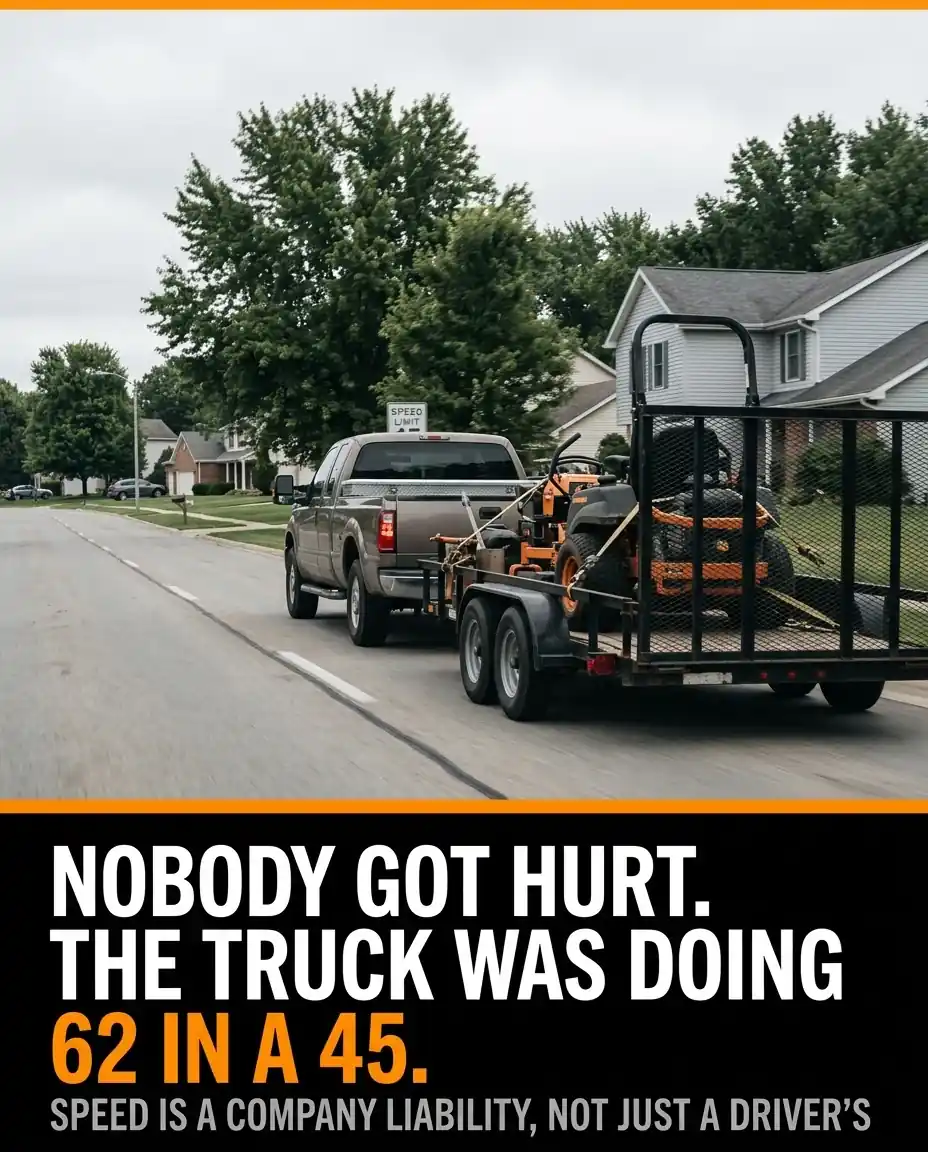
Last Thursday one of your crews ran a little behind. The second property took longer than it should have, and the guy driving wanted to get to the third job before the afternoon heat set in.
So he did 62 on a 45 mile per hour road, pulling a tandem-axle trailer with a zero-turn, a stand-on, two blowers, and a full fuel caddy on it.
Nothing happened. He got there, the crew worked, everyone went home. You never heard about it and you never will.
That is the version of this story that plays out thousands of times a season across the industry, and it is genuinely fine.
The other version is the one worth thinking about for ten minutes, because in that one a kid on a bike comes off a driveway, and the difference between a scare and a catastrophe is a stopping distance that got longer the moment you hooked up a loaded trailer.
And here is what most owners have never had spelled out for them: in that second version, the legal exposure does not stop at the driver. It lands on the company, through two separate doors, and one of them has nothing to do with whether the company did anything wrong at all.
Two Doors Into Company Liability
Before going further: this is general information about how these claims are commonly structured, not legal advice. The specifics vary substantially by state, and a plaintiff's theory in Texas may not look like one in Maryland. If you have real exposure, talk to an attorney who does this work.
With that said, here is the structure most owners have never seen laid out.
Door one is vicarious liability, usually called respondeat superior. Under this doctrine an employer is responsible for an employee's negligence when the employee was acting within the course and scope of employment. The important word is responsible, not at fault. The company does not have to have done anything careless. The driver was on the clock, driving a company truck, going to a company job. That is generally enough.
Most owners intuitively understand some version of this one. It is the "my insurance covers it" door.
Door two is negligent entrustment, and this is the one that catches people. This is a direct claim against the company for its own conduct in handing the keys to a particular person. The elements are broadly consistent across jurisdictions: the company entrusted a vehicle to the driver, the company knew or should have known that the driver was incompetent, unlicensed, or reckless, and that incompetence was a substantial factor in causing the harm.
Related claims for negligent hiring, supervision, and retention run on similar logic.
The distinction matters for a practical reason. Vicarious liability is about the employee's conduct. Negligent entrustment is about yours. And in many jurisdictions, a finding of gross negligence in entrusting a vehicle opens the door to punitive damages, which are frequently not covered by insurance and in some states cannot be insured at all.
That is the part that reaches past the policy limit and into the business.
The Speed Data Is Not Ambiguous
Speed is not a moral question here. It is a measured one.
According to the National Highway Traffic Safety Administration, speeding was a contributing factor in 29 percent of all traffic fatalities in 2024, killing 11,288 people. An estimated 316,757 people were injured in speeding-related crashes that year, about 13 percent of everyone injured on the road. NHTSA notes that for more than two decades, speeding has been involved in roughly one-third of all motor vehicle fatalities.
Here is the number that should matter most to anyone running local crews:
In 2024, 87 percent of all speeding-related traffic fatalities occurred on non-interstate roadways (NHTSA).
Not the highway. The two-lane connector between subdivisions. The 35 mile per hour road past the elementary school. The residential street where the crew parks the trailer. Those are the roads where speeding kills people, and they are precisely the roads your trucks spend the entire day on.
The exposure is not concentrated in some occasional long haul. It is distributed across every ordinary day of your operation.
Driving Is the Most Dangerous Thing Your Crews Do
Owners in this industry think about equipment safety constantly. Blade guards, chainsaw chaps, eye protection, trench boxes, lifting technique. All of it warranted.
The data says the drive is worse.
The Bureau of Labor Statistics Census of Fatal Occupational Injuries for 2024 found that transportation incidents were the most frequent type of fatal work event, accounting for 38.2 percent of all occupational fatalities, with 1,937 fatal transportation incidents that year. Roadway incidents involving motorized land vehicles accounted for 1,146 of them.
Building and grounds cleaning and maintenance occupations recorded 356 fatalities in 2024, about 7 percent of all worker deaths. In the prior year's data, landscaping and groundskeeping was the occupation with the most fatalities within its sector.
Nearly four in ten workplace deaths in this country happen in a vehicle. Not on a ladder, not around a machine. In traffic.
Now add the trailer. A loaded tandem-axle trailer materially changes how the truck behaves: longer stopping distance, more weight transfer under braking, sway that becomes more likely as speed increases, and much less margin for a sudden lane change. NHTSA's braking standards for heavy commercial tractors exist precisely because regulators treat the relationship between mass and stopping distance as a first-order safety issue. Those particular standards govern air-braked heavy tractors rather than a pickup and a landscape trailer, so do not read them as your legal requirement. Read them as the physics: more weight behind you means more road in front of you before you stop.
Ten miles per hour over the limit with an empty bed and ten over with four thousand pounds of equipment behind you are not the same event.
The Uncomfortable Part: Speed Data Cuts Both Ways
Most vendors selling tracking hardware will tell you speed monitoring protects you in a lawsuit. That is only half true, and you deserve the other half before you spend money.
Negligent entrustment turns on whether the employer knew or should have known. Collecting speed data creates knowledge. That is the entire point of collecting it, and it is also the risk.
If you have twelve months of records showing a driver regularly running 20 over on residential streets, and you never counseled him, never documented anything, never changed his assignment, and then he hurts somebody, you have handed a plaintiff's attorney a clean narrative. You knew. You had it in writing. You did nothing.
That is worse than having no data at all, and any vendor who does not tell you so is not being straight with you.
Two things are worth understanding before you conclude that ignorance is safer.
First, "we don't track anything" is not the shield it sounds like. In negligent entrustment claims, plaintiff's counsel routinely pulls the driver's full history: license record, citations, prior collisions, prior employers. If those records show a pattern, the argument becomes that a reasonable employer would have discovered it. The absence of internal records does not establish that nothing was discoverable. It frequently establishes that nobody looked.
Second, the data is rarely as private as owners assume. Phone records, customer complaints, dashcams on other vehicles, and the crew's own testimony all exist independently of anything you chose to collect.
So the real choice is not between having data and not having it. It is between finding out about a pattern while you can still fix it, or finding out about it in a deposition.
Which makes the actual answer straightforward, and it is not "buy a tracker."
What Actually Protects a Company
Data alone protects nobody. What protects a company is a documented practice that data feeds. Roughly in this order:
A written vehicle policy. Plain language, one page, signed by every driver. Posted speed limits are the maximum, not the target. Reduced speed when towing. Seat belts. No phone use while driving. Pre-trip check on trailer lights, chains, and load securement. This is the single highest-value item on the list and it costs nothing.
MVR checks at hire and annually. Pull the driving record before you hand over a truck, and pull it again every year. This is the most direct answer to a "should have known" argument, and most operations in this industry have never done it once.
A regular review cadence. Someone looks at driving data monthly. Not to build a case against anybody, but so a pattern gets caught in week three instead of year two.
Documented corrective action. When something turns up, there is a conversation, and there is a one-paragraph note in the file recording that it happened. The paper trail showing you responded is what converts data from a liability into a defense.
Consequences that are real and consistent. Applied the same way to the ten-year foreman and the guy hired in April.
Notice that a tracker is nowhere in that list. Tracking is what makes items three and four possible at scale. It is the instrument, not the program. A company with a signed policy, annual MVR checks, and a documented review habit is in a materially stronger position than a company that bought hardware and never opened the reports.
And be honest with your crews about all of it. Frame it as a safety program, because that is what it is. Crews accept driving standards far more readily when the standard is written down, applied evenly, and explained as protecting them, which it also does. A crew member who gets rear-ended has the same interest in a verified record that you do.
Where AlerTrax Fits, and Where It Does Not
Being precise about this matters more than usual on a topic like liability.
AlerTrax is a battery-powered GPS asset tracker. It logs location and movement, and its trip reports include the maximum speed recorded on a trip along with start and stop times, addresses, duration, and distance. It is not a hardwired telematics system, it does not read the vehicle's ECU, and it does not produce continuous engine-level driver behavior scoring the way a wired fleet safety platform does. If you need harsh-braking and cornering analytics on every truck, that is a wired install in a different product category.
What AlerTrax does give a small operation is the practical thing: an independent record of where trucks and trailers went, when, and how fast the trip ran, on equipment where wiring in a telematics module was never realistic.
- Trip Reports With Max Speed: Exportable by vehicle or across the fleet, with start and stop times, addresses, duration, distance, and maximum speed per trip. Enough to spot a pattern in a monthly review.
- Battery Powered, No Wiring Required: Two AA batteries, over a year of life. The same device works on a truck, a dump trailer, an enclosed trailer, a mower, or a skid steer.
- Track the Trailer, Not Just the Truck: Trailers get swapped between trucks constantly. Tracking the trailer itself tells you where your equipment actually went.
- Automatic Time-on-Site Logging: Arrival and departure timestamped at every stop, with no crew input required.
- AddressFence: Address-based arrival and departure alerts for specific properties and yards.
- Geofencing and After-Hours Movement Alerts: Boundaries around the yard, storage, and job sites, with instant notification on movement outside expected hours.
- Live Fleet Map: Every tracked asset on one screen in the AlerTrax Fleet Portal, with updates as often as every two minutes.
- 100% Waterproof, Ruggedized Housing: IP67 rated, built for weather, mud, and pressure washing.
- iOS and Android Apps: Full access to the map, alerts, and history from anywhere.
What It Costs
You can put AlerTrax on your fleet for $49.99 per month over 12 payments, with no long-term contract and no hidden fees.
(Prefer to own it outright? There is a $599 Lifetime option for permanent, subscription-free tracking.)
We are deliberately not going to put a dollar figure on what a serious injury claim costs a landscaping company. Verdicts and settlements vary enormously by state, by facts, and by insurance structure, and any specific number we quoted would be theater rather than information.
What we will say is that the everyday return stands on its own without the liability argument: verified job times, accurate repricing, and knowing where your equipment is. The safety program is the reason to build the review habit. The operational data is what pays for the hardware.
And Yes, Trailers Get Stolen More Than Anything Else You Own
Worth saying on a post about trailers specifically. A loaded landscape trailer is close to the ideal theft target: it sits in a driveway or an open yard, it holds five figures of equipment, it requires no keys to take, and it is designed to be towed away by any vehicle with a ball hitch.
A tracker on the trailer itself, rather than only on the truck, means you have a live location instead of a description. Geofence the yard, set after-hours movement alerts, and you find out within minutes rather than at 6:30 the next morning when the crew shows up to an empty spot.
It is the reason most owners look at trackers to begin with. It is just not the reason the good ones keep them.
Start With the Policy
If you take one thing from this, do not make it "buy a tracker."
Make it: write the one-page vehicle policy this week, have every driver sign it, and pull MVRs on your crew. That costs almost nothing and it addresses the "should have known" problem more directly than any hardware purchase.
Then, if you want the review habit to be based on something other than what people tell you, add the record that shows where the trucks and trailers actually went and how fast the trip ran.
Nearly four in ten workplace deaths happen in a vehicle, and 87 percent of speeding deaths happen on exactly the kind of road your crews drive all day. That is the risk. It deserves a program, not a purchase.
Visit www.buyalertrax.com to put tracking on every truck and trailer you own. Questions? Reach us at sales@buyalertrax.com or call 800-240-6533.
Sources
National Highway Traffic Safety Administration, Speeding: 2024 Data (National Center for Statistics and Analysis): Speeding a contributing factor in 29 percent of all traffic fatalities in 2024, 11,288 people killed; an estimated 316,757 people injured in speeding-related crashes, 13 percent of all people injured
NHTSA, Speeding and Aggressive Driving Prevention: For more than two decades, speeding has been involved in approximately one-third of all motor vehicle fatalities
NHTSA / Traffic Safety Marketing: In 2024, 87 percent of all speeding-related traffic fatalities occurred on non-interstate roadways
U.S. Bureau of Labor Statistics, Census of Fatal Occupational Injuries, 2024: Transportation incidents the most frequent type of fatal event at 38.2 percent of all occupational fatalities; 1,937 fatal transportation incidents; 1,146 roadway incidents involving motorized land vehicles; building and grounds cleaning and maintenance occupations recorded 356 fatalities
U.S. Bureau of Labor Statistics, Census of Fatal Occupational Injuries, 2023: Landscaping and groundskeeping was the occupation with the most fatalities (102) within the administrative and support and waste management and remediation services sector
NHTSA, FMVSS No. 121 Air Brake Systems stopping distance final rule: Heavy truck tractors required to stop within 250 feet when loaded to GVWR and tested at 60 mph. Cited only to illustrate the regulatory relationship between mass and stopping distance. These standards apply to air-braked heavy tractors, not to light trucks towing trailers
Legal doctrine: Descriptions of respondeat superior, negligent entrustment, and negligent hiring, supervision, and retention reflect elements commonly recited across U.S. jurisdictions. Requirements, procedural treatment, and the availability of punitive damages vary substantially by state
Note: This article is general information, not legal advice, and no attorney-client relationship is created by reading it. Vehicle liability law, insurability of punitive damages, and employer duties differ by state. Consult a qualified attorney and your insurance carrier about your specific situation.
