He gave notice on a Friday in July. Three years on your crew, knew every property on the route, could run a job without being asked twice, trained the last two guys you hired. Now he is going somewhere that offered him a dollar an hour more, and you have eleven weeks of peak season left and a hole in your best crew.
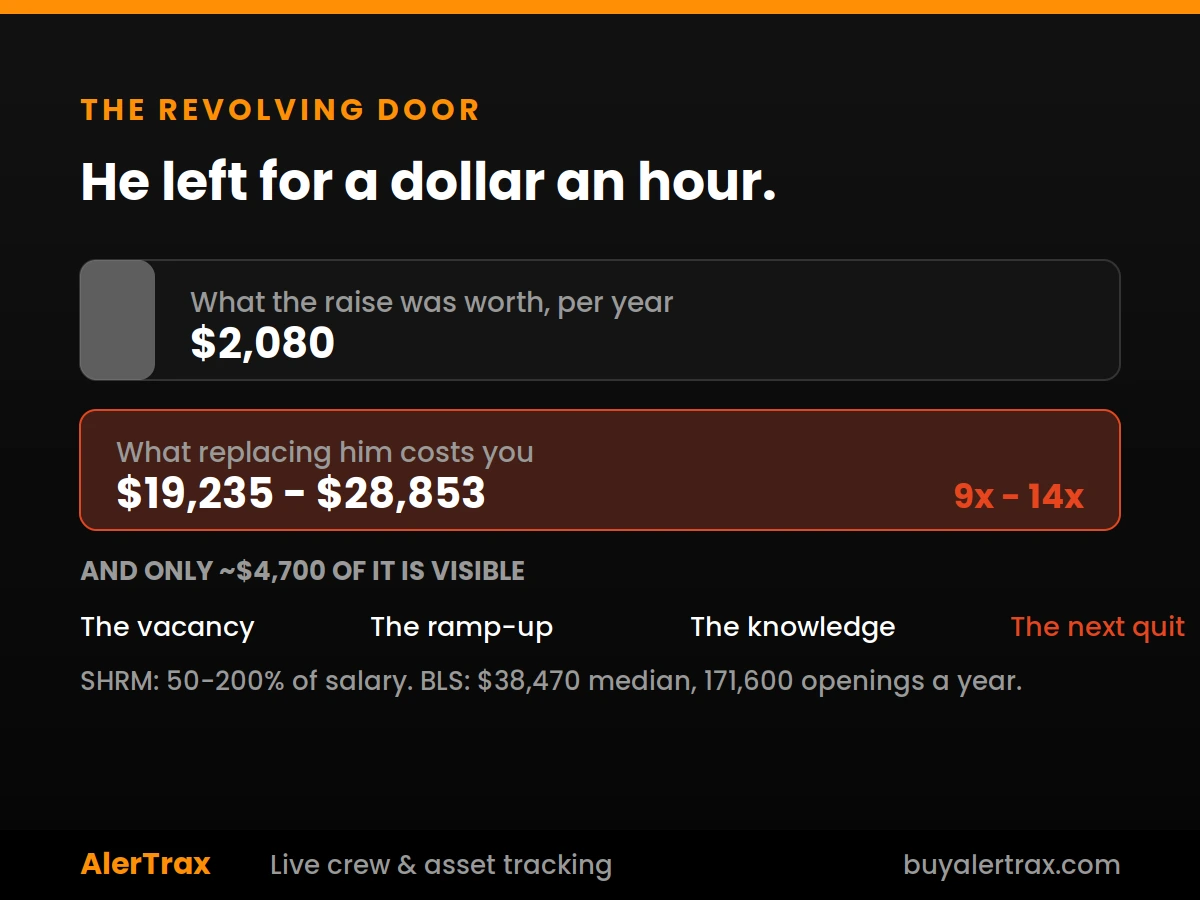
Most owners price that moment as a dollar an hour. That is the number that got him, so that is the number that stings. But the actual cost of what just happened is roughly nine to fourteen times the annual value of that raise, and almost none of it will ever show up as a line item you can see.
This post puts real numbers on the revolving door, using government and professional-association data, then gets specific about the part of turnover that is genuinely inside your control.
The Churn Is Not Your Imagination
- 3.1 million Americans quit their jobs in a single month. That is May 2026 alone, against 5.1 million total separations and 5.2 million hires (U.S. Bureau of Labor Statistics, Job Openings and Labor Turnover Survey).
- 7.6 million open jobs sat unfilled at the end of that month (BLS, JOLTS, May 2026). Your people have options, and they know it.
- 171,600 openings a year are projected in grounds maintenance work alone through 2034, the large majority of them replacing workers who leave rather than filling new positions (BLS, Occupational Outlook Handbook).
That last number deserves a second read. The dominant driver of hiring in this trade is not growth. It is replacement. The industry runs a treadmill, and every company on it is paying for the same walk.
What One Departure Actually Costs
The professional benchmark for replacement cost is wide but consistent in shape. The Society for Human Resource Management estimates that replacing an employee costs between 50 and 200 percent of that person's annual salary, with frontline and entry-level roles clustering at the lower end and specialized or supervisory roles running much higher (SHRM). The Department of Labor puts the cost of a bad hire, which is the same math with a worse ending, at a minimum of 30 percent of the employee's first-year earnings (U.S. Department of Labor).
Now anchor that to real wages. The median grounds maintenance worker earns $18.50 an hour, or $38,470 a year (BLS, May 2024). Run SHRM's frontline range against it:
- $19,235. Replacement cost at the bottom of SHRM's range, 50 percent of salary.
- $28,853. Replacement cost at 75 percent, which is where SHRM places skilled frontline roles.
- $4,700 or so of that is the visible part. SHRM's average cost per hire, covering postings, screening, and onboarding paperwork, has climbed to roughly that figure, and it represents only the hard costs. The majority of replacement cost is soft: the vacancy, the ramp-up, and the drag on everyone covering the gap (SHRM).
So the man who left over a dollar an hour, about $2,080 a year, costs you somewhere around $19,000 to $29,000 to replace. Lose three crew members in a year, which is unremarkable in this industry, and you have spent between $58,000 and $87,000 on standing still.
Where That Money Actually Goes
Almost none of it is the job posting. The cost lives in four places, and it is worth naming them because three of the four are operational problems, not HR problems:
- The vacancy. Between his last day and the new hire's first day, the work does not stop. It gets absorbed by the crew, which means longer days for people who are already stretched, or it gets pushed, which means jobs run late and customers notice.
- The ramp. A new hire is not a replacement on day one. He is a partial worker being paid full wages while a productive crew member spends part of every day training him, so you are effectively down more than one person for weeks.
- The knowledge. Three years of knowing which property has the tricky gate, which customer wants a call first, and how long that hillside actually takes walked out the door with him, and none of it was written down anywhere.
- The contagion. The people absorbing his workload are now working harder for the same pay, which is the most reliable way to generate the next departure.
Notice that the third item, institutional knowledge, is the only one your payroll system could never price and the only one that compounds. Every departure that takes undocumented knowledge with it makes the next departure more expensive.
The Wage Response, and Its Ceiling
The industry's instinct is to pay the problem away. Roughly 70 percent of landscaping companies planned wage increases heading into this year, and 72 percent of owners name labor as their single biggest barrier to growth (Aspire, 2025 Commercial Landscape Industry Report). Raising wages is often the right call, and nothing here argues against it.
But run the arithmetic on where that leads. Labor already consumes 30 to 50 percent of revenue at a typical company (Aspire, 2025). If wage increases come out of margin rather than out of productivity, you have bought retention with the profit that was supposed to fund your growth. And the raise is matchable: whatever you pay, the shop across town can offer a dollar more, because they are running the same treadmill you are.
What is not matchable is being a company that is organized, fair, and not chaotic to work for. That part is operational, and it is where the data actually helps.
Being Honest About What Tracking Does Here
Let me be direct, because this is the part where a vendor would overreach. GPS tracking is not a retention program. It will not make anyone love the job, and installed with the wrong message, a tracker communicates distrust and makes retention worse, not better. If your crews first hear about it as a crackdown, you have spent money to create a problem.
What visibility does do, when the message is right, is remove three specific frictions that push good people out:
- It ends unfair blame. When a customer claims nobody showed up, or that the crew left at noon, your foreman currently defends himself with his memory. Timestamped arrival and departure records settle it in seconds, in his favor, because he was there. The best people on your crew are the ones most damaged by a system where accusations cannot be disproven.
- It stops crews from eating the schedule's mistakes. A crew running late because the route zigzagged across town looks like a slow crew to everyone who cannot see the map. Route history shows the day for what it was, which puts the fix on the schedule where it belongs instead of on the people driving it.
- It makes the ramp visible. Time-on-site data shows you when a new hire's job durations start converging on the veterans'. That tells you when the ramp is genuinely finished, where the coaching is needed, and lets you recognize progress with evidence instead of impressions.
The framing that works with crews is the true one: we track trucks, not people, so we can schedule better, bill accurately, and back you up when a customer's story does not match yours. Introduced that way, the same data that protects your margin protects your best employees.
Why AlerTrax Fits
AlerTrax was built for field operations, not for enterprise IT departments:
- Over a Year of Battery Life, No Wiring: No splicing, no OBD port, no install appointment. Magnetic mount, a minute per vehicle, on trucks, trailers, mowers, and skid steers alike.
- Automatic Time-on-Site Logging: Arrival and departure timestamps at every stop, the record that settles disputes and measures the ramp.
- Route History: Every day's actual route on a map, so schedule problems stop being blamed on crews.
- Live Fleet Map: Every asset in the AlerTrax Fleet Portal and the iOS and Android app, updated as often as every 2 minutes, so you check the screen instead of interrupting a working crew with a phone call.
- AddressFence and Geofence Alerts: Automatic notifications when assets arrive at or leave any address or boundary you define.
- 100% Waterproof, Ruggedized, Covert Mount: Built for equipment that works outside for a living.
Pricing, Against a $19,000 Problem
You can put AlerTrax on your entire fleet for a low monthly rate, with no long-term contracts and no hidden fees. Weigh that against the low end of a single replacement, roughly $19,000 for one crew member at median wages. Tracking the whole fleet for a year costs a small fraction of losing one good person once.
(Want to own it outright? There is a $599 one-time Lifetime option for permanent, subscription-free tracking. No fees, ever.)
See the monthly plan and get set up here.
And Yes, It Watches the Equipment Too
Since the trackers are on the trucks anyway: geofence your yard and AlerTrax alerts you within minutes if a truck, trailer, or mower moves after hours, with tamper notifications on the device and a live tracking link you can hand to law enforcement. Not the reason to buy. Just a second job the same hardware does while you sleep.
The Cheapest Employee to Hire Is the One You Keep
Every number in this post points the same direction. Replacement is expensive, mostly invisible, and compounding. Wages are worth paying and still matchable. What is not matchable is being the company where the schedule makes sense, the records back the crew up, and nobody gets blamed for a bad route they did not build.
Visit www.buyalertrax.com and give your crews the one thing a raise across town cannot copy: an operation that runs on facts.
Sources
U.S. Bureau of Labor Statistics, Job Openings and Labor Turnover Survey (May 2026): 7.6 million job openings, 5.2 million hires, 5.1 million total separations, and 3.1 million quits in a single month.
U.S. Bureau of Labor Statistics, Occupational Outlook Handbook (Grounds Maintenance Workers): Median wage of $18.50 per hour, or $38,470 per year (May 2024); about 171,600 openings projected each year through 2034, most resulting from the need to replace workers who leave the occupation.
Society for Human Resource Management (SHRM): Replacement cost estimated at 50 to 200 percent of an employee's annual salary depending on role and seniority, with entry-level and frontline roles at the lower end; average cost per hire of roughly $4,700, covering direct recruiting costs only.
U.S. Department of Labor: Average cost of a bad hire estimated at a minimum of 30 percent of the employee's first-year earnings.
Aspire, 2025 Commercial Landscape Industry Report: Labor consumes 30 to 50 percent of revenue; 72 percent of owners cite labor as their top barrier to growth; roughly 70 percent of companies planned wage increases.