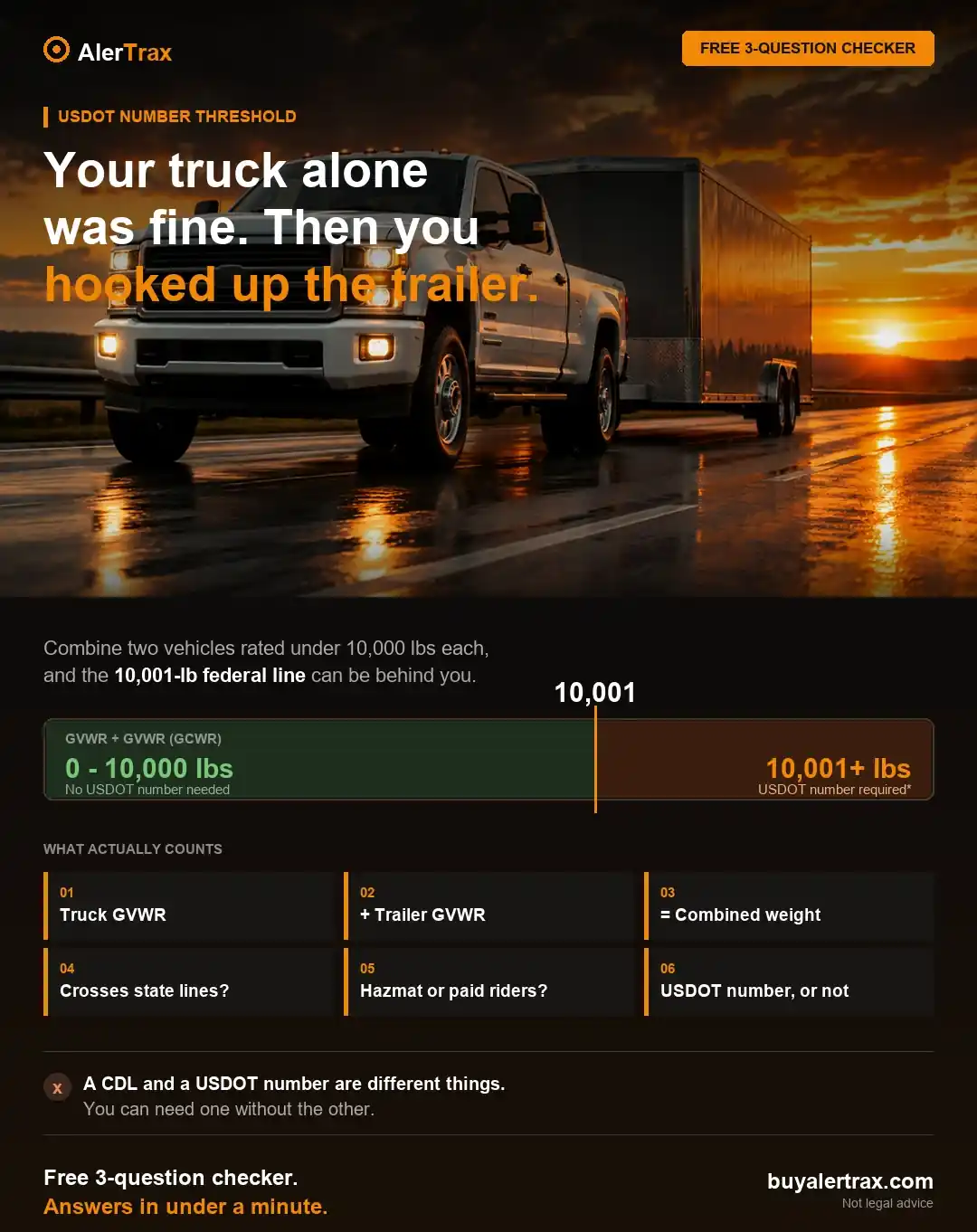
A landscaper gets pulled into a roadside inspection outside Charlotte. Half-ton pickup, tandem-axle trailer loaded with two mowers and a skid steer. Nothing hazardous, nothing over the road he doesn't drive every week, no CDL required for either vehicle.
The inspector asks for his USDOT number. He does not have one. He has never heard the term applied to his own truck - he thought that was for eighteen-wheelers.
It was not for eighteen-wheelers. It was for him, the moment he backed up to that trailer.
That is the gap this article is about. Not whether you need a commercial driver's license - almost certainly not, for a pickup and a trailer. The gap is between "my vehicles are small" and "my vehicles, added together, cleared a federal line," and it is a much easier line to cross than most contractors realize.
There is a free 3-question tool at the bottom of this article that answers it for your specific truck and trailer in under a minute.
The Part Almost Everyone Gets Right
Let's clear up the question that causes most of the confusion, because the answer is simpler than people expect.
A USDOT number has nothing to do with a commercial driver's license. They come from different rules and answer different questions. A CDL is about who is allowed to drive a given vehicle. A USDOT number is about whether your business, as a motor carrier, has to be registered with the Federal Motor Carrier Safety Administration at all. You can need one without needing the other - and for a truck-and-trailer combination under 26,001 lbs, that is exactly the situation most contractors are in: no CDL required, USDOT number required anyway.
So if it is not about the driver's license, what is it about?
The Number That Actually Matters: 10,001
Under the federal definition of a commercial motor vehicle (49 CFR § 390.5), a truck operating in interstate commerce needs a USDOT number if any of the following is true:
- Its gross vehicle weight rating (GVWR), gross combination weight rating (GCWR), or actual weight is 10,001 lbs or more; or
- It is designed or used to transport more than 8 passengers for compensation, or more than 15 passengers not for compensation; or
- It transports hazardous materials in a quantity requiring placards.
The first bullet is the one that catches contractors, because it is not about your truck's weight rating in isolation. It is the combined rating of the truck and whatever it is pulling. A half-ton pickup with a GVWR around 7,000 lbs and a tandem-axle equipment trailer rated for 7,000 lbs do not individually clear 10,000 lbs. Hooked together, their combined rating is 14,000 lbs - well past the line.
Neither vehicle looks like a "commercial truck." Put them behind each other and, on paper, you are running federally regulated equipment.
Does "Interstate Commerce" Mean You Have to Cross a State Line?
Mostly, yes - the federal requirement in 49 CFR § 390.19 attaches to vehicles operating in interstate commerce, which generally means the vehicle, cargo, or trip crosses a state line, even occasionally. If every truck and trailer you own never leaves your home state, the federal USDOT number rule may not apply to you directly.
That is not the end of the question, though. Many states run their own intrastate motor carrier registration programs with their own weight thresholds, and quite a few mirror the federal 10,001-lb line for their own state DOT number or motor carrier registration requirements. A contractor who never leaves Ohio can still end up needing to register with Ohio. The federal rule and your state's rule are separate systems that happen to ask a similar question, and you may owe an answer to both.
This is the part a lot of generic compliance articles skip, and it is exactly why we built the checker linked below to ask about your state and your actual travel pattern rather than just your weight.
Three Trucks, Three Outcomes
Two more things that override the weight math entirely: transporting placarded hazardous materials, or transporting passengers for compensation (9 or more paid, 16 or more unpaid), requires a USDOT number regardless of how light the vehicle is.
What About the ELD Mandate?
A separate question that tends to arrive at the same time: does your vehicle need an electronic logging device? The ELD mandate generally applies to drivers required to keep records of duty status - which, for most small operations, means it rides on top of the same 10,001-lb / interstate test, with its own exceptions for short-haul operations and specific vehicle ages. It is a related but separate compliance question from the USDOT number itself, and the checker below flags it alongside your weight answer.
What Actually Happens If You Don't Have One
A roadside inspector who finds a commercial motor vehicle without a required, visibly displayed USDOT number (49 CFR § 390.21 requires the number on the vehicle itself) can issue a citation, and in some cases place the vehicle out of service until the paperwork is fixed - which for a landscaping crew or a contractor mid-route means a truck sitting on the shoulder instead of finishing the day's jobs. Fines vary by state and by whether it is a first offense, but the bigger cost for most small operators is the day of lost work, not the ticket itself.
Registering is free and done through the FMCSA's Unified Registration System. The hard part has never been the paperwork - it's realizing you needed to file it before someone else pointed it out on the side of a highway.
Find Out in Three Questions
Enter your truck's weight, whether you haul across state lines, and whether you carry hazmat or paid passengers. The checker tells you immediately whether you need a USDOT number and whether the ELD mandate applies - no email required.
Take the Free Checker
Please read this part. AlerTrax is a GPS tracking company, not a law firm, and nothing here is legal advice. This is a general summary of federal rules as of September 2026, built from publicly available FMCSA regulations. Your state may impose its own intrastate registration requirements in addition to, or instead of, the federal rule described here. Confirm your specific obligations with your state's Department of Transportation or Department of Motor Vehicles, or with a transportation attorney, before you conclude you are or are not required to register.
Where AlerTrax Fits
AlerTrax is not an ELD and does not replace one. What it does is give a USDOT-registered fleet - or one that is not sure yet whether it should be - a straight answer to the question a compliance review or an insurance adjuster eventually asks: where was this vehicle, and when?
- Route History with Timestamps: A complete, dated record of where every truck and trailer traveled, which turns "we're not sure which state that job was in" into a settled answer.
- Geofence Alerts: Get notified the moment a truck leaves the yard or crosses a boundary you set, so an occasional out-of-state trip doesn't happen without anyone noticing.
- Role-Based Portal Access: Decide who in the office can pull location history, so the record is there when you need it and controlled when you don't.
- Shareable Tracking Link: Send a customer or an insurer a live link to one asset without handing out a login to the rest of the fleet.
- Over a Year of Battery Life, No Wiring: Magnetic mount, about a minute per unit, on the truck or the trailer - no OBD port, no install appointment.
- iOS and Android App: The whole fleet on your phone, wherever the trucks end up.
Pricing
You can put AlerTrax on your entire fleet for a low monthly rate, with no long-term contracts and no hidden fees.
(Want to own it outright? There is a $599 Lifetime option for permanent, subscription-free tracking. No fees, ever.)
One Minute Now, Or an Out-of-Service Order Later
Most of the contractors this catches are not trying to dodge anything. They just never added up the two numbers on their own paperwork - the truck's GVWR and the trailer's GVWR - and put them side by side against 10,001.
Take the checker, get a straight answer for your actual truck and trailer, and if the answer is yes, register it before an inspector tells you it should have already been done.
Then visit www.buyalertrax.com and put a tracker on every truck, trailer and machine you own - so wherever your fleet goes, you already know.
Sources
49 CFR § 390.5 - Definitions; commercial motor vehicle
49 CFR § 390.19 - Motor carrier identification report; USDOT number registration
49 CFR § 390.21 - Marking of self-propelled CMVs; display of USDOT number
49 CFR Part 395 - Hours of service of drivers; electronic logging devices
FMCSA Unified Registration System - Federal motor carrier registration process