What the New Number Says
The National Insurance Crime Bureau released its first-half analysis on September 30, 2026. A total of 268,415 vehicle thefts were reported to law enforcement in the first six months of the year, a 21 percent decline from the same period in 2025. The national theft rate was about 77.81 per 100,000 people, and all 50 states recorded year-over-year decreases (NICB, September 30, 2026).
The declines were steep in places. Tennessee fell 42 percent, Colorado 35 percent, and Florida 31 percent. California still recorded the most thefts of any state, 57,821, and among the ten metro areas with the most thefts, Chicago was the only one to rise, up 2 percent.
NICB was careful not to declare victory. Chief Operating Officer Tim Slater noted that "with more than a quarter-million vehicles stolen in just six months, continued investment in these partnerships, as well as prevention and public awareness, is paramount to sustaining positive progress."
What It Does Not Measure
The release reports vehicles. It does not mention trailers, construction equipment, or landscaping equipment, and it does not report how many of the stolen vehicles were recovered.
One line in it deserves more attention than it got. NICB noted that "organized crime groups have increasingly shifted away from traditional vehicle theft," while "a wide range of other vehicle-related crimes and fraudulent schemes continue to rise."
That is not a claim that thieves have moved to equipment, and we are not going to make it. It is a reminder that a falling number in one category tells you about that category. Whether the risk to a trailer sitting in a yard overnight has gone up, down, or sideways is a question this report was never designed to answer.
The Last Equipment Theft Report Covers 2016
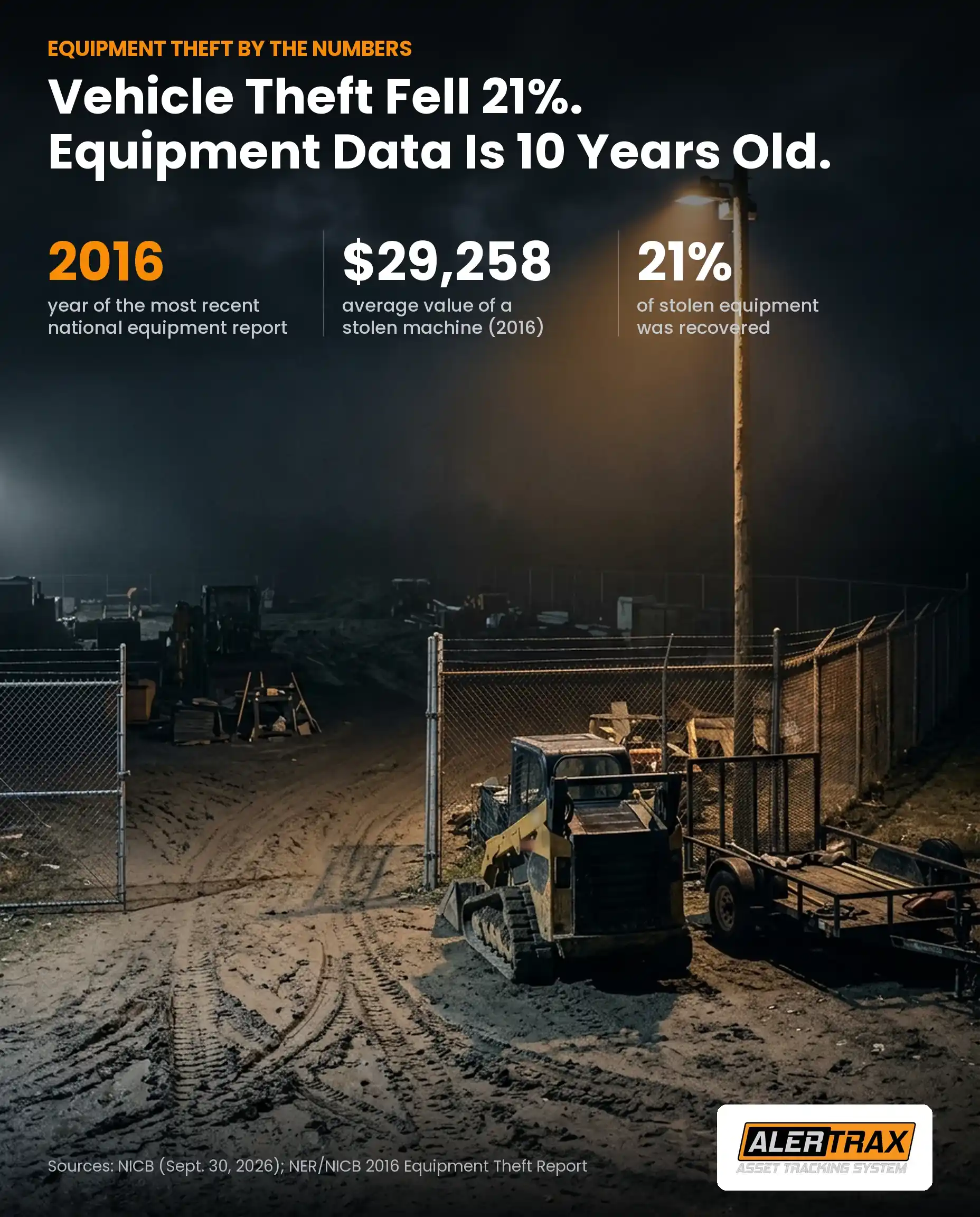
For years, the National Equipment Register and NICB published a joint annual report on heavy equipment theft. NER's own report page still lists the 2016 Equipment Theft Report as its most recent edition (NER, retrieved October 2026). That is a ten year gap with no national update.
The 2016 report is old, and we will say so every time we cite it. But it is the most recent national picture available, and its numbers are sobering:
11,574 equipment thefts were reported in 2016.
2,442 recoveries were reported through NCIC, about 21 percent.
$29,258 was the average estimated value of a stolen machine.
$300 million to $1 billion is the range of annual cost estimates, with most estimates around $400 million.
(NER and NICB, 2016 Equipment Theft Report, published 2017)
The report was candid about its own limits, too: "At present, there is no centralized, accurate, or exhaustive database that includes every loss." Its recovery rate also excludes equipment recovered but never marked as recovered, and thefts that were never reported at all.
Why Four Out of Five Never Came Back
The useful part of the 2016 report is not the theft count. It is the list of reasons recovery was so low, because almost none of them are about the thief.
The first reason listed is "delays in discovery of thefts and subsequent delays between time of the occurrence and reporting." The rest are about records: owners' "inaccurate or nonexistent ownership records," confusing equipment identification number formats, limited and possibly inaccurate equipment information in law enforcement systems, and equipment entered into the NCIC "article file" instead of the "vehicle file," where it is harder to match.
Read that list as a to-do list. Discovery delay is a visibility problem. Records are a paperwork problem. Both are on the owner's side of the fence, and both are fixable before anything goes missing.
As an illustration, not a survey figure: a machine taken from a job site on Friday evening and discovered missing Monday morning has a roughly 60 hour head start before anyone calls it in. A machine whose movement triggers an alert on Friday evening has a head start measured in minutes.
What to Do This Week
1. Build the equipment list the report says owners lack. Every machine, trailer, and attachment worth more than you would shrug off: make, model, year, and the PIN or serial number, photographed from the plate itself.
2. Know the difference between a VIN and a PIN. Trailers carry VINs. Construction equipment carries a product identification number in a format that varies by manufacturer. Write down exactly what is on the plate, because that is what a police report needs.
3. Shorten the time to discovery. The biggest single factor in the report is how long it takes to notice. Anything that tells you a machine moved when it should not have, on the night it happened, attacks that factor directly.
4. Report fast, with the numbers in hand. When something goes missing, the serial, the photos, and the last known location are what make the report useful. Having them ready turns an hour of digging into a five minute call.
5. Follow NICB's basics on the trucks. NICB's own tips: park in well-lit areas, lock the doors, never leave a vehicle running unattended, and take the keys. Its list of anti-theft technology for an added layer of security includes aftermarket GPS tracking.
6. Do not let a good headline change the plan. A national decline in vehicle theft is real progress. It is not a reason to leave a trailer unlocked in a lot that has never been checked after dark.
Where Alertrax Fits
The 2016 report's first explanation for low recovery was delay. The fastest way to cut that delay is to find out the moment something moves, not the next morning.
Alertrax was built for exactly the equipment that national theft headlines do not break out: trailers, mowers, compact equipment, and anything else with no power of its own.
- After-Hours Movement Alerts: Equipment that is supposed to sit still overnight or over a weekend is the easiest thing in the world to watch. Any movement is the alert, on the night it happens.
- Geofence Alerts: Draw a boundary around the yard or the job site. If a trailer or machine crosses it, you know, wherever you are.
- Live Tracking in the Fleet Portal: Every tracked asset on one map in the Alertrax Fleet Portal, with location updates every 2 minutes, so the last known location in a police report is a live one.
- Shareable Tracking Link: Send the responding officer a live link straight from the app or portal, with no login to walk anyone through.
- One-Year Battery, No Wiring Required: Alertrax runs on two AA cells, with nothing to wire in and nothing to charge, which is what makes it work on a trailer, a mower, or a machine parked for the winter.
- 100% Waterproof, Covert Magnetic Mounting: Mounts to a steel frame in seconds, somewhere that is not the first place anyone looks.
- iOS and Android App: Get the alert and act on it from your phone.
Pricing
You can equip your fleet with Alertrax for a low monthly rate, no long-term contracts, no hidden fees.
(Want to own it outright? We offer a $599 Lifetime option for permanent, subscription-free tracking.)
Set that against the 2016 report's average stolen machine value of $29,258, and a recovery rate that left roughly four out of five machines gone for good.
Sources
National Insurance Crime Bureau (NICB), "U.S. Vehicle Thefts Fall 21% in First Half of 2026, Continuing Nationwide Decline," news release, September 30, 2026, retrieved October 2026: 268,415 vehicle thefts reported in the first half of 2026; 21 percent decline from the first half of 2025; theft rate of approximately 77.81 per 100,000 people; all 50 states recording year-over-year decreases; state and metro figures cited above; statement by Chief Operating Officer Tim Slater; statement that organized crime groups have increasingly shifted away from traditional vehicle theft; prevention tips including parking in well-lit areas, locking doors, not leaving vehicles running unattended, taking keys, and anti-theft technology including aftermarket GPS tracking
National Equipment Register (NER) and National Insurance Crime Bureau (NICB), "2016 Equipment Theft Report," published 2017, retrieved October 2026: 11,574 reported equipment thefts in 2016; 2,442 recoveries reported through NCIC; average estimated value of a stolen machine of $29,258; annual cost estimates of about $300 million to $1 billion, most around $400 million; statement that there is no centralized, accurate, or exhaustive database that includes every loss; listed factors in low recovery rates. Note: this is the most recent edition listed on NER's annual theft report page as of October 2026, and its figures are a decade old
National Equipment Register (NER), Annual Theft Report page, ner.net, retrieved October 2026: 2016 Equipment Theft Report listed as the current edition
This article is provided for general informational purposes and is not legal, insurance, or security advice. AlerTrax is a GPS tracking company, not a law enforcement agency or insurer. National theft statistics describe reported thefts and may not reflect your area or your risk. The 2016 equipment figures are the most recent national figures we could find, and conditions have changed since. The Friday to Monday example above is an illustration, not survey data. No tracking device can guarantee recovery of stolen property.
Count Your Own
There is no current national equipment theft report to tell you whether the risk to your trailers and machines went up or down this year. That means the theft data that matters most to your business is your own: what you own, where it is, and how fast you would know if it moved.
The headline is good news. Make sure your equipment is not the part of the story it does not cover.
Visit www.buyalertrax.com today and know the moment a trailer or machine moves when it should not.