The radar went red at 11:40 on a Tuesday morning. By noon your crews were sitting in trucks watching it come down sideways, and by two o'clock you had made the call: everybody in, we will pick it up tomorrow.
Most owners file that day under bad luck and move on. But the day did not disappear. It relocated. Every job that did not happen Tuesday is now competing for space on Wednesday, Thursday, and Friday, on a calendar that was already full before it rained. That is the part weather actually costs you, and almost nobody puts a number on it.
Here is what the data says about how often this happens, how much worse it is getting, and the one part of it you can genuinely control.
The Disruption Is Getting Measurably Worse
A quick note on sourcing, because it matters here. NOAA's National Centers for Environmental Information maintained the definitive U.S. Billion-Dollar Weather and Climate Disasters database from 1980 until it was discontinued in May 2025. Climate Central, a nonprofit climate science organization, now maintains it using the same methodology, having hired the program's former lead scientist. Figures through 2024 are NOAA's. The 2025 figures are Climate Central's continuation of that dataset.
- 23 separate billion-dollar weather and climate disasters struck the United States in 2025, the third-highest annual total on record (Climate Central, continuing the NOAA/NCEI dataset).
- Behind only 2023 (28 events) and 2024 (27 events). The three worst years on record are the three most recent years (Climate Central; NOAA/NCEI).
- 21 of those 23 were severe storms, a new record for billion-dollar severe storm events in a single year, reflecting near-record damaging wind and tornado reports through the spring and summer (Climate Central).
- 2025 was the fifteenth straight year with ten or more billion-dollar disasters (Climate Central).
- Severe storms are the most frequent category historically: of 403 billion-dollar disasters from 1980 through 2024, 203 were severe storms, roughly half the total (NOAA/NCEI).
Read past the headline damage figures and notice what is actually in that data for a service company. The costly events are not mostly hurricanes. They are thunderstorms, hail, and wind: the ordinary summer afternoon weather that shuts down outdoor work across a whole metro for half a day at a time, several times a season, in every region.
What Counts as a Lost Day
Construction contracting has spent decades formalizing this question, and the convention is useful for anyone running outdoor crews. The standard threshold is that 0.1 inch of precipitation during a workday interrupts outdoor work, with heavier rainfall, roughly an inch or more, typically affecting the following workday too through mud, standing water, and unworkable ground. Contractors pull the underlying counts from NOAA's Climate Data Online and build the expected number of weather days into the schedule before the job starts.
That last point is the one most service companies skip. Construction firms treat weather days as a planned, budgeted quantity. Landscaping, HVAC, and pest control companies mostly treat each one as a surprise, which is why every washout turns into an improvised scramble instead of a procedure.
The Compression Math
Here is the number that actually matters, and you can run it for your own operation in about a minute.
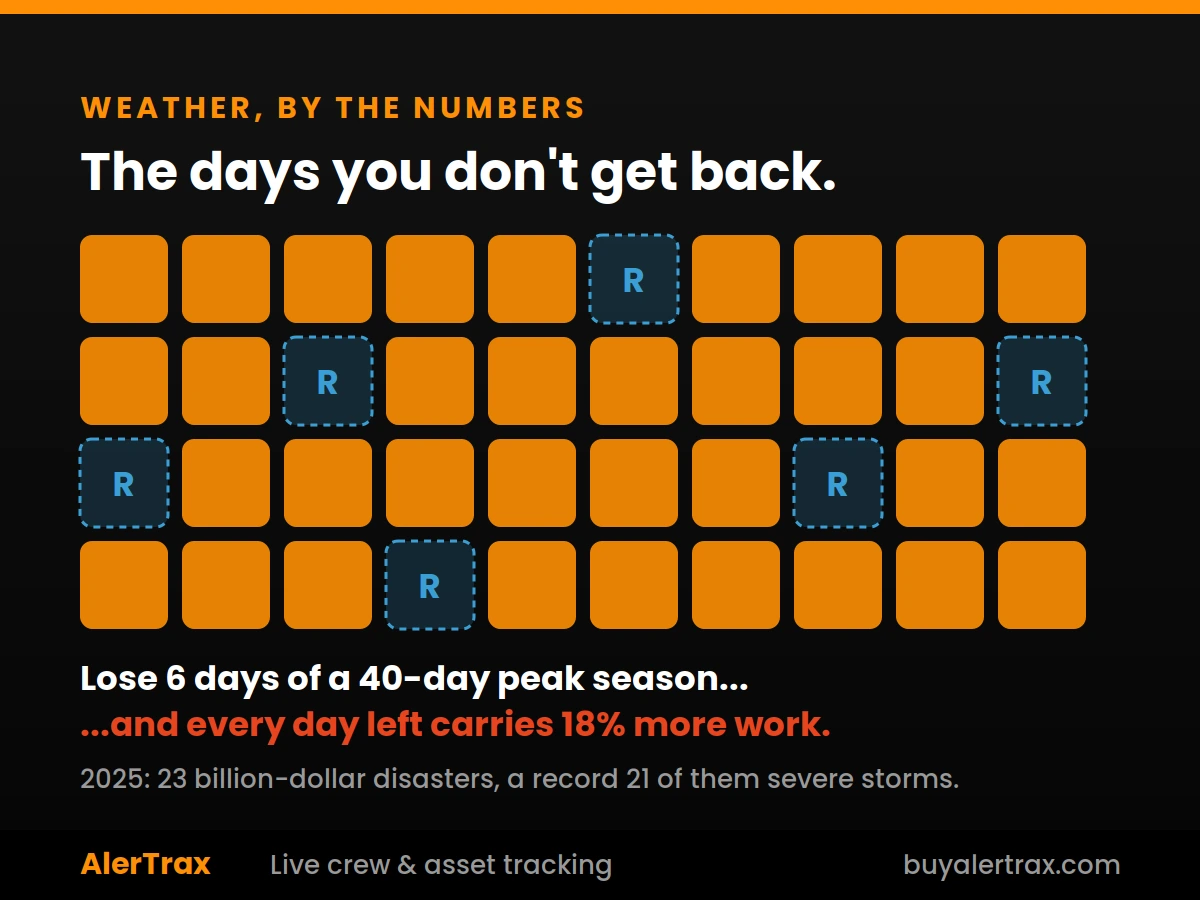
There are roughly 40 working days between the Fourth of July and Labor Day. Lose six of them to weather across that stretch, which is unremarkable in a normal thunderstorm season, and you now have 34 days to deliver 40 days of committed work. Every remaining day has to carry about 18 percent more work than it was scheduled for.
That compression is where the real damage lives, and it shows up as:
- Overtime, because catching up means longer days at premium rates on your largest expense.
- Rushed routes, because squeezing eight stops into a six-stop day means driving faster between them, which is its own risk.
- Skipped or shortened visits, which quietly become the underpriced jobs and the service complaints that show up six weeks later.
- Customer friction, because rescheduling twelve properties means twelve conversations, and the ones you cannot reach are the ones who call the office annoyed.
None of that is caused by the rain. All of it is caused by how the recovery gets handled.
Being Honest About the Part Software Cannot Fix
Let me be direct, since this is where a vendor would start overpromising. No tracker changes the forecast, recovers a lost day, or makes it stop raining. AlerTrax has exactly zero influence on the weather, and anyone implying otherwise is selling you something.
What is genuinely inside your control is the quality of the recovery, and recovery is an information problem. When the storm hits at 11:40 on a Tuesday, the questions that determine how expensive Wednesday will be are all questions about facts you either have or do not:
- Which jobs actually got finished before the rain started? Not which ones were scheduled. Which ones were completed. Arrival and departure timestamps answer that definitively, so Wednesday's rebuild starts from what really happened rather than from four separate foremen's recollections.
- Where is everybody right now? A live map lets you pull the right crew off the right site when you make the call, instead of running a phone tree while the weather closes in.
- What can Wednesday realistically absorb? If your time-on-site history says that property genuinely takes 2 hours and 40 minutes rather than the two hours it was estimated at, you can build a catch-up day that is actually achievable instead of one that sets your crews up to fail and then blames them for it.
- Which properties can be re-clustered? Route history shows which of the rained-out stops sit near Thursday's existing route and can be absorbed with minimal added drive time, versus which ones need their own trip.
The difference between a good and a bad recovery is not effort. Everybody works hard on the catch-up day. The difference is whether the plan for that day was built on records or on guesses.
Why AlerTrax Fits
AlerTrax was built for crews and equipment that work outside, which is the same reason weather matters to you in the first place:
- 100% Waterproof, Ruggedized Housing: IP67 rated and salt water protected. The device keeps reporting through exactly the conditions that shut your day down.
- Automatic Time-on-Site Logging: Arrival and departure timestamps at every stop, so you know precisely which work was completed before the radar turned.
- Live Fleet Map: Every asset in the AlerTrax Fleet Portal and the iOS and Android app, updated as often as every 2 minutes, for making the call-it-off decision quickly and accurately.
- Route History: Every day's actual routes on a map, so re-clustering the rained-out stops is a geography exercise instead of a guess.
- AddressFence Alerts: Arrival and departure notifications tied to customer addresses, so rescheduled visits are verifiable when a customer asks whether anyone ever came back.
- Over a Year of Battery Life, No Wiring: No splicing, no OBD port, no install appointment. Magnetic mount, a minute per vehicle.
Pricing Against a Compressed Season
You can put AlerTrax on your entire fleet for a low monthly rate, with no long-term contracts and no hidden fees. Measured against a single badly rebuilt catch-up day, the overtime, the rushed routes, the shortened visits, and the customer calls, the tracking cost is not a close comparison. And unlike the weather, the recovery is repeatable: every washout for the rest of the season gets handled the same improved way.
(Want to own it outright? There is a $599 one-time Lifetime option for permanent, subscription-free tracking. No fees, ever.)
See the monthly plan and get set up here.
And Storms Are When Equipment Wanders
One footnote worth mentioning. Storm days scatter equipment: trailers left at half-finished sites, mowers parked wherever the crew could get them under cover, gear staged for a job that never happened. Geofence your yard and job sites and AlerTrax alerts you if anything moves when it should not, with tamper notifications on the device. Knowing where every asset ended up after a chaotic afternoon is worth something on its own.
Plan the Weather Days You Know Are Coming
Fifteen straight years of ten or more billion-dollar disasters, a record year for severe storms, and the three worst years on record all landing in the last three. The washouts are not anomalies to be absorbed one surprise at a time. They are a recurring, plannable feature of every outdoor season, and the companies that recover well are the ones rebuilding the day from records instead of memory.
Visit www.buyalertrax.com and make sure that when the radar goes red, you know exactly what got done and exactly what has to move.
Sources
NOAA National Centers for Environmental Information, U.S. Billion-Dollar Weather and Climate Disasters: 403 billion-dollar disasters from 1980 through 2024, of which 203 were severe storms, the most frequent category. NOAA discontinued the database in May 2025.
Climate Central, U.S. Billion-Dollar Weather and Climate Disasters (continuation of the NOAA/NCEI dataset): 23 billion-dollar weather and climate disasters in 2025, the third-highest annual total behind 2023 (28) and 2024 (27); a record 21 billion-dollar severe storm events in 2025; 2025 marked the fifteenth consecutive year with ten or more billion-dollar disasters.
NOAA Climate Data Online: Source of historical precipitation-day counts used for weather-day scheduling.
Construction contracting convention: 0.1 inch of precipitation during a workday is the standard threshold treated as interrupting outdoor work, with precipitation of roughly one inch or more commonly affecting the following workday as well.