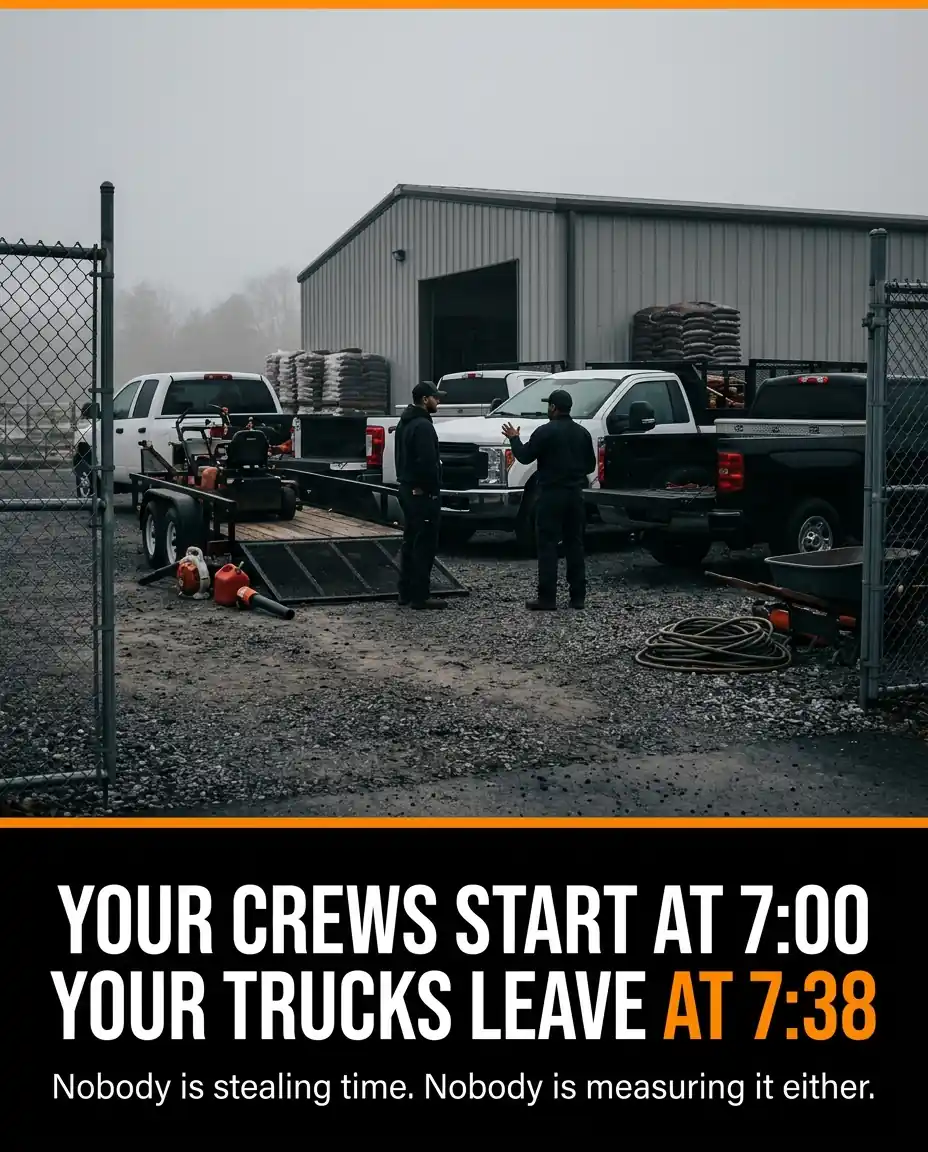
Your crews start at 7:00.
That is what the schedule says. That is what you tell customers. That is the number in your head when you price a job at eight billable hours.
So here is a question worth sitting with: what time did your last truck actually pull out of the yard yesterday?
Not what time the guys clocked in. Not what time they showed up. What time did the truck cross the gate with the trailer hooked and everything loaded?
Most owners do not know, and the ones who guess tend to guess low. The clock-in is 7:00. The gate is 7:38. And that thirty-eight minutes belongs to nobody, appears on no report, and repeats itself every single working day of the season.
Nobody is stealing time. The guys are in the yard, they are doing things, they are not sitting in their trucks. The morning just has more friction in it than anyone has ever measured, because the only person who could measure it is standing in the same yard doing the same things.
Where the Thirty-Eight Minutes Goes
Walk a yard at 7:05 and the delay is never one big thing. It is eight small ones stacked on top of each other, and every one of them is somebody doing their job.
- Waiting on the crew member who is not there yet. One guy is nine minutes out and the foreman decides to wait rather than shuffle the truck assignment.
- Fuel. The mowers were not filled Friday, so somebody is filling cans while the rest of the crew stands there.
- Finding the trailer. Or the machine. Or the attachment that belongs on the machine.
- A conversation with you. The foreman catches you about the change order on Thursday's job, which is a legitimate and useful conversation happening at exactly the wrong time.
- The blower that will not start. Ten minutes of pulling before somebody grabs the backup.
- Getting the day's sequence straight. Nobody is sure whether the Harbor Ridge job moved to today or Thursday.
- Loading. Which is real work and takes actual minutes, and almost never gets counted as part of the workday.
Each item costs three to eight minutes. None of them is worth mentioning. Together they are the single largest recurring loss in most landscaping and hardscaping operations, and the only reason nobody addresses it is that nobody has ever put a number on it.
Put a Number on It
Use real wage data rather than a guess.
Aspire's 2026 Commercial Landscape Industry Report, based on a survey of 1,015 commercial landscape professionals conducted between May 2 and May 23, 2025, found that 28 percent of maintenance crews earn $21 to $25 per hour, and 30 percent of construction crews fall in the same range (Aspire, 2026). The Bureau of Labor Statistics puts the national mean for landscaping and groundskeeping workers at $20.33 per hour as of May 2025 (BLS, May 2025 OEWS).
Take $22 an hour as a working number, which sits inside both ranges and is conservative once you remember that burden adds meaningfully on top.
A three-person crew at $22 is $66 an hour in base wages. Thirty-eight minutes of yard time is $41.80.
Now run it across a season. Four crews, five days a week, thirty weeks:
- One crew, one day: $41.80
- Four crews, one day: $167.20
- Four crews, one week: $836
- Four crews, thirty-week season: $25,080
Twenty-five thousand dollars in base wages, before burden, before the trucks idling, before the jobs that got pushed to the next day because the morning started late.
And here is the part that stings: you cannot cut it to zero. Some yard time is real work. Loading a trailer is not waste. But the difference between a 38-minute morning and a 20-minute morning is about $11,880 a season on the same four crews, and eighteen minutes is an entirely reachable improvement.
Why This Is the Most Expensive Number You Are Not Tracking
Most operational waste is variable. A bad route costs you on the days you run it. A blown estimate costs you on that job. Drive time varies with the schedule.
Yard time is different, and the difference is what makes it worth attacking first.
It happens every single day. Not on bad days. Not on busy weeks. Every crew, every morning, all season. There is no version of your operation where it does not occur.
It compounds forward. A late departure does not just cost you the minutes in the yard. It pushes the first job, which pushes the second, and by mid-afternoon you either drop the last stop or pay overtime to finish it. The thirty-eight minutes at 7:00 can cost you an hour at 4:00.
It is invisible to your books. Payroll records the clock-in. Your job costing records the hours a crew was assigned to a property. Nothing anywhere in your system records the gap between the two, which means the money leaves without ever being observed.
Aspire's research found that 51 percent of commercial landscape companies name improving operational efficiency as a key business goal, while 70 percent plan to increase wages (Aspire, 2026). Those two facts are related in a way worth noticing. If you are raising pay in a tight labor market, every unproductive minute costs more this year than it did last year. Wage increases make yard time more expensive automatically, whether or not anything else about your operation changed.
The Reason Nobody Fixes It
Ask an owner why mornings run long and you will usually get an answer about people. The guys are slow, the foreman does not push, somebody is always late.
That diagnosis is wrong often enough to be worth challenging, and it leads to the wrong fix.
The actual reason mornings run long is that nobody in the yard can see the clock the way you can see a job. On a job site there is a visible finish line: the patio is done or it is not. In the yard at 7:12 there is no finish line, no scoreboard, and no signal that anything is going wrong. Everyone is busy. Everyone is doing something legitimate. The morning simply expands to fill whatever space it is given.
Which is why telling people to hurry does not work, and why it tends to backfire. You get resentment, and you get crews who leave the yard less prepared, which costs you more later in the day than the minutes you saved.
What works is measurement, and specifically measurement that does not require anyone to do anything. The moment a departure time exists as a number rather than an impression, the conversation changes from "you guys need to move faster" to "we averaged 7:34 last week and 7:19 the week before, what changed?" One of those is an accusation. The other is a question with an answer.
What You Learn in the First Two Weeks
Put a geofence around the yard, let it run, and stop looking at it for fourteen days. What comes back is usually more interesting than a single average.
The spread between crews. Almost every company finds that one crew leaves consistently earlier than the others, often by fifteen or twenty minutes. That crew is doing something the others are not: loading the night before, fueling on the way in, staging the trailer differently. That is not a discipline story, it is a method you can copy, and you would never have found it without the numbers.
Monday. Mondays run long almost everywhere, usually because nothing was staged over the weekend and the week's sequence gets rebuilt in the yard. Knowing the size of the Monday penalty tells you whether Friday afternoon staging is worth the trouble.
The days that break the pattern. A morning that ran twenty minutes past the average almost always has a specific cause: a machine that would not start, a crew member out, a last-minute schedule change. Seeing the outlier lets you ask what happened while people still remember.
What happens after you talk about it. Departure times usually improve on their own once a crew knows the number is being watched, without anyone being pushed. That effect fades if nothing else changes, which is exactly why the measurement has to be continuous rather than a one-time audit.
Five Things to Fix Once You Can See It
The data only matters if it points somewhere. In practice it usually points at the same handful of things.
1. Move loading to the afternoon before. The single biggest lever. Loading takes the same twenty minutes either way, but in the afternoon it comes out of the tail of the day instead of the front, where it delays every job behind it.
2. Fuel on the way out, not in the yard. A fuel stop en route costs the crew, not the crew plus everyone waiting on them.
3. Publish the sequence the night before. Most yard confusion is schedule confusion. If the crew knows the order before they arrive, the morning becomes loading rather than planning.
4. Stop having your conversations at 7:00. The change order discussion is important. It is also the most expensive time of day to have it, because it stops a truck while three people wait.
5. Stage equipment where it goes, not where it lives. If the mini skid is going to the Harbor Ridge job, it should be near the gate on the correct trailer before anyone arrives.
None of these are new ideas. What is new is knowing which of them is actually costing you, and being able to tell in two weeks whether the change worked.
How AlerTrax Measures It
The reason this metric has never existed in most companies is that collecting it by hand is impossible. Nobody is going to stand at the gate with a clipboard every morning, and any system that asks a foreman to log a departure time will be abandoned by the second week of May.
AlerTrax records it without anyone doing anything.
- Geofence the yard: Draw a boundary around your yard once. Every departure and return is timestamped automatically from that point forward, for every tracked truck, trailer, and machine.
- AddressFence: Load your job site addresses and get automatic arrival alerts as crews reach each property, so you can measure yard-to-first-job time as well as departure time.
- Exportable trip reports: Pull departure times by crew and by date range from the fleet portal, so the two-week baseline above is a report rather than a project.
- Two AA batteries, no wiring: Nothing to splice into a truck's electrical system, no installation appointment. Over a year of battery life on assets that move occasionally, roughly 4 to 6 months on a truck running five days a week.
- 8 lb magnetic mount, screws, or zip ties: Mounts to any steel surface in seconds, on trucks, trailers, and equipment alike.
- IP67 waterproof and ruggedized: Rated for dust and water immersion including salt water exposure. It survives mud, rain, and pressure washing.
- Live fleet map: Every truck, trailer, and machine on one screen, with location updates as often as every 2 minutes.
- After-hours movement and tamper alerts: Get notified when something moves outside expected hours or when a device is disturbed.
What It Costs
AlerTrax is $49.99 per month over 12 payments, with no long-term contract and no hidden fees.
(Prefer to own it outright? There is a $599 Lifetime option for permanent, subscription-free tracking.)
Four trucks on the monthly plan is $199.96 a month. Set that against the $11,880 a season that eighteen minutes of recovered morning is worth on four crews, and the comparison is not close.
Worth being clear about what you are actually buying, though. The device does not make anyone leave earlier. It tells you what time they left, which is the thing you currently do not know and cannot manage.
And Yes, the Same Geofence Watches the Yard at Night
The boundary you draw to measure morning departures is working the other sixteen hours too.
Industry reporting puts the volume at nearly 1,000 pieces of equipment reported stolen to the National Crime Information Center every month, and treats that as a low estimate because a meaningful share of thefts are never reported. The National Insurance Crime Bureau estimates annual losses between $300 million and $1 billion (CONEXPO-CON/AGG, 2023).
The same reporting notes that thieves favor the stretches when nobody is paying attention, and that recovery odds improve the sooner an owner knows something moved.
A yard geofence that logs a 7:38 departure on Tuesday morning also logs a 2:14 departure on Tuesday night, and one of those two should generate a phone call. Same boundary, same device, no additional setup.
Useful. Still not the reason to buy. The reason is the thirty-eight minutes.
Find Out What Time You Actually Start
Every owner reading this believes their crews start at 7:00, because that is what the schedule says and that is what they tell customers.
The schedule is not a measurement. It is an intention. And the gap between the intention and the gate is the largest recurring cost in most field operations precisely because it has never been counted.
You do not need to change anything about how your crews work to find out. Draw one boundary around your yard, let it run for two weeks, and look at the number. Then decide what to do about it.
Visit www.buyalertrax.com and find out what time your trucks are really leaving.
Sources
Aspire, 2026 Commercial Landscape Industry Report : Survey of 1,015 commercial landscape professionals conducted by Thrive Analytics between May 2 and May 23, 2025. 28 percent of maintenance crews and 30 percent of construction crews earning $21 to $25 per hour; 51 percent naming improved operational efficiency as a key business goal; 70 percent planning wage increases, 44 percent of those by at least 4 percent.
U.S. Bureau of Labor Statistics : Occupational Employment and Wage Statistics, May 2025 (released May 15, 2026). National mean hourly wage of $20.33 for landscaping and groundskeeping workers (37-3011).
CONEXPO-CON/AGG (2023) : Equipment theft volume reported to the National Crime Information Center, NICB annual loss estimates of $300 million to $1 billion, and the relationship between speed of discovery and recovery odds.
Note on figures: The 7:38 departure time, 38-minute yard gap, $22 hourly rate, three-person crew, four crews, and 30-week season are illustrative inputs used to demonstrate the calculation, not survey findings. The $22 rate was chosen to sit within the Aspire and BLS ranges cited above. Substitute your own crew count and wage figures to run the same math.