What the Exception Requires
The exception lives at 49 CFR 395.1(e)(1). It applies to drivers of commercial motor vehicles, the category that generally starts at 10,001 pounds and that we covered in the 10,001 pound rule. A driver is exempt from keeping records of duty status (395.8) and the supporting documents that go with them (395.11) if all four of these are true:
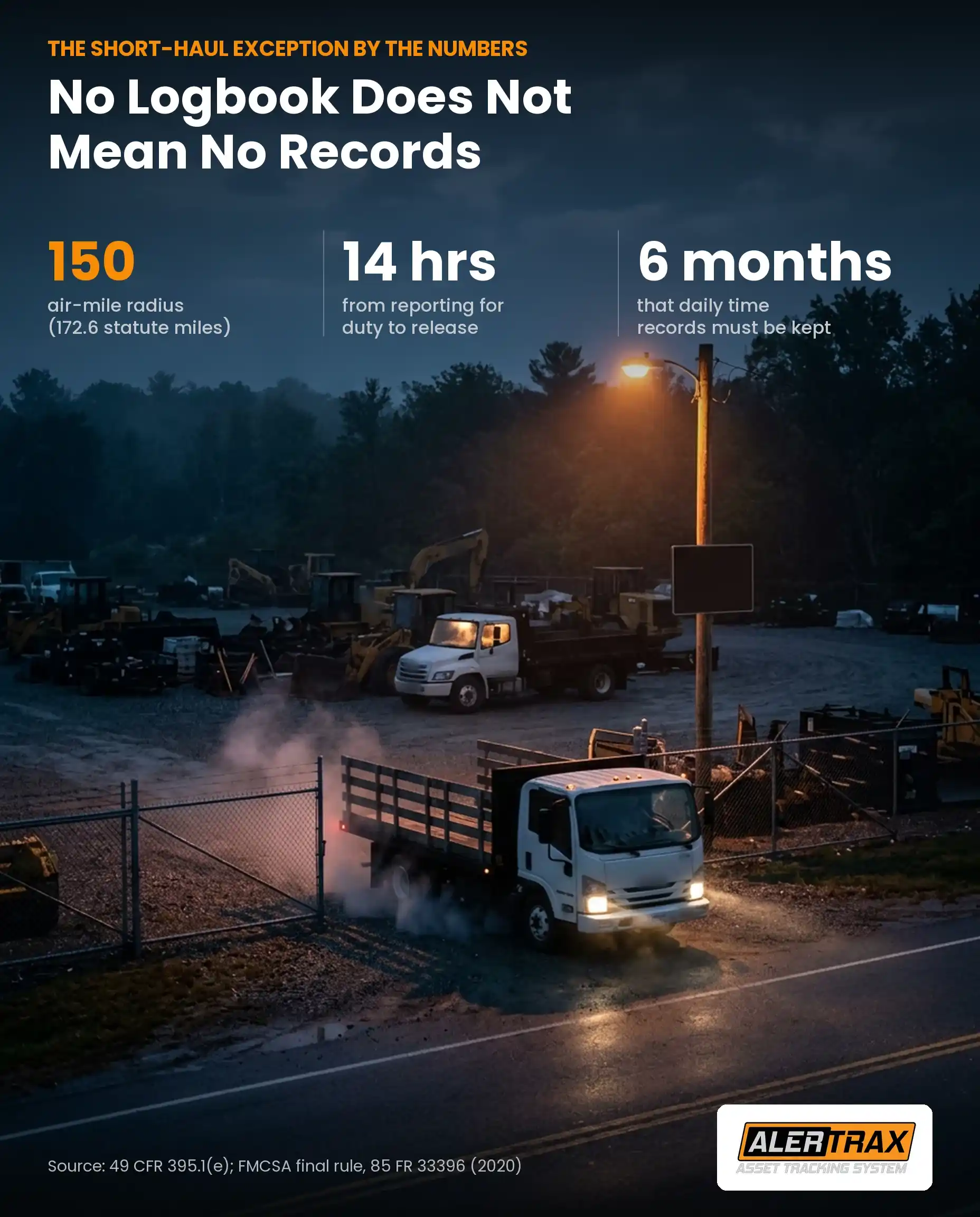
1. Distance. The driver operates within a 150 air-mile radius (172.6 statute miles) of the normal work reporting location.
2. Time. The driver returns to the work reporting location and is released from work within 14 consecutive hours.
3. Rest. A property-carrying driver has at least 10 consecutive hours off duty between each 14 hour stretch on duty. (For passenger-carrying drivers it is 8.)
4. Records. The motor carrier "maintains and retains for a period of 6 months accurate and true time records" showing the time the driver reports for duty each day, the total hours on duty each day, the time the driver is released each day, and, for drivers used for the first time or intermittently, the total time for the preceding 7 days (49 CFR 395.1(e)(1), eCFR, current as of September 2026).
Read the fourth condition again, because it is a condition, not a suggestion. The exemption from logs exists if the carrier keeps those records. Without them, the exception is not being met.
Note what the exception does not touch. Paragraph (e)(1) exempts drivers from the log and supporting-document requirements. It does not exempt them from the hours limits themselves, which is why FMCSA noted in the 2020 rule that truck drivers using the exception remain limited to 11 hours of driving.
If Your Drivers Do Not Need a CDL, There Is a Second Version
Most small landscaping and trade fleets run trucks that are heavy enough to be commercial motor vehicles but do not require a commercial driver's license. Those drivers have their own short-haul provision at 49 CFR 395.1(e)(2), with different time limits.
Under (e)(2), the driver must operate within a 150 air-mile radius of the normal work reporting location and return there at the end of each duty tour. Instead of a flat 14 hour limit, the driver may not drive after the 14th hour after coming on duty on 5 days of any 7 consecutive days, and may not drive after the 16th hour on 2 days of any 7 consecutive days.
The record-keeping requirement is the same: the carrier keeps accurate and true time records for 6 months showing report time, total on-duty hours, and release time each day, plus the 7 day total for new or intermittent drivers.
So the CDL question changes the hours math, but not the paperwork. Either way, somebody has to be writing down when each driver started and finished.
Where the 150 Mile Radius Came From
Before 2020, the CDL version of the exception was tighter. FMCSA's final rule "Hours of Service of Drivers," published June 1, 2020 and effective September 29, 2020, extended the maximum duty period under 395.1(e)(1) from 12 hours to 14 hours and the radius from 100 to 150 air-miles (85 FR 33396).
The agency's stated reason for the radius change was consistency: 150 air-miles was already the radius in the non-CDL provision, and the rule aligned the two.
This matters for one practical reason. Plenty of guidance still floating around, including old training materials and older posts, describes the 100 mile, 12 hour version. If your understanding of the exception comes from before 2020, it is out of date in your favor, but only on the limits. The time record requirement did not go away.
Air Miles Are Not Road Miles
The regulation measures the radius in air-miles, and it tells you the conversion: 150 air-miles equals 172.6 statute miles. That is a straight line from the reporting location, not the distance on the odometer.
That cuts in your favor more often than not. Roads wind, so a job site that is 190 miles away by road may well be inside the radius. As an illustration, not a measured figure: a route that runs 20 percent longer than the straight line would put a site roughly 207 road miles out right at the 172.6 statute mile edge.
The catch is that the only way to know is to measure it, from the actual reporting location, for the actual job site. "It is about a three hour drive" is not a measurement.
What Happens on the Days You Go Past It
The exception is judged day by day. On a day a driver goes outside the radius or runs past the time limit, that driver needs a record of duty status for that day.
The part that keeps most small fleets off ELDs is in 49 CFR 395.8(a)(1)(ii)(A)(1): a carrier may have a driver record duty status manually, rather than with an ELD, if the driver is operating in a manner requiring a record of duty status on not more than 8 days within any 30-day period.
Read that as a budget. A handful of long days a month can be handled with paper logs. Cross 8 in any rolling 30 days and the ELD requirement is back on the table. A company that does not track which days were outside the exception has no way of knowing how close it is to that line.
Where logs are required, 49 CFR 395.8(k) sets the same six month retention period for records of duty status and supporting documents.
What an Investigator Actually Looks At
The 2020 rule is unusually direct about how short-haul compliance gets checked, and it is worth quoting because it tells you exactly which records matter.
FMCSA acknowledged that enforcing the exception at the roadside has always been hard, because officers "do not have access to supporting documents, specifically records indicating when the driver began the work day." It said enforcement at the terminal or principal place of business provides a better opportunity, and that enforcement personnel "will continue to focus on (1) the time between the driver reporting to the normal work-reporting location and the time the driver is released from work, and (2) the maximum distance the driver traveled from the normal work-reporting location."
It went on: "The enforcement official could request certain records that would identify where the driver traveled and the time spent at those locations," and "Safety investigators will continue to sample and examine time cards and other HOS records during compliance investigations" (85 FR 33396).
Two questions, then. When did each driver start and finish? How far from the yard did they go? If your answers live in a foreman's memory, they are not records.
A Short-Haul Checklist
1. Decide who is using the exception. Every driver of a commercial motor vehicle who is not keeping logs is relying on it. Know which drivers those are, and which version, (e)(1) or (e)(2), applies to them.
2. Keep the time record every day. Report time, total on-duty hours, release time. A simple daily sheet or a time system that captures all three is enough. It has to be accurate and true, and it has to exist.
3. Keep it for six months. Put the retention on the calendar. Records that got thrown out in month four do not help in month five.
4. Measure your far job sites. Straight-line distance from the normal work reporting location. Anything close to 172.6 statute miles deserves an actual measurement, not a guess.
5. Count the days outside the exception. Track which days needed a log. If a driver is approaching 8 in any 30 day window, you want to know before the ninth, not after.
6. Check your state rules too. Everything above is the federal rule for interstate commerce. Intrastate operations are governed by state rules that may differ. Confirm with your state's motor carrier agency.
Where Tracking Fits
To be precise about it: a GPS tracker is not a time card, it is not an ELD, and it does not make anyone compliant on its own. What it produces is an independent record of the two things the rule text says enforcement focuses on, when the vehicle left and came back, and how far it went.
Alertrax keeps that record automatically, including on trailers and equipment with no power of their own.
- Automatic Time-on-Site Logging: Every arrival and departure is timestamped. Departures from the yard in the morning and returns at night become a record you can check against the driver's time sheet, instead of a memory.
- Location History: Where each tracked vehicle went, with dates. That answers the "maximum distance traveled" question with data, and shows which days a truck went farther than usual.
- Geofence Alerts: Draw a boundary around the yard and know when each truck leaves and returns without a phone call.
- Live Tracking in the Fleet Portal: Every tracked asset on one map in the Alertrax Fleet Portal, with location updates every 2 minutes.
- One-Year Battery, No Wiring Required: Alertrax runs on two AA cells, with nothing to wire into the vehicle, so it works on trailers and equipment as well as trucks.
- 100% Waterproof, Covert Magnetic Mounting: Mounts to a steel frame in seconds.
- Shareable Tracking Link and Mobile App: Send a live link with no login required from the iOS or Android app.
Pricing
You can equip your fleet with Alertrax for a low monthly rate, no long-term contracts, no hidden fees.
(Want to own it outright? We offer a $599 Lifetime option for permanent, subscription-free tracking.)
The short-haul exception already saves you the cost and hassle of ELDs. Keeping the records that prove you qualify is the cheap half of that deal.
Sources
49 CFR 395.1(e), Short-haul operations, Electronic Code of Federal Regulations, current as of September 1, 2026, retrieved September 2026: (e)(1) 150 air-mile radius (172.6 statute miles), return and release within 14 consecutive hours, 10 consecutive hours off duty for property-carrying drivers and 8 for passenger-carrying drivers, and 6 month retention of accurate and true time records showing report time, total on-duty hours, release time, and the preceding 7 day total for first-time or intermittent drivers; (e)(2) non-CDL property-carrying drivers, 150 air-mile radius, return at end of each duty tour, no driving after the 14th hour on 5 days or after the 16th hour on 2 days of any 7 consecutive days, same 6 month time record requirement
49 CFR 395.8, Driver's record of duty status, eCFR, current as of September 1, 2026, retrieved September 2026: (a)(1)(ii)(A)(1) manual records of duty status permitted for drivers requiring a record of duty status on not more than 8 days within any 30-day period; (k)(1) retention of records of duty status and supporting documents for not less than 6 months
Federal Motor Carrier Safety Administration (FMCSA), "Hours of Service of Drivers," final rule, published June 1, 2020, 85 FR 33396, document number 2020-11469, effective September 29, 2020, retrieved September 2026: extension of the short-haul maximum duty period from 12 to 14 hours and radius from 100 to 150 air-miles; statements on enforcement focus, requests for records identifying where the driver traveled and time spent at those locations, and examination of time cards during compliance investigations
This article is provided for general informational purposes and is not legal, regulatory, or compliance advice. AlerTrax is a GPS tracking company, not a law firm or compliance service, and is not affiliated with FMCSA. A GPS tracker is not an electronic logging device and does not by itself satisfy any record-keeping requirement. Whether the short-haul exception applies to your drivers depends on your operation, your vehicles, and whether you operate in interstate or intrastate commerce, and state rules may differ from the federal rules described here. The road-mile example above is an illustration, not a measured figure. Consult FMCSA, your state motor carrier agency, or a qualified compliance professional before relying on any of the above.
Keep the Record That Earns the Exception
The short-haul exception is one of the most useful provisions in the hours of service rules for local service companies. It is also conditional, and the condition is a piece of paper most companies assume they do not need.
Write down when each driver starts and finishes. Keep it for six months. Know how far your trucks actually go. That is the whole price of the exemption.
Visit www.buyalertrax.com today and keep an independent record of when your trucks leave, when they come back, and how far they go.